A child tax loan lets a Canadian family borrow money against their Canada Child Benefit (CCB) before the next payment arrives. Lenders count your monthly CCB deposit as income, which means you can qualify even without a traditional job or strong credit.
Raising kids is expensive, and the gap between benefit dates does not always line up with when rent, groceries and daycare are due. This guide explains how child tax loans work, what the CCB actually pays in 2026, and how to compare your options so you can bridge a short gap without falling into a high-cost payday cycle.
Key Takeaways
- Child tax loans use your Canada Child Benefit as income. Many lenders accept your monthly CCB deposit instead of employment income, so you can qualify without a traditional job.
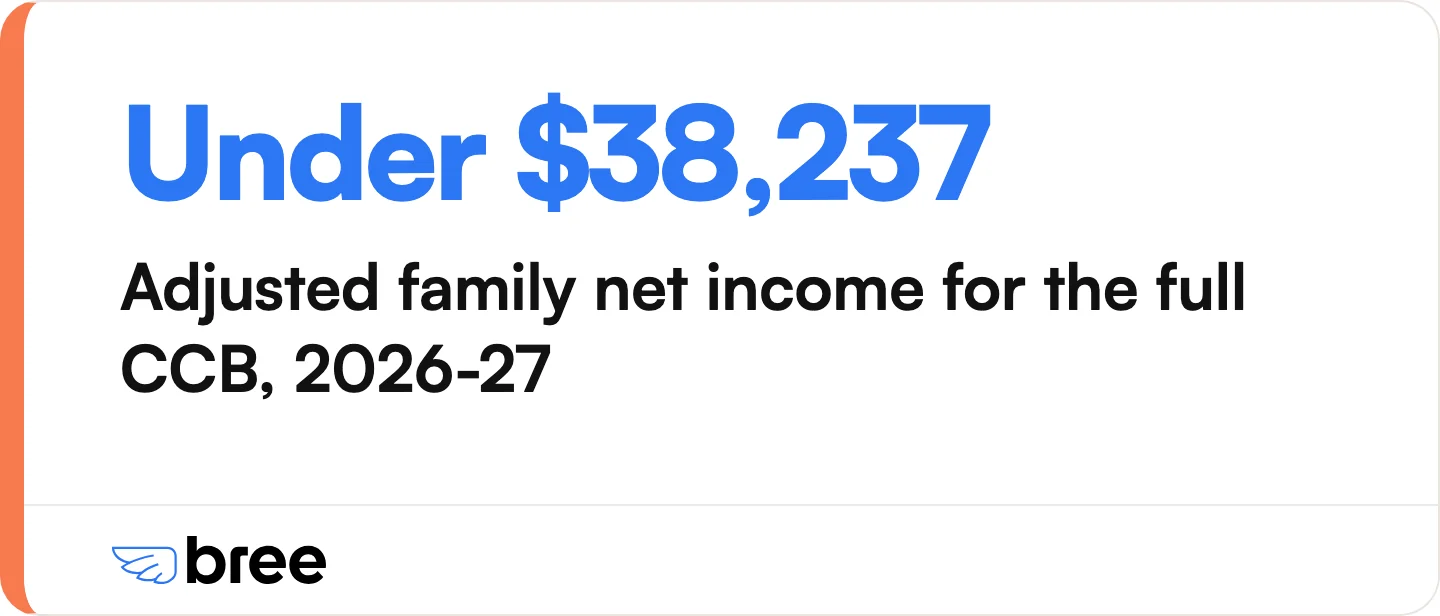
- The CCB pays up to $8,157 a year for a child under 6 and $6,883 for a child aged 6 to 17. Families with an adjusted family net income under $38,237 receive the full amount.
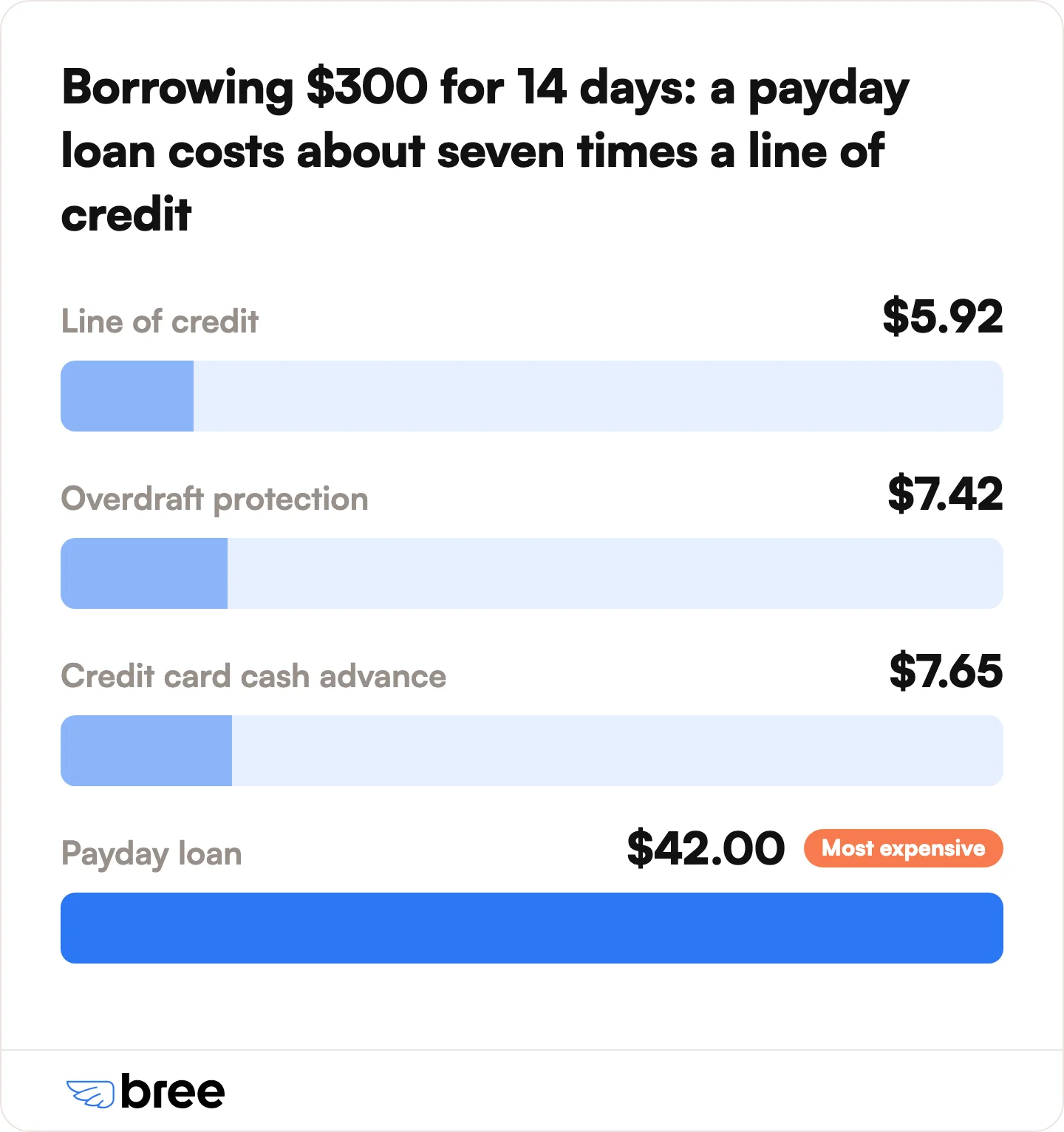
- Payday loans are the most expensive way to borrow, at $14 per $100 (about 365% APR). Borrowing $300 for two weeks costs $42.00 on a payday loan versus $5.92 on a line of credit.
- Provincial child benefits stack on top of the federal CCB. In most provinces they arrive in the same monthly payment and add to the income a lender can count.
- Bree is an interest-free line of credit of up to $750 that accepts CCB and other government benefits as income, runs no credit check, and charges 0% with no mandatory fees.

What Are Child Tax Loans?
A child tax loan is short-term funding that uses your Canada Child Benefit (CCB) as a verified source of income to qualify. It is aimed at parents who need cash before their next benefit deposit and may not qualify for a regular bank loan.
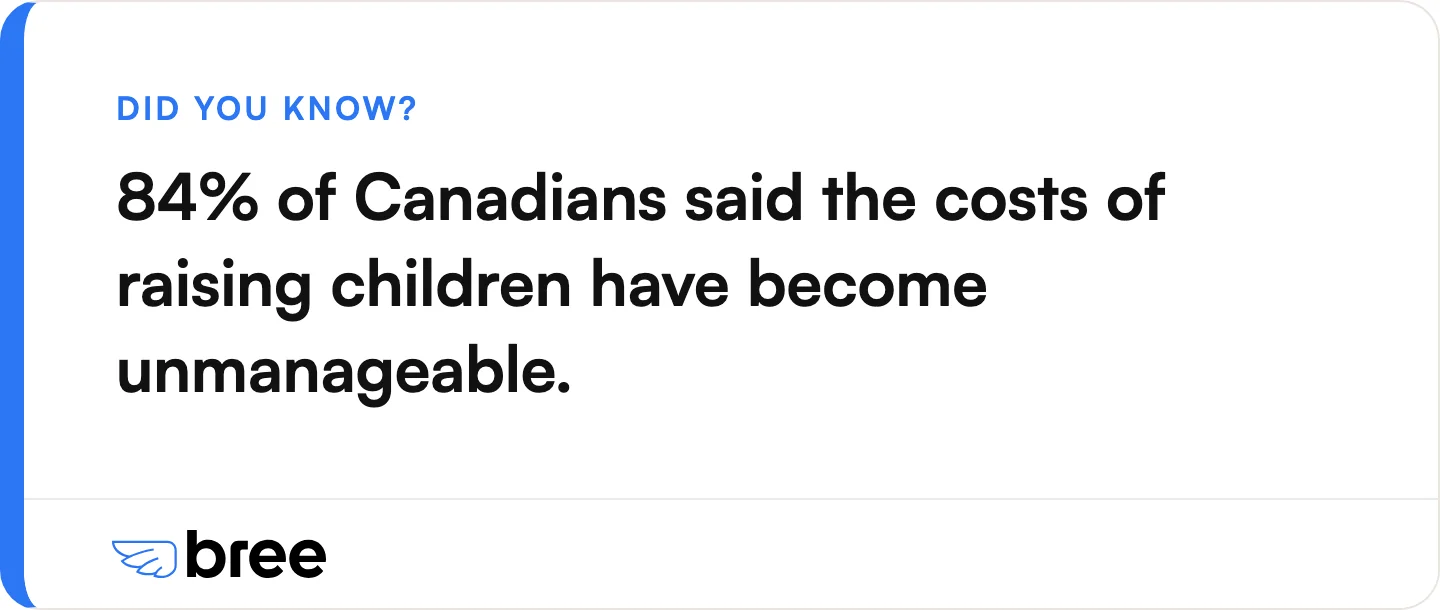
Most families feel the squeeze. In a 2025 BMO survey, 84% of Canadians said the costs of raising children have become unmanageable, and more than half said having children compromised their financial security. That pressure is why "child tax loans" is such a common search.
Here is what defines them:
- Income qualification: the lender accepts your regular CCB deposit in place of, or on top of, employment income.
- Amounts: payday-style advances usually run from $100 to $1,500, while installment lenders may go higher. Interest-free options tend to cap lower.
- Funding: payday and cash advance lenders often send money by Interac e-Transfer, while other options deposit funds straight to your bank account.
How Much Do Child Tax Loans Cost?
The cost of a child tax loan depends entirely on the type of lender. A payday loan is the most expensive way to borrow in Canada, capped by federal rules at $14 for every $100 you borrow, which works out to roughly 365% APR (Financial Consumer Agency of Canada).
To see the gap, the Financial Consumer Agency of Canada compares the cost of borrowing $300 for 14 days across four options:
A payday loan costs about seven times what a line of credit does for the same short-term borrowing. If a payment does bounce, the news is a little better than it used to be: as of March 12, 2026, non-sufficient funds (NSF) fees at federally regulated banks are capped at $10, a sharp drop from what banks charged before.
Understanding the Canada Child Benefit in 2026
The Canada Child Benefit (CCB) is a tax-free monthly payment from the Canada Revenue Agency (CRA) that helps families with the cost of raising children under 18. It is sometimes called the "baby bonus," and the amount you receive is based on your family income and the number and ages of your children.
2026-2027 Canada Child Benefit Amounts
For the benefit year running from July 2026 to June 2027, the maximum Canada Child Benefit is $8,157 per year for a child under 6 and $6,883 per year for a child aged 6 to 17 (Canada Revenue Agency).
Families with an adjusted family net income (AFNI) under $38,237 receive the full amount. Above that, the payment is gradually reduced, with a second reduction band applying between $38,237 and $82,847. The more children you have, the higher the income level at which your benefit phases out.
Child Disability Benefit
The Child Disability Benefit adds up to $3,480 per year ($290 per month) for each child who qualifies for the disability tax credit. This is paid on top of the regular CCB and helps families cover the extra costs of caring for a child with a physical or mental disability.
How to Qualify for the Canada Child Benefit
To qualify for the CCB, you must meet all of the following:
- You live with a child under 18 years old.
- You are primarily responsible for the child's care and upbringing.
- You are a resident of Canada for tax purposes.
- You or your spouse or common-law partner is a Canadian citizen, a permanent resident, a protected person, a temporary resident who has lived in Canada for the previous 18 months with a valid permit, or a person registered under the Indian Act.
You and your spouse or common-law partner also need to file your taxes every year, even with no income, because the CRA uses your return to calculate the payment.
How to Apply for the Canada Child Benefit
You can apply for the CCB when your child is born, when a child starts to live with you, when you gain custody, or when you start or change a shared-custody arrangement. There are three ways to apply:
- In hospital (Automated Benefits Application): when you register your baby's birth, you can consent to share your details with the CRA. You will need your Social Insurance Number and a bank account set up for direct deposit so your CCB payments arrive on time.
- Online through CRA My Account: if you did not apply at birth, you can apply through My Account, the fastest option after the fact.
- By mail: fill out Form RC66, the Canada Child Benefits Application, and send it to your tax centre.
Once you are receiving the CCB, that monthly deposit becomes income a lender can use when you apply to borrow.
Provincial Child Benefits in Canada (2026)
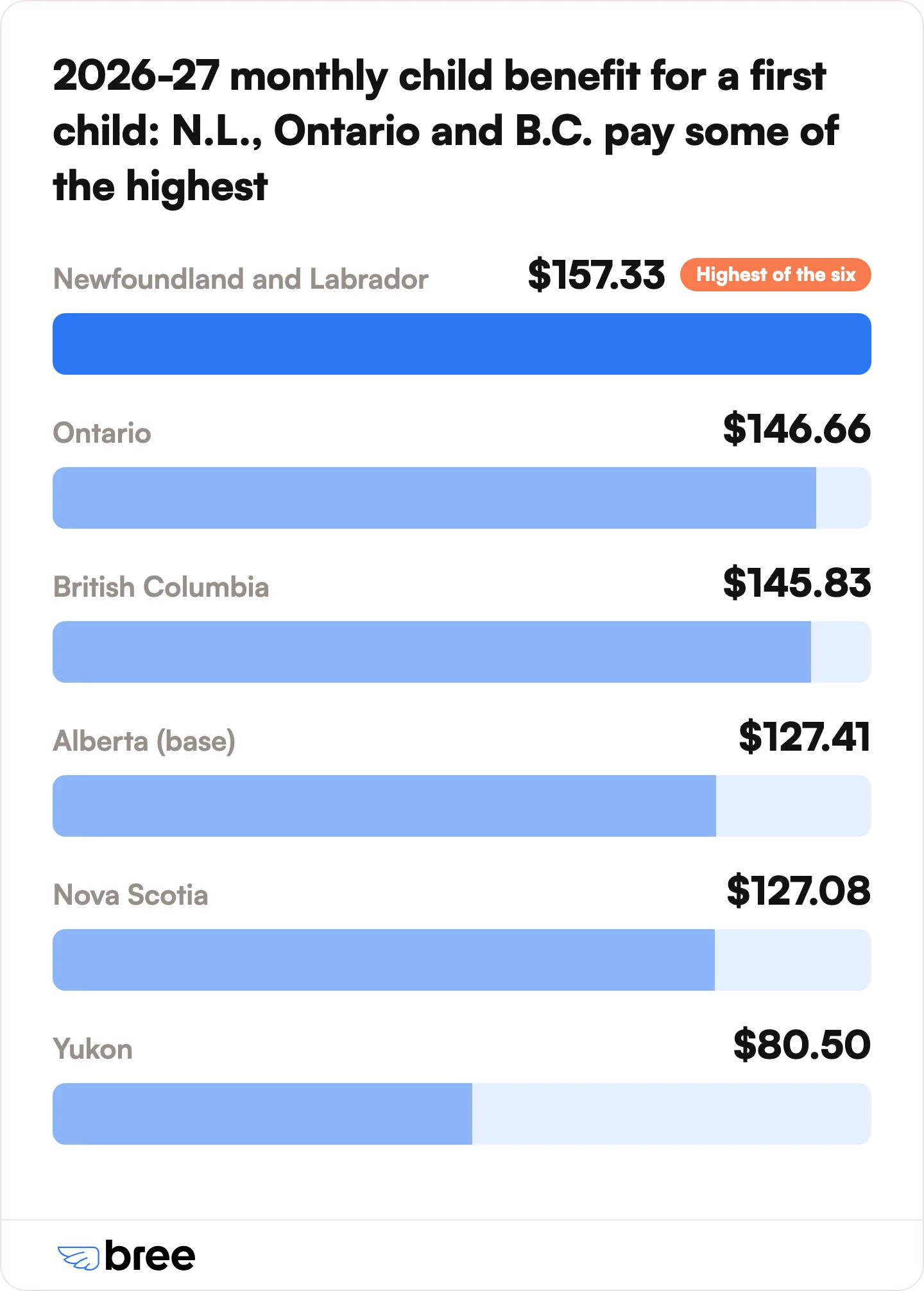
Most provinces and territories run their own child benefit on top of the federal CCB, and in most cases it is combined into your single monthly CCB payment. That matters when you borrow, because provincial benefits add to the income a lender can count. Here are the current maximum monthly amounts for a first child under the largest programs (Canada Revenue Agency):
Alberta also adds a working-income component on top of the base amount. Each program is reduced as your family income rises, and amounts change every July. New Brunswick, the Northwest Territories, Nunavut, Prince Edward Island and Quebec run their own family benefits too, with Quebec's Family Allowance administered by Retraite Québec rather than the CRA. Check your province's current rate for your exact amount.
Which Province Pays the Most Child Benefit?
There is no single answer, because every province ties its benefit to income and the number of children. Among the largest programs for a first child in 2026-2027, Newfoundland and Labrador, Ontario and British Columbia pay some of the highest monthly amounts. What matters most for your family is your income and how many children you have, since both federal and provincial benefits phase out as income rises.
Can You Get a Child Tax Loan With No Income?
Yes, you can often borrow with no traditional job, because your Canada Child Benefit counts as income. Many lenders that market "loans that accept child tax" treat your regular CCB deposit as proof you can repay, and some accept other government benefits the same way.
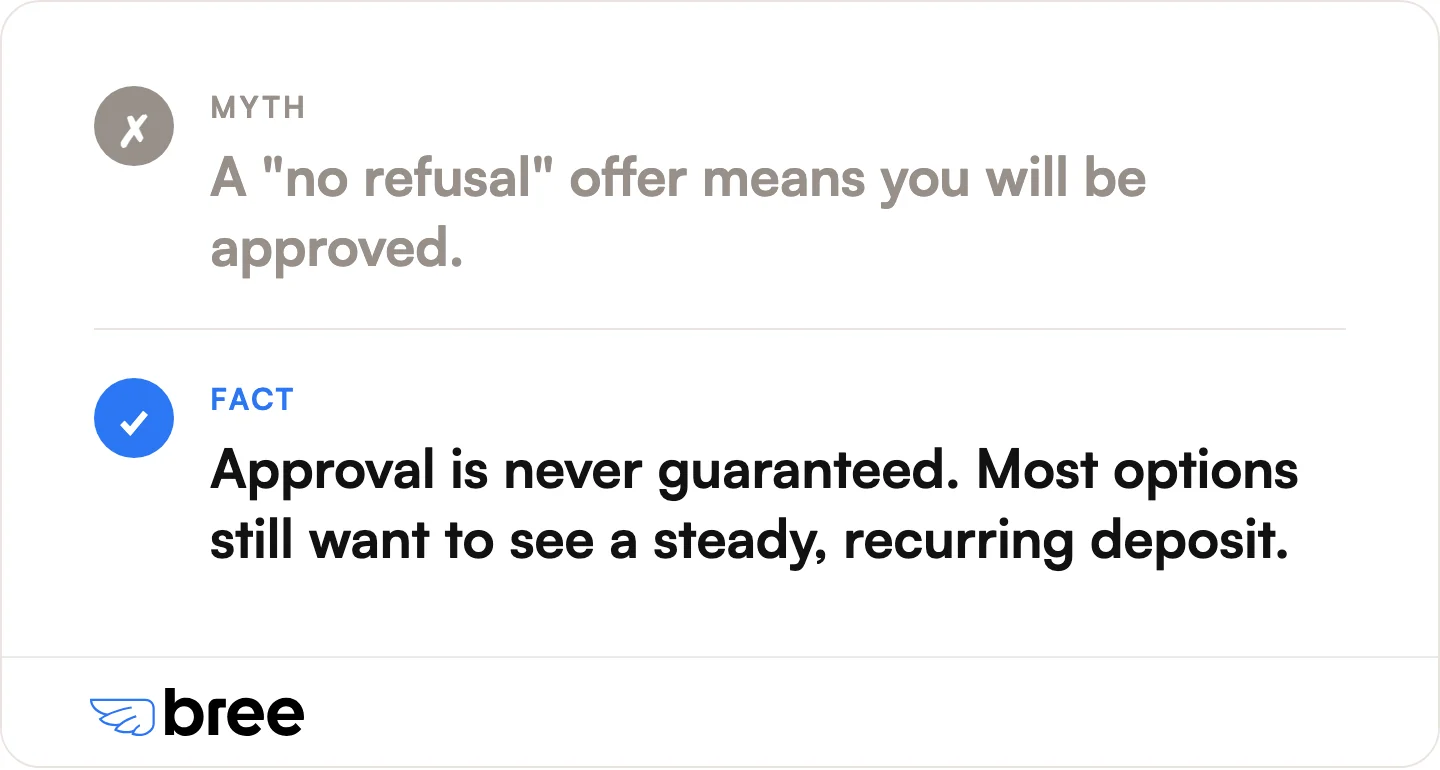
The honest catch is that most options still want to see a steady, recurring deposit. Bree looks for consistent deposits of at least $1,200 per month over about two months of bank history, rather than a job or a credit score. For many families, the CCB on its own or combined with a provincial benefit, part-time earnings or another government payment is enough to clear that bar. Approval is never guaranteed, so treat any "no refusal" claim with caution.
How Child Benefits Help You Qualify to Borrow
Your Canada Child Benefit works as income across several borrowing options, and the right one depends on how much a mistake will cost you. Here is how the main options compare:
Payday loans are the fastest to get but the most expensive, and they are easy to roll into a cycle of debt. Because repayment often lands on your next benefit date, borrowing against next month's CCB can leave a hole in the following month's budget. If you are weighing this route, our guide to loans that accept child tax breaks down what to watch for.
Bank and credit union personal loans usually charge the least interest, but they require a hard credit check and a solid credit history, which puts them out of reach for many families who are searching for a child tax loan in the first place.
Cash advance apps and installment lenders sit in between. Some accept benefits and skip the credit check, but costs and terms vary widely, so read the fine print before you commit.
Bree is a Canadian interest-free line of credit of up to $750, built for families between paydays, and we accept the Canada Child Benefit as income with no credit check. There is 0% APR and no mandatory fees, just an optional tip. Every payment is a direct deposit to your bank account, free within one to three business days or within minutes with an optional express fee, and you repay on your own schedule rather than on a fixed payday deadline.
Making the Right Choice for Child Tax Loans
The right child tax loan is the one that solves this month's gap without creating next month's. Before you apply anywhere, work through a short checklist:
- Compare the true cost. Look at the total dollars you repay, not just the advertised amount. A payday loan's $14 per $100 adds up fast.
- Confirm the lender is licensed. Payday lenders must be licensed in your province, and provincial rules cap what they can charge.
- Check how you repay. A fixed due date tied to your benefit deposit can trigger the debt cycle. A flexible schedule gives you room.
- Watch for hidden fees. Ask about late fees, NSF fees and any mandatory charges beyond the amount you borrow.
- Borrow only what you need. A smaller amount is easier to repay and keeps you clear of a rollover.
If your gap is small and short, an interest-free option almost always beats paying triple-digit interest for the same two weeks.
Frequently Asked Questions
Can I get a child tax loan with bad credit?
Yes. Options that accept child tax benefits often skip the credit check, basing approval on your CCB income and bank history instead. Bree, an interest-free line of credit, requires no credit check at all, so a low score or a thin credit file does not disqualify you.
How much can I borrow with a child tax loan?
It depends on the option. Payday lenders in Canada can offer up to $1,500 but charge $14 per $100. Bree offers an interest-free line of credit of up to $750. The amount you qualify for usually reflects your CCB income and your recent deposit history.
Do child tax loans affect my Canada Child Benefit payments?
No. Borrowing against your benefit does not change your CCB amount or your eligibility, and your payments from the CRA continue on schedule. You simply use an upcoming deposit to repay what you borrowed.
What is the difference between a child tax loan and a payday loan?
A child tax loan is any short-term borrowing that accepts your Canada Child Benefit as income. A payday loan is one type of child tax loan, and it is the most expensive, with costs around 365% APR. Other options, including an interest-free line of credit, also accept CCB income at a far lower cost.
Who will approve me if no one else will?
Options that accept government benefits as income are usually the most flexible, because they do not rely on employment or credit history. Bree, an interest-free line of credit, approves based on consistent deposits into your bank account, accepts CCB and other benefits, and runs no credit check, though approval is never guaranteed.
What is the maximum income to receive the Canada Child Benefit?
There is no hard income cutoff, but the full benefit goes to families with an adjusted family net income under $38,237. Above that, the payment shrinks as income rises and phases out at higher levels depending on how many children you have.
How much CCB will I get for two children?
A family with two children under 6 and an income under $38,237 receives the maximum for each, which is $8,157 per child, or $16,314 per year. If the children are aged 6 to 17, the maximum is $6,883 each. Your actual amount drops as your family income rises above $38,237.
When do CCB payments arrive each month?
The CRA pays the Canada Child Benefit once a month. You can see every 2026 payment date in our guide to CCB payment dates.
The Bottom Line
Child tax loans give Canadian families a way to bridge the gap between benefit payments, and your Canada Child Benefit does the heavy lifting by qualifying you as income. The choice that matters is the type of borrowing you choose. A payday loan solves today at a punishing cost, while an interest-free line of credit solves it without setting up next month to fail.
Bree is the interest-free line of credit we built for Canadian families between paydays, with up to $750, 0% APR, no credit check and government benefits accepted as income. More than 600,000 Canadians use Bree, and it holds a 4.8 out of 5 rating on Trustpilot across more than 8,000 reviews.
If you need to cover a short gap before your next child benefit lands, see how a 0% line of credit up to $750 compares, or get started with Bree and put your Canada Child Benefit to work.
Sources
- Canada Revenue Agency: How we calculate your CCB
- Financial Consumer Agency of Canada: Payday loans
- Financial Consumer Agency of Canada: New NSF fee regulations
- Canada Revenue Agency: Child and family benefits provincial and territorial programs
- Canada Revenue Agency: Canada child benefit overview
- BMO: Survey on families and financial pressures

Join our newsletter to get the latest updates