
A consumer proposal lets you settle part of what you owe and keep your assets, paying one fixed amount over up to five years. Bankruptcy can wipe out most of your debt in as little as nine months, but you give up non-exempt assets to do it. Both are formal legal processes under the federal Bankruptcy and Insolvency Act, and both can only be filed through a Licensed Insolvency Trustee (LIT). The right choice comes down to three things: how stable your income is, what assets you want to protect, and how much you owe.
We're Bree, an interest-free line of credit up to $750. We don't file proposals or bankruptcies, and neither one is something we sell. What we do is help Canadians sidestep high-interest payday loans, so we wrote the plain-language version of a decision that most articles bury in legal jargon.
Key Takeaways
- Both are legal insolvency processes, and only a Licensed Insolvency Trustee can file either one. A proposal is a deal to repay part of your debt. Bankruptcy discharges most of it in exchange for your non-exempt assets.
- A consumer proposal lets you keep your assets. Bankruptcy means surrendering the non-exempt ones. For most people with home equity, vehicle equity, or savings, this is the deciding factor.
- Bankruptcy is faster and often cheaper. A proposal usually costs more in total but less per month. A first bankruptcy ends in 9 to 21 months, while a proposal runs up to 5 years.
- A proposal needs under $250,000 in unsecured debt. Bankruptcy has no upper limit and starts at $1,000. That ceiling rules a proposal out for a small number of high-debt filers.
- Both hurt your credit, but a proposal (R7) is treated less harshly than bankruptcy (R9). Neither mark is permanent, and credit can be rebuilt afterward.

Consumer Proposal vs Bankruptcy: Key Differences at a Glance
A consumer proposal and a bankruptcy differ on every point that matters to a filer: the debt limit, the assets you keep, the cost, the timeline, and the hit to your credit. The order here is for navigation, not a ranking. Neither option is "better" in the abstract, and the one that fits depends on your income, your assets, and the size of your debt.
What Is a Consumer Proposal?
A consumer proposal is a legally binding offer, filed through a Licensed Insolvency Trustee, to repay a portion of what you owe over a set term. Your trustee files it with the Office of the Superintendent of Bankruptcy, and your creditors vote on it. It is approved when a simple majority of the dollar value voting accepts, and it is deemed accepted if no creditor requests a meeting within 45 days of filing.
You qualify if you are an individual, you are insolvent, and your total unsecured debts are not more than $250,000, excluding any mortgage on your principal residence. That limit is set in the Bankruptcy and Insolvency Act.
You repay through a single fixed monthly payment with no interest added. The term can run up to five years, and you can pay it off early with no penalty. The payment is set when the proposal is accepted and does not change, even if your income goes up later. The moment the proposal is filed, it legally stops collection calls, wage garnishments, and interest from piling up. Like bankruptcy, a consumer proposal also requires you to attend two credit-counselling sessions.
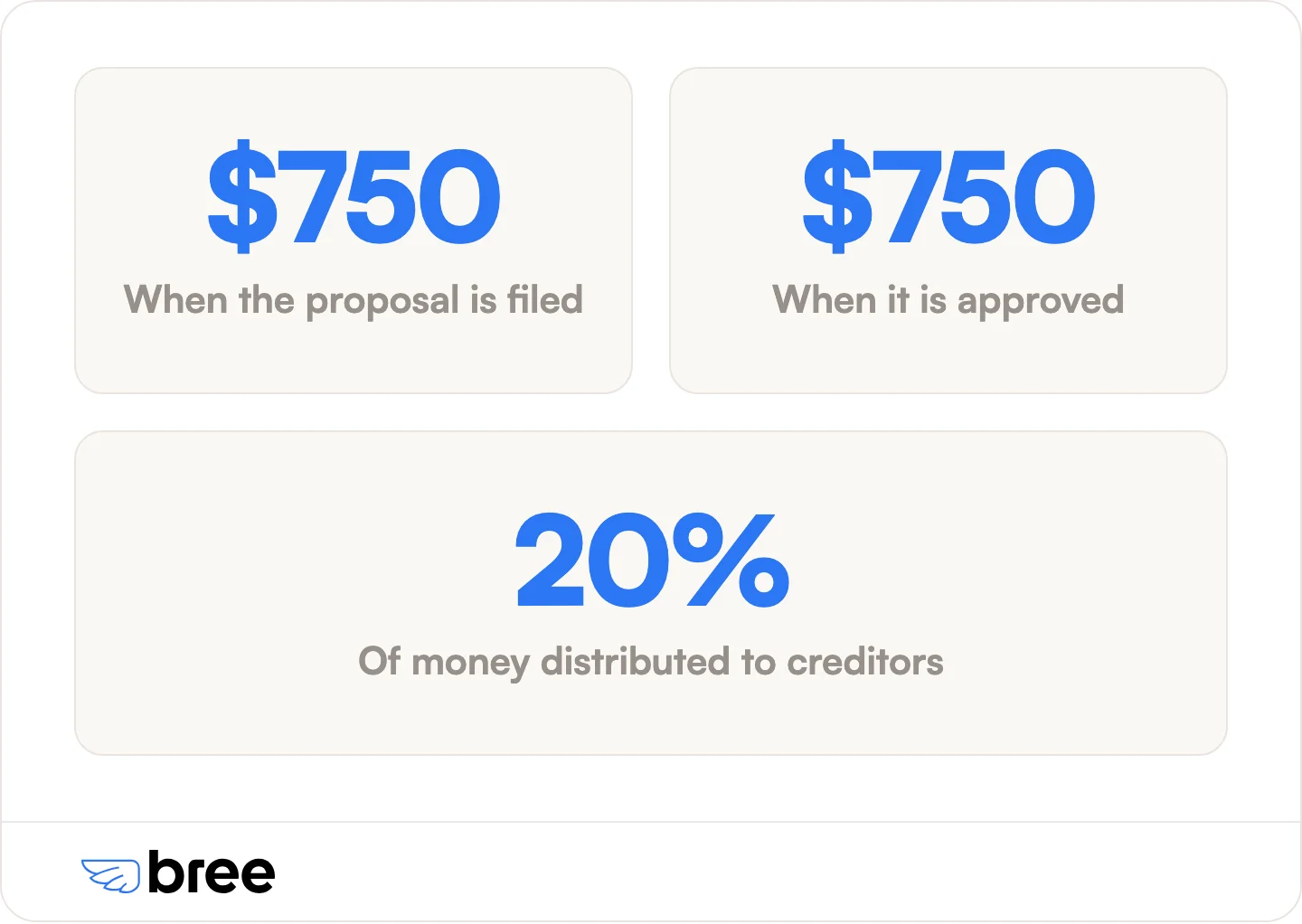
The trustee's fees are regulated and come out of the payments you already make, not on top of them. The current tariff in the Bankruptcy and Insolvency General Rules is $750 when the proposal is filed, another $750 when it is approved, and 20% of the money distributed to your creditors.
What Is Bankruptcy?
Bankruptcy is a legal process that assigns your non-exempt assets to a Licensed Insolvency Trustee, who sells them for your creditors, in exchange for a discharge that releases you from most debts. You qualify as an "insolvent person" if you owe at least $1,000 and cannot meet your debts as they come due, under the Bankruptcy and Insolvency Act. There is no upper limit on the debt bankruptcy can cover.
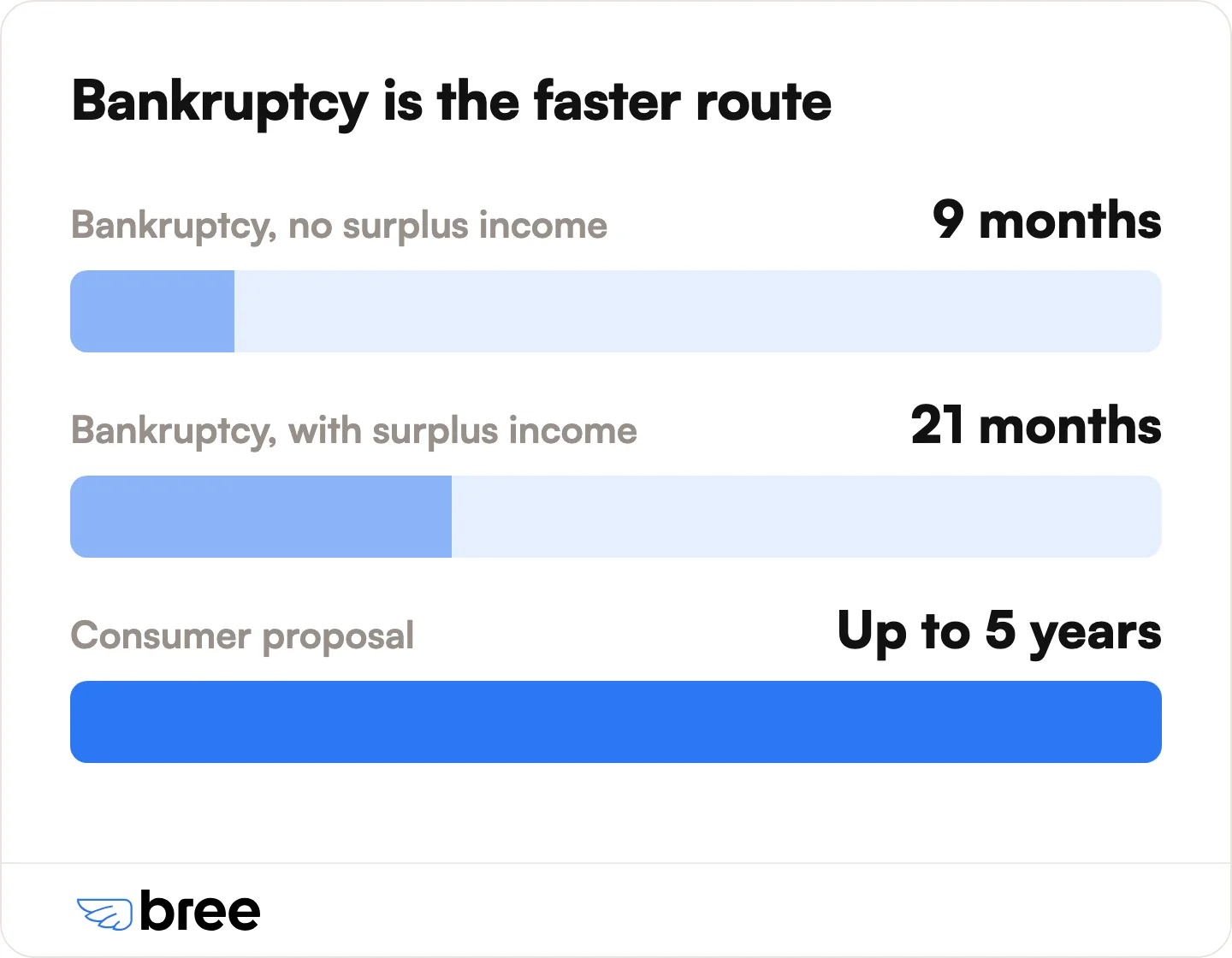
During the bankruptcy you report your income every month, attend two mandatory credit-counselling sessions, and surrender assets that provincial exemptions do not protect. A first-time bankruptcy ends with an automatic discharge at 9 months if you have no surplus income, or at 21 months if you do, according to the Office of the Superintendent of Bankruptcy.
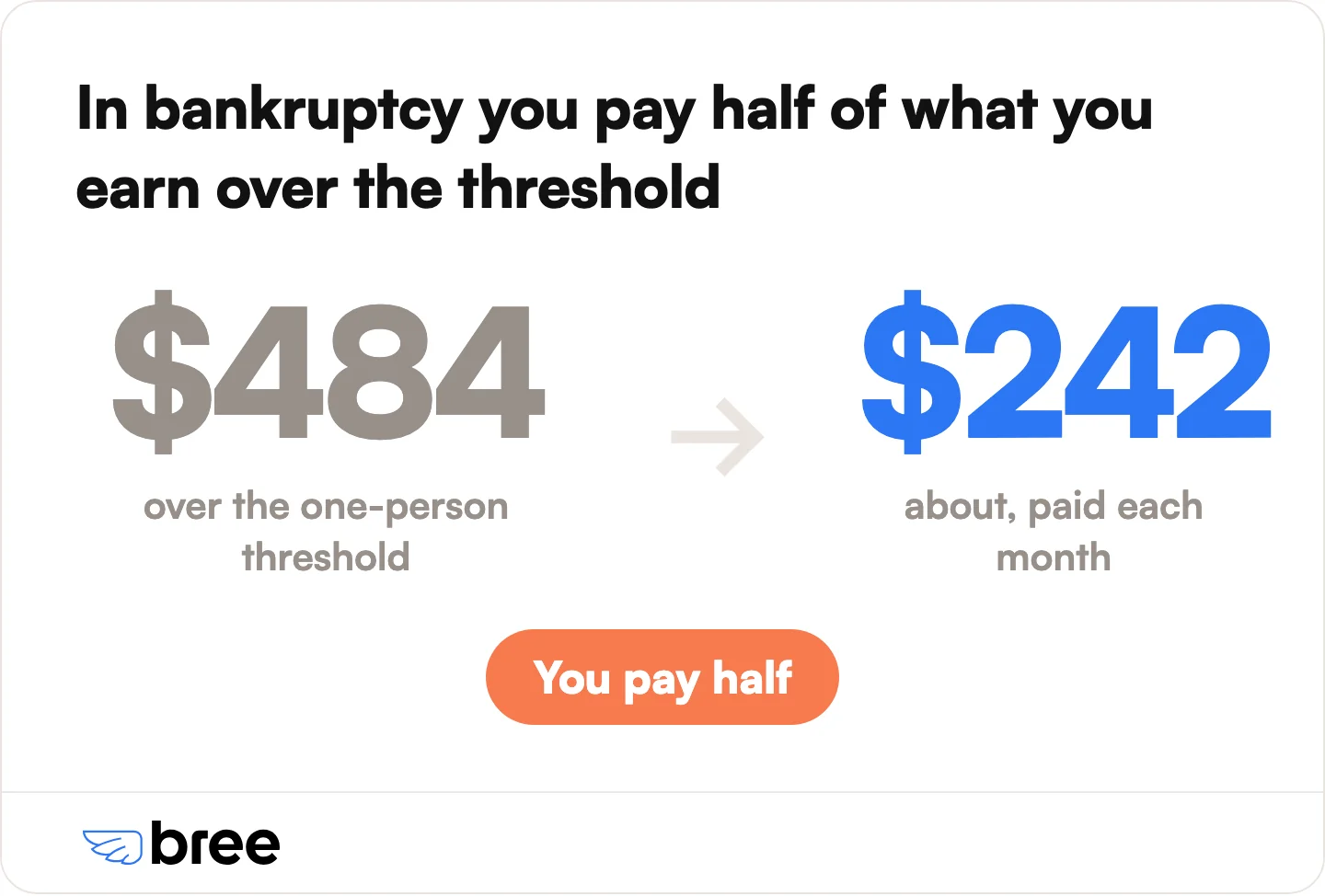
Surplus income is the mechanism that makes bankruptcy cost more for higher earners. Under the current surplus income directive, if your monthly income is more than $200 above a government threshold, you pay half of the amount over that threshold to your estate. The 2026 monthly thresholds rise with household size:
Tax refunds and windfalls you receive during the bankruptcy, such as an inheritance, go to your estate rather than to you. Like a proposal, filing for bankruptcy immediately stops collection calls, garnishments, and interest.

The Differences That Actually Decide It
Four dimensions decide the choice for most people: what each does to your credit, what you keep, what it costs, and how long it takes. Here is each one in plain terms.
What each one does to your credit
A consumer proposal is recorded as an R7 on your credit report, and bankruptcy is recorded as an R9, the most severe rating. A proposal clears your credit report sooner than a bankruptcy does, and the exact timing is set by the credit bureaus, Equifax and TransUnion, rather than by law. Confirm the dates for your own file with the bureaus directly. What matters more is that neither rating is permanent, and both can be rebuilt from.
What you keep versus what you give up
A consumer proposal lets you keep your home, vehicle, savings, and investments, as long as you stay current on any secured loans attached to them. Bankruptcy requires you to surrender assets beyond what your province protects. Provincial exemptions vary, and each province sets its own limits on vehicle equity, home equity, and household goods, so what you can keep depends on where you live. A trustee confirms your province's exemptions before you file. For anyone with real home or vehicle equity, protecting it is usually the single biggest reason to choose a proposal over bankruptcy.
What it actually costs
A consumer proposal usually costs more in total, because you are agreeing to repay a negotiated portion of your debt over several years. Bankruptcy is usually cheaper in total for someone with low income and few assets, because the cost is driven by surplus-income payments rather than a repayment target. With no surplus income and few assets, a bankruptcy often ends up cheaper than a comparable proposal for exactly that reason: there is no repayment target to fund.
Here is how the surplus-income side plays out, using the 2026 thresholds. Say you are single and earn $3,200 a month, against the one-person threshold of $2,716. You are $484 over it, so in bankruptcy you would pay half of that, about $242 a month, for the length of the bankruptcy. That payment rises if you start earning more. A consumer proposal payment, by contrast, is a fixed amount you and your creditors agree to up front, so it does not move when your income does. The trade is real: a proposal costs more but protects your assets and locks your payment, while bankruptcy often costs less but puts your assets at risk and scales with what you earn.
How long each one takes
Bankruptcy is the faster route. A first-time bankruptcy ends in 9 to 21 months, while a consumer proposal can run up to five years. Speed cuts both ways. A shorter bankruptcy ends the stress sooner and starts your credit recovery earlier, but it asks for your assets to get there. A longer proposal keeps your assets and spreads smaller payments out, at the cost of living under the arrangement for longer.
What neither one erases
Some debts survive both a proposal and a bankruptcy. Under section 178 of the Bankruptcy and Insolvency Act, these include child or spousal support, court-ordered fines and penalties, debts from fraud, secured debts like your mortgage or car loan, and student loans if you left school within the last seven years. If most of what you owe falls into these categories, neither process will give you the relief you are hoping for, which is exactly the kind of thing a trustee will flag in a free consultation.
What Happens If You Fall Behind on Payments
Falling behind has different consequences for each process. A consumer proposal is deemed annulled if you fall three monthly payments behind, under section 66.31 of the Bankruptcy and Insolvency Act. Annulment cancels the protection, and your creditors can resume collection and interest as if the proposal never happened. If you see a payment problem coming, talk to your trustee early, and read our guide on how to catch up on missed payments before it reaches that point.
In a bankruptcy, missing your duties, skipping a counselling session, or having a creditor oppose your discharge means you do not get an automatic discharge. A court then decides, and it can suspend the discharge, attach conditions, or refuse it. In both cases, the process only works if you keep up your side of it.
How to Choose Between a Consumer Proposal and Bankruptcy
Start with three questions: Is your income steady? Do you have assets worth protecting? How much do you owe? Steady income plus assets you want to keep points toward a proposal. Little or unstable income and few assets points toward bankruptcy, where a short discharge often costs less and ends sooner. If you owe more than $250,000 in unsecured debt, a proposal is not available and bankruptcy is the formal route.
Proposals have become the far more common choice. In 2025, consumer proposals made up 78.4% of all consumer insolvency filings in Canada, according to the Office of the Superintendent of Bankruptcy. Common does not mean correct for you, though. One thing worth knowing: a trustee models your proposal against what your creditors would collect if you went bankrupt instead, so a very low offer tends to get pushed up or rejected.

The honest next step is a free consultation with a Licensed Insolvency Trustee, the only professional who can file either process. The first meeting costs nothing, and there is no obligation. Booking two or three and comparing what each trustee says is a smart move before you decide anything.
Do You Even Need to File? Lighter Options First
Not everyone who is struggling needs an insolvency process. If your unsecured debt is relatively small and your income is stable, there are lighter options that do not carry an R7 or R9 mark. A realistic budget, debt consolidation, or a credit counselling debt management plan can be enough to get ahead of the balance without filing anything.
Be careful with "debt settlement" companies that charge upfront fees to do what a trustee does. Only a Licensed Insolvency Trustee can legally file a consumer proposal or a bankruptcy. If a proposal or bankruptcy is genuinely the right tool for your situation, a trustee is where it has to happen anyway, so there is no reason to pay a middleman first.
Rebuilding After a Consumer Proposal or Bankruptcy
Recovery starts the moment the process ends, and it is faster than most people fear. A secured credit card, consistent on-time payments, and low balances rebuild a credit file over time. Many people re-access everyday credit far sooner than they expect, often while the insolvency is still on their report. Our guide to rebuilding your credit in Canada walks through the concrete steps.
The real risk during rebuilding is relapse. When money runs short before payday, falling back on a payday loan undoes the progress fast, at an annual rate the Financial Consumer Agency of Canada puts at around 365%. If a short gap comes up while you are getting back on your feet, an interest-free option beats a predatory one.
Bree is an interest-free line of credit up to $750 with no credit check, so your bank transaction history, not a credit score you are still rebuilding, decides approval. Funds arrive by direct deposit, with Express getting cash to your account in minutes, and you repay on your own schedule. It is a bridge for a one-off shortfall, not a debt-relief tool, and it is built so a bad week does not send you back to a lender charging triple-digit interest. You can see how the interest-free line of credit works if that is where you are.
Frequently Asked Questions
What are the downsides of a consumer proposal?
The main downsides are the length and the commitment. A proposal can run up to five years, your creditors can reject your first offer or push for a higher payment, and it is recorded on your credit as an R7. You also lose access to any existing credit cards that carry a balance. For many people the trade is worth it, because a proposal freezes interest and protects assets, but it is a multi-year arrangement, not a quick reset.
Is a consumer proposal or bankruptcy a public record in Canada?
Yes. Both a consumer proposal and a bankruptcy are recorded in the Office of the Superintendent of Bankruptcy's public Bankruptcy and Insolvency Records Search. Anyone can search the registry for a small per-search fee. In practice, the people who look are lenders and landlords running a check, not the general public browsing names.
What debts cannot be erased by either process?
Some debts survive both a proposal and a bankruptcy under Canadian law. These include child and spousal support, court-ordered fines and penalties, debts obtained through fraud, secured debts like your mortgage or car loan, and student loans if you left school within the last seven years. If most of your debt is in these categories, neither process will clear it.
Can a trustee take my tax refund?
In a bankruptcy, yes. Tax refunds for the period of your bankruptcy go to your estate for your creditors. In a consumer proposal, no. You keep your tax refunds, because a proposal does not involve surrendering assets. For some filers, keeping refunds is a meaningful reason to choose a proposal.
Will a consumer proposal or bankruptcy affect a government security clearance?
Insolvency on its own rarely decides a security clearance. A clearance review weighs honesty and whether your finances are under control, not the mere fact that you filed. Undisclosed or hidden financial trouble is the real risk, so if a clearance matters for your job, disclose a proposal or bankruptcy to your employer's security office directly rather than hiding it, and get advice specific to your role.
Can I switch from a consumer proposal to bankruptcy?
Yes. If a proposal is annulled or is no longer workable, you can file for bankruptcy instead. A Licensed Insolvency Trustee can walk you through switching and what it changes for your timeline and your assets.
How long can you be chased for a debt in Canada?
Each province sets its own limitation period on debt. Once that period passes from your last payment or written acknowledgment, a creditor generally cannot take you to court to collect, though the clock can reset if you make a payment or admit you owe the debt. The exact length varies by province, so check your province's limitations rules. A limitation period does not erase the debt or remove it from your credit report. It only limits court action, which is different from the full legal release a proposal or bankruptcy provides.
The Bottom Line
A consumer proposal and a bankruptcy solve the same problem in opposite ways. A proposal lets you keep your assets and repay part of your debt, interest-free, over up to five years. Bankruptcy is faster and often cheaper, but you surrender non-exempt assets to get there. The right choice depends on your income, your assets, and how much you owe, and the only person who can file either one is a Licensed Insolvency Trustee. Book a free consultation, bring your numbers, and let the math decide.
Whatever path you take, the goal after it is staying out of the debt cycle for good. Bree is an interest-free line of credit up to $750 that Canadians use to bridge the gap between paycheques without turning to payday loans, with a 4.8 out of 5 rating across more than 8,000 customer reviews. If you are rebuilding and a short shortfall comes up, it is a transparent, zero-interest way to get through the week instead of one charging around 365%.
Sources
- Bankruptcy and Insolvency Act, section 66.11
- Bankruptcy and Insolvency Act, section 178
- Bankruptcy and Insolvency Act, section 66.31
- Bankruptcy and Insolvency General Rules, section 129
- Office of the Superintendent of Bankruptcy: Understanding the bankruptcy discharge
- Office of the Superintendent of Bankruptcy: Directive on Surplus Income
- Office of the Superintendent of Bankruptcy: Insolvency Statistics in Canada
- Office of the Superintendent of Bankruptcy: Consumer proposals
- Bankruptcy and Insolvency Act, section 2
- Financial Consumer Agency of Canada: Understanding payday loans

Join our newsletter to get the latest updates


