In Canada, a debt collector who threatens you, lies to you, or calls at all hours is breaking the law. Debt collection is regulated province by province, and every province sets firm limits on when a collector can call, how often, who they can talk to, and what they can say. If a collector has crossed those lines, you have the right to make it stop, and you do not have to face it alone or uninformed.
This guide answers the three questions people ask when a collector will not let up: is this legal, what are my rights, and how do I make the calls stop. We put it together from federal and provincial government sources so you can act on it today.
Key Takeaways
- Debt collection is regulated province by province. There is no single Canada-wide collection law, so your exact rights, including call hours and how often a collector can contact you, depend on where you live.
- Harassment is illegal. Threats, abusive language, calls outside legal hours, lying about what you owe, or pretending to be police or a lawyer all break the rules.
- You can force a collector to stop contacting you by sending a written notice by a verifiable method that disputes the debt and asks for the matter to go to court. This is the single most effective step, and a copy-ready script is included in this guide.
- A collector cannot have you arrested, and cannot garnish your wages or freeze your bank account without first winning a court judgment against you.
- Paying or even acknowledging an old debt can restart the clock. Verify that a debt is really yours, and check whether it is past the limitation period, before you pay a cent.

What debt collectors are not allowed to do in Canada
A debt collector cannot harass, threaten, or mislead you, and cannot contact other people to discuss your debt. These limits apply whether the collector works for the original creditor or a third-party agency that bought the debt. Across every province, collectors are prohibited from the following:
- Using threatening, profane, intimidating, or abusive language toward you or your family. The federal Financial Consumer Agency of Canada (FCAC) lists "using threatening, profane, intimidating or abusive language" as a prohibited practice.
- Giving false or misleading information, such as lying about how much you owe or pretending to be a police officer, a lawyer, or a government official.
- Threatening action they cannot take, like claiming you will be arrested or jailed. You cannot be arrested for falling behind on a consumer debt.
- Making public, or threatening to make public, your failure to pay. Publicly shaming you over a debt is banned.
- Adding fees or interest that your original contract or the law does not allow.
- Contacting you at your own expense, such as repeated collect calls.
- Continuing to contact you after you have properly disputed the debt by written notice and asked for the matter to go to court.
What a collector is allowed to do stays within those limits. A collector can contact you by phone, mail, or email during permitted hours, report an unpaid debt to the credit bureaus, confirm your employment, and take you to court to try to get a judgment. None of that is harassment on its own. The line is crossed by how they do it, not by the fact that they are trying to collect.
When and how often a collector can contact you
Most provinces let a collector call only between 7 a.m. and 9 p.m. on weekdays and Saturdays, with a narrow Sunday window and no calls on statutory holidays. Several provinces also cap how many times a collector can contact you in a week. The exact rules depend on your province, so the specifics for each are set out here.
Sources for the table: Government of Ontario, Government of Alberta, Consumer Protection BC, the Office de la protection du consommateur, Government of Nova Scotia, Government of Manitoba, Saskatchewan's Financial and Consumer Affairs Authority, and the Financial Consumer Agency of Canada. Alberta, for example, confirms a collector can "contact you at home between 7 am and 10 pm" and cannot make "more than 3 unsolicited contacts in any period of 7 consecutive days." Ontario sets the same three-contact cap.
If you live in a province not listed here, such as New Brunswick, Newfoundland and Labrador, Prince Edward Island, or one of the territories, the same pattern applies under your own consumer-protection rules. Contact your provincial or territorial consumer affairs office for the exact window.
Who a collector can and cannot contact about your debt
A debt collector can contact your friends, employer, relatives, or neighbours only to get your phone number or address, and cannot discuss your debt with them. The FCAC is explicit: a collector may "contact your friends, employer, relatives or neighbours only to get your telephone number or address."
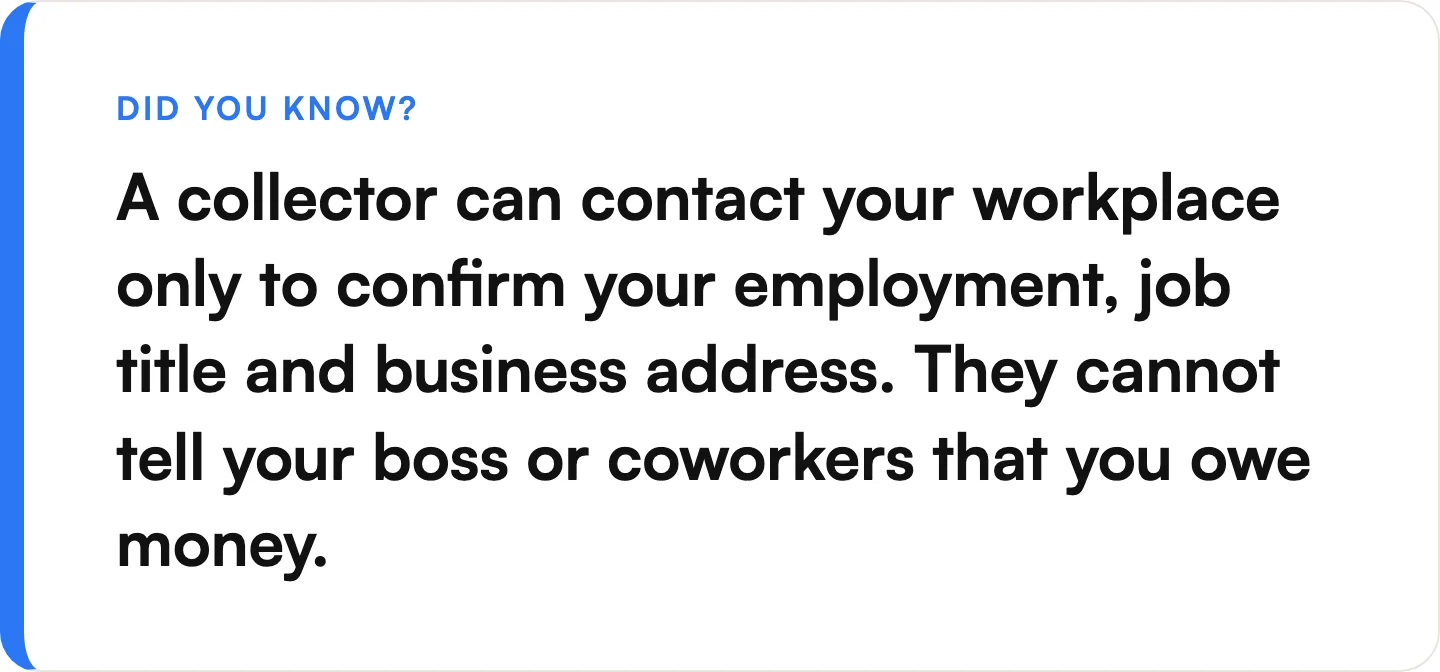
Your employer is a special case. A collector can contact your workplace only to confirm your employment, your job title, and your work address. The FCAC states a collector cannot "contact your employer other than to confirm your employment, the nature of your employment, your business title and your business address." They cannot tell your boss or coworkers that you owe money, and cannot pressure anyone else to pay your debt unless that person co-signed or guaranteed it. If a collector is telling your family or workplace about your debt, that is a violation you can report.
How to make the calls stop
You stop collection contact by putting your request in writing and sending it by a method you can prove was delivered. A phone call asking them to stop is not enough, and in several provinces a request to "communicate in writing only" does not legally force a collector to stop calling. The step that actually ends contact is a written dispute notice. Here is how to do it.

- Keep a record of every contact. Write down the date, the time, the name of the collector and their agency, the phone number, and what was said. This log is your evidence if you need to file a complaint, and it takes minutes to keep.
- Ask for the debt in writing before you agree to anything. Request written validation of the debt, naming the original creditor and the amount, so you are not acting on a phone claim.
- Send a written cease-contact notice by a verifiable method. Use registered mail, a courier, or email you can prove was sent and received. Ontario's rule is the clearest model: "A collection agency cannot continue to contact you without your consent if you send them a notice by verifiable means (such as e-mail, registered mail, or a courier) to say that you dispute the debt and suggest that the matter be taken to court." Most provinces have a similar written-dispute mechanism, so check your own provincial regulator for the exact wording it requires.
- Keep a copy of the notice and the delivery receipt. You want proof of what you sent and when.
- If contact continues after that, escalate with a complaint to your provincial regulator, using your record of calls as evidence.
You can copy this template, fill in your details, and send it by registered mail or another verifiable method:
To: (collection agency name and address) From: (your name and address) Re: Account or file number ______, originally with (original creditor)
I dispute this debt. I am asking that this matter be taken to court if you intend to pursue it. Under the collection rules in my province, you are not to contact me further about this account by telephone once you have received this notice.
Please direct any further communication about this account to me in writing at the address above.
(your signature and the date)
Keep the tone factual. You are not admitting you owe the money, and you should not promise to pay in this notice. Disputing the debt is a legal step, not an insult.
How to check the debt is actually yours
Before you pay or promise anything, make the collector prove the debt is real, is yours, and is for the right amount. A legitimate collector must send written notice identifying the original creditor, the amount owing, and a breakdown of what makes up the balance. You have the right to request a full accounting, and in some provinces the timelines are set in law. In Alberta, a collector must provide an accounting on request. Quebec gives you the right to documents backing the claim, free of charge.
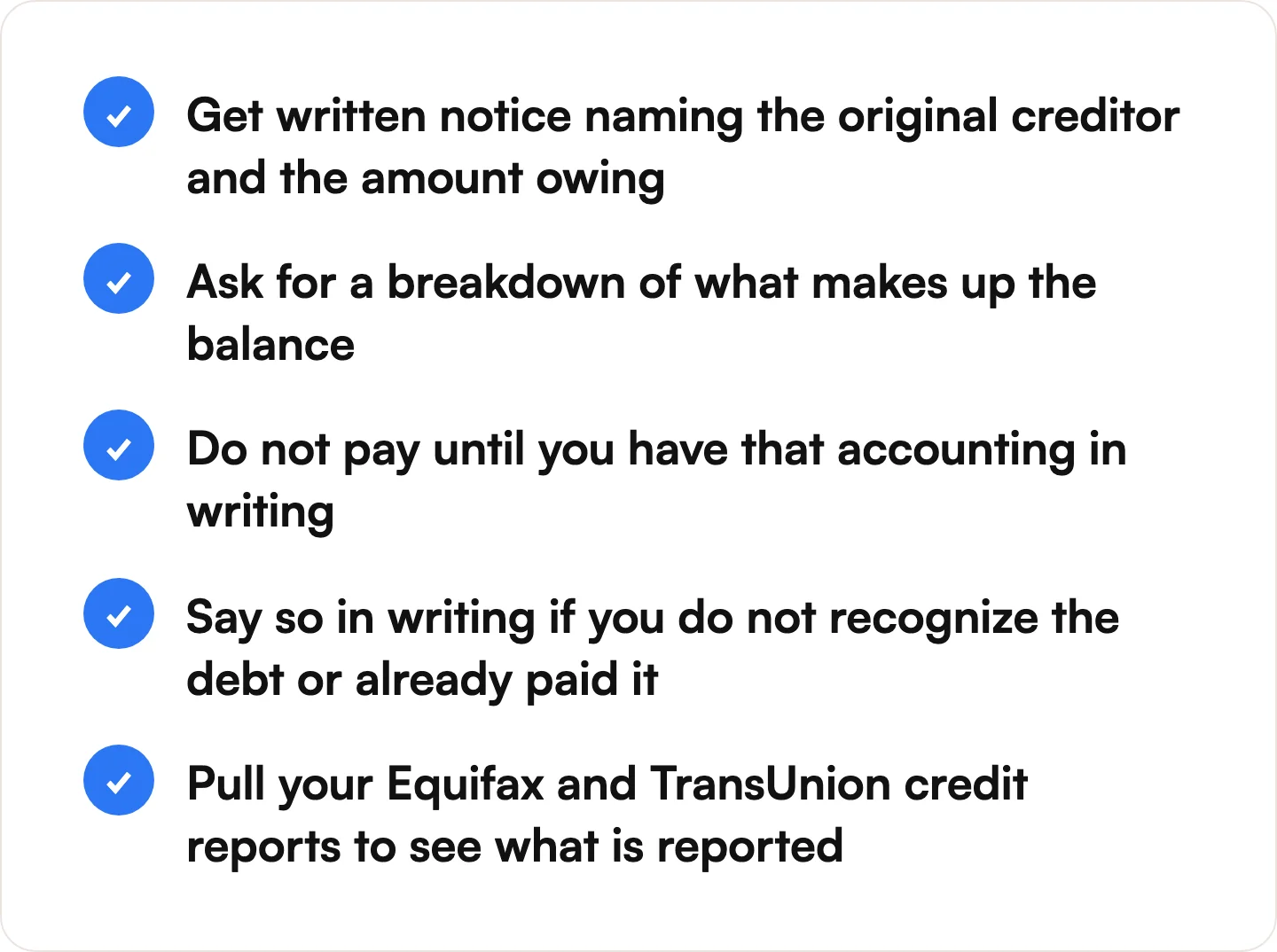
Ask for this in writing and do not pay until you have it. If you do not recognize the debt, believe you already paid it, or think it may be the result of identity theft, say so in writing, do not make a payment, and pull your credit report from Equifax and TransUnion to see what is being reported. Mistaken-identity collection is common enough that it is worth ruling out: collectors sometimes pursue the wrong person based only on a shared name. A written "you have the wrong party, do not contact me again" notice, sent by a verifiable method, is the right response if the debt is not yours.
How to tell a real collector from a scam
A real collector sends written notice and can identify the original creditor; a scammer pressures you to pay immediately and refuses to put anything in writing. Collection scams are common, and the Canadian Anti-Fraud Centre warns that "a fraudster calls to demand payment for a non-existent debt" using high-pressure tactics to get you to pay on the spot. Watch for these red flags:
- Demands for payment by gift card, cryptocurrency, or wire transfer. No legitimate collector takes payment this way.
- Threats of arrest, jail, or sending the police. Consumer debt is a civil matter, and these threats are both false and illegal.
- Refusing to send written notice or to identify the agency and the original creditor.
- Asking for your Social Insurance Number "to verify" the debt. A real collector does not need your SIN.
- Pressure to pay "right now" before you have time to check anything.
- Fake legal documents, such as a paper made to look like a court filing or statement of claim.
To verify a collector is real, request written notice, check whether the agency is licensed in your province (collection agencies must be licensed), and pull your credit report to confirm the debt exists. If you believe a call is a scam, report it to the Canadian Anti-Fraud Centre and your provincial regulator.
Can a collector sue you, garnish your wages, or have you arrested?
A collector can sue you and, if they win a judgment, can garnish your wages or your bank account, but they cannot arrest you and cannot take your money without going through court first. Here is what each of those actually means.
Being sued. A creditor or collector can take you to court to try to get a judgment, as long as the debt is still within your province's limitation period. This is a civil lawsuit, not a criminal charge.
Wage garnishment and bank seizure. A collector cannot garnish your pay or freeze your account on their own. They must first sue you, win a judgment, and then ask the court to enforce it. Only after a judgment can wages be garnished, and every province protects a portion of your pay from garnishment. Government debts and some credit-union obligations are narrow exceptions that can be collected by set-off, but a third-party collection agency cannot skip the court step.
Arrest. You cannot be arrested or jailed for a consumer debt in Canada. Debt collection is a civil matter, not a criminal one, so a collector cannot have you jailed, and threatening arrest or the police is itself a prohibited practice. Any threat of arrest is a sign of either an abusive collector or an outright scam.
Your credit. Once a debt goes to collections, it hurts your credit score, and a collection account can stay on your credit report for about six years. Equifax Canada says "most types of negative information generally remain on your Equifax credit report for 6 years." That six-year reporting window is also the source of a common myth about debt "disappearing" that is worth clearing up.
How long can a debt collector keep chasing you?
A collector can keep calling about a debt for as long as it is unpaid, but they can only sue you within your province's limitation period. The two are different, and mixing them up is where people get caught out.
The limitation period is the deadline to start a lawsuit, and it is set by each province's own limitations legislation. In most provinces it is two years from when the debt was discovered. Ontario's Limitations Act, 2002 sets the rule that "a proceeding shall not be commenced in respect of a claim after the second anniversary of the day on which the claim was discovered." Quebec is three years under the Civil Code of Québec, article 2925. A few provinces and territories run longer. Check your own province's limitations act for the exact period that applies to you. Once the limitation period has passed, the debt is "statute-barred": a collector can still ask you to pay, but a court will not force you to.
Two separate things can restart the clock, and both matter:
- Reviving the limitation period. If you make a payment or sign a written acknowledgment that you owe a statute-barred debt, you can reset the limitation period and make yourself suable again. Simply saying "that is old, I do not owe it" is generally not an acknowledgment, but a payment is.
- Refreshing the credit-report date. Separately, making any payment on an old debt can update the "last activity" date on your credit file and restart the roughly six-year reporting window.
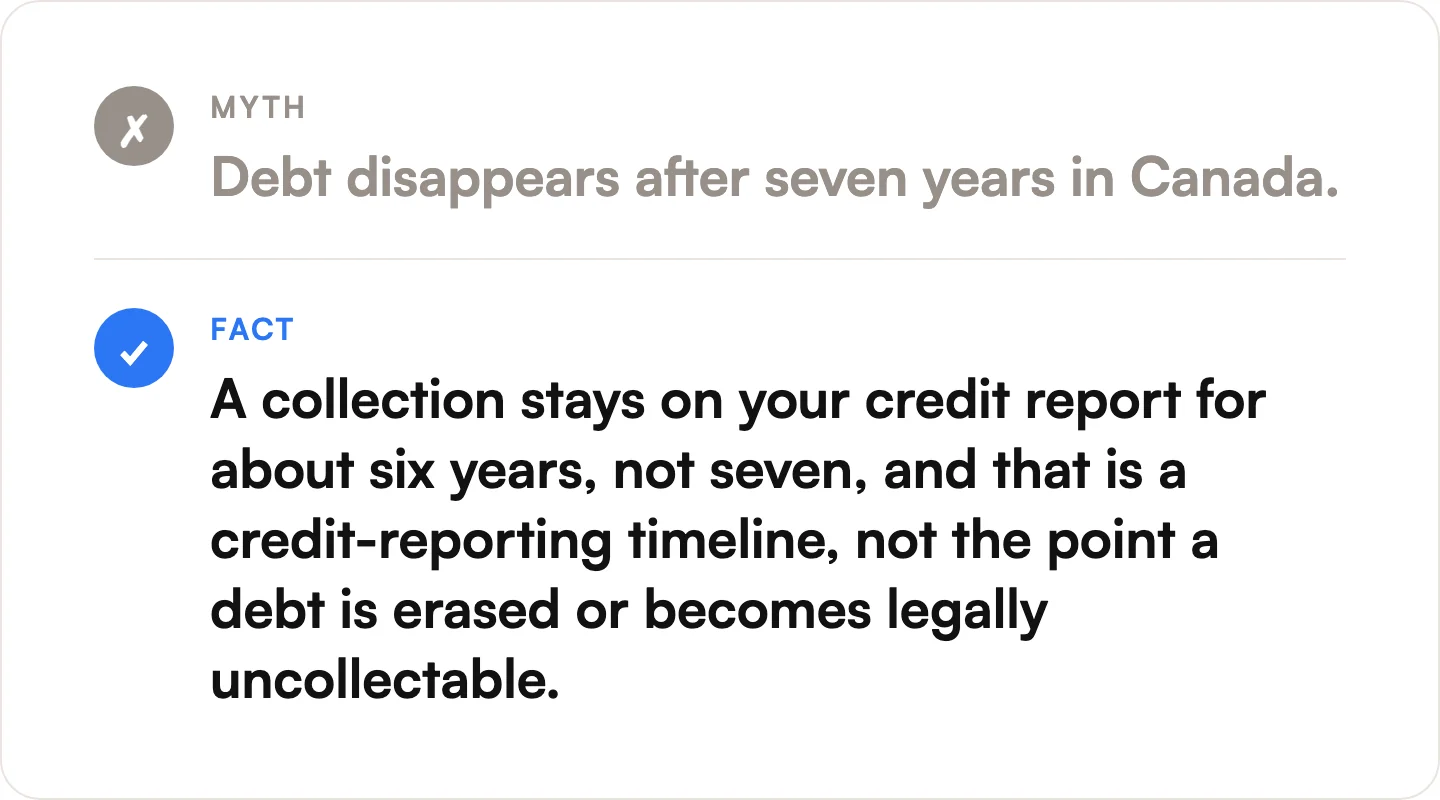
This is why the "debt disappears after seven years" idea is a myth. A collection stays on your credit report for about six years, not seven, and that is a credit-reporting timeline, not a point where the debt becomes legally uncollectable or gets erased. Because of both reset effects, it is worth confirming whether an old debt is statute-barred before you make any payment on it. This is general information, not legal advice; for a specific old debt, a licensed insolvency trustee or a community legal clinic can tell you where you stand.
How debts end up with a collector, and how to stop the cycle
A debt reaches a collection agency after you miss payments, the original creditor gives up on collecting it in-house, and the account is either assigned or sold to a third-party collector. Unsecured debts, from credit cards to payday loans, all travel this same path.
Payday loans are one of the fastest routes into collections. The FCAC notes that a payday loan costing $14 per $100 works out to an annual interest rate of roughly 365%, and when a borrower cannot clear it on time, the balance rolls over, grows, and eventually defaults and gets sold to a collector, often for a fraction of its face value. The harassment starts after the spiral, not before it.
Breaking that cycle early is the surest way to stay out of collections. One option is to avoid high-cost borrowing in the first place: Bree is a Canadian interest-free line of credit of up to $750, with no credit check, that helps cover a shortfall between paycheques and sends funds by direct deposit to your bank account. It is free to use, you repay on your own schedule, and because there is no interest, there is no triple-digit balance waiting to snowball. If a payday loan is already part of your situation, our guide on escaping the payday loan debt cycle walks through the steps.

If a debt has already reached collections, you still have options to deal with the underlying balance, and the right one depends on how much you owe and your income:
- A payment plan or settlement with the collector or original creditor. Always get the terms in writing before you pay.
- Non-profit credit counselling, which can set up a debt management plan. See our overview of credit counselling in Canada.
- A consumer proposal or bankruptcy through a licensed insolvency trustee, which legally stops collection action once filed. We compare these in consumer proposal vs bankruptcy.
- Debt consolidation, which rolls several debts into one payment, explained in our guide to debt consolidation in Canada.
How to file a complaint about a collector
If a collector breaks the rules, complain to your province's consumer-protection regulator, and for a bank collecting its own debt, complain to the bank first and then to the FCAC. Use the record of calls you kept: dates, times, names, and what was said. Each province routes complaints to its own regulator. Ontario complaints go to Consumer Protection Ontario, British Columbia to Consumer Protection BC, Alberta to Service Alberta, Quebec to the Office de la protection du consommateur, Nova Scotia to Service Nova Scotia, Saskatchewan to the FCAA, and Manitoba to the Consumer Protection Office.
For a debt owed to a federally regulated bank, the complaint path is different. Raise it with the bank through its complaint process first, and if it is not resolved, bring it to the Financial Consumer Agency of Canada. The regulator can investigate, and collectors who break the rules can lose their licence.
Also read: Cancel a Pre-Authorized Payment in Canada
Frequently asked questions
Can I just ignore a debt collector?
Ignoring a collector does not make the debt go away. The calls usually continue, the debt keeps hurting your credit, and the collector can still sue you within the limitation period. A better move is to verify the debt in writing, respond on paper, and deal with the underlying balance rather than letting it sit.
Does debt disappear after seven years in Canada?
No. A collection account stays on your credit report for about six years, not seven, and that is a credit-reporting timeline, not a point where the debt is erased or becomes legally uncollectable. Whether a collector can still sue you depends on your province's limitation period, which is a separate rule.
How many calls from a collector count as harassment?
It depends on your province. Ontario, Alberta, and Nova Scotia cap contact at three times in any seven-day period, so going beyond that can be a violation. Calls outside permitted hours, or any threatening or abusive contact, count as harassment regardless of how many there are.
Can a collection agency take money from my bank account?
Not on their own. A collection agency must sue you, win a court judgment, and then get a court order before it can garnish wages or seize funds from a bank account. A collector who threatens to empty your account over the phone is bluffing or running a scam.
Should I pay a debt in collections?
Only after you confirm the debt is really yours and check whether it is past your province's limitation period. Get any settlement in writing before you pay, because a payment on an old debt can restart both the limitation clock and the credit-reporting window.
Can a collector call me at work?
A collector can contact your workplace only to confirm your employment, title, and business address. They cannot discuss your debt with your employer or coworkers, and if your job forbids personal calls, you can tell the collector to stop contacting you there.
Conclusion
Debt collector harassment is not something you have to tolerate. Collection in Canada is regulated in every province, aggressive or dishonest tactics are illegal, and a written dispute notice sent by a verifiable method can bring the contact to an end. Know your province's call hours and contact limits, make the collector prove the debt before you pay, and keep a record you can take to your regulator.
If a payday loan is what pushed you toward collections, there is a better way to cover a shortfall. We built Bree as an interest-free line of credit of up to $750 with no credit check, trusted by more than 600,000 Canadians, a transparent alternative to the triple-digit payday loans that start the spiral. You can see how it works and cover the gap without the interest that leads here in the first place.
Sources
- Financial Consumer Agency of Canada: Dealing with a debt collector
- Financial Consumer Agency of Canada: Debt collection, know your rights
- Government of Ontario: Guide to collection agencies
- Government of Ontario: Stop collection agency calls
- Government of Ontario: Ontario Limitations Act
- Government of Alberta: Collection agencies and debt repayment
- Consumer Protection BC: The rules debt collectors must follow
- Office de la protection du consommateur du Québec: Collection representatives
- Government of Nova Scotia: Collection agencies, your rights
- Government of Manitoba: Collection practices
- LégisQuébec: Civil Code of Québec
- Canadian Anti-Fraud Centre: Debt collection scams
- Financial Consumer Agency of Canada: Payday loans
- Equifax Canada: How long does information stay on your credit report

Join our newsletter to get the latest updates