
Having poor credit makes it harder to qualify for a loan in Canada, and if you do get approved, it often comes with a higher interest rate or a smaller amount. Ads promising bad credit loans guaranteed approval in Canada are built to catch you at exactly that moment. The honest answer is that no legitimate lender offers truly guaranteed approval. Every real lender runs some kind of qualification check first.
If you see a guaranteed approval offer, treat it as a warning sign, not a lucky break. Many of these products target people with a low credit score who feel out of options, and "instant approval no matter what" is almost always the setup for a scam or a predatory rate. This guide covers what these offers really are, how to spot the fakes, and the safer ways to borrow when your credit is poor.
Key Takeaways
- No legitimate lender offers truly guaranteed approval. Every real lender verifies your identity, income, and ability to repay before lending.
- "Guaranteed approval" ads are often scams or predatory products. The clearest red flags are upfront-fee demands and rates above the legal cap.
- The federal criminal interest rate is 35% APR. Since January 1, 2025, any non-payday lender charging more than that is breaking the law.
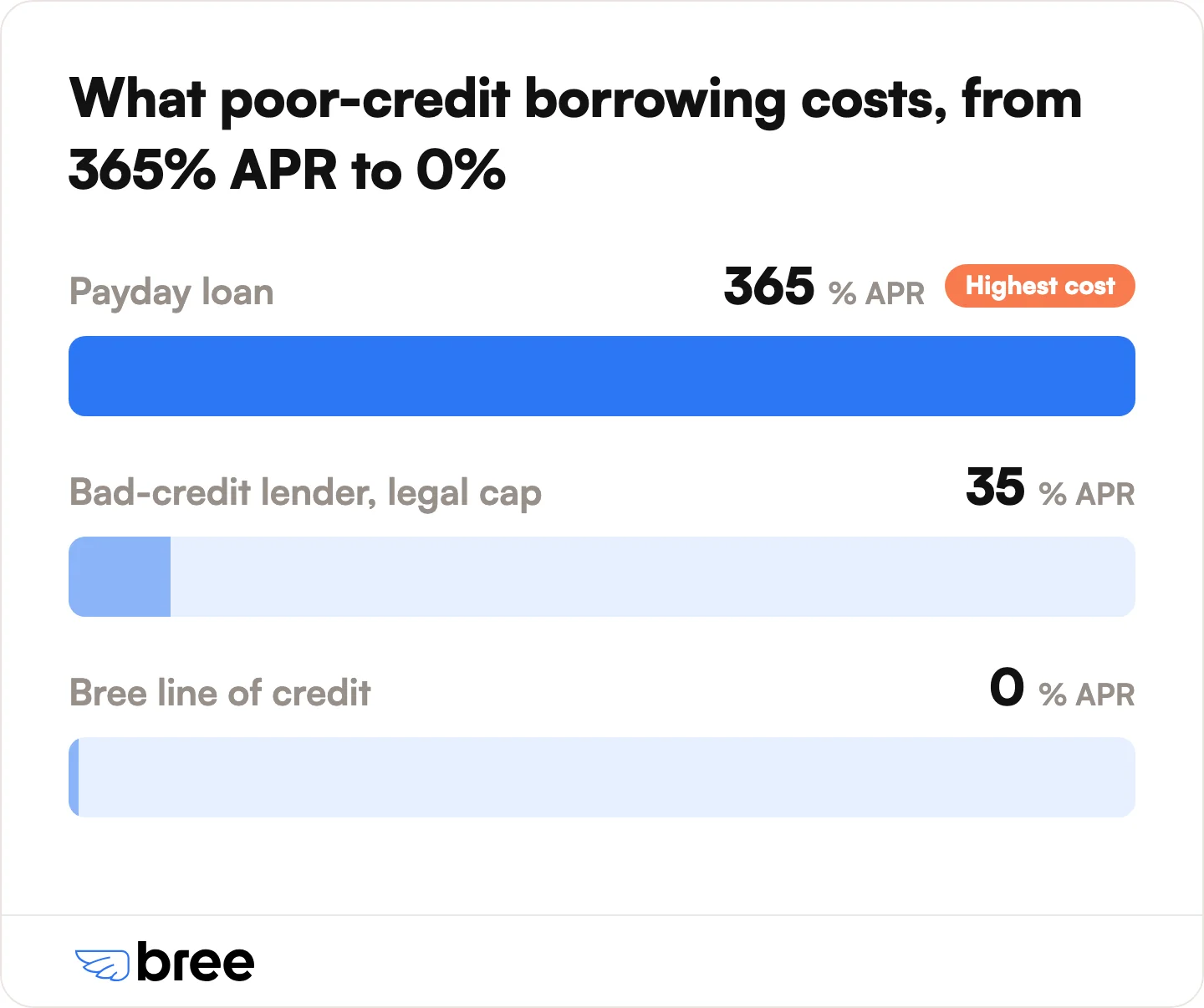
- Payday lenders are exempt from that cap but still limited to $14 per $100 borrowed, which works out to roughly 365% APR on a two-week loan.
- Safer options exist, including secured loans, credit union loans, and employer payroll advances.
- An interest-free line of credit with no credit check is one of the safer options, and some accept government benefits like EI, CPP, and ODSP as qualifying income.

What Are Guaranteed Approval Loans?
A "guaranteed approval loan" is a marketing label, not a real loan product. Legitimate lenders always run an approval process, so a genuine guarantee does not exist. What does exist is a range of bad-credit loans that accept applicants with a low score or thin credit history, each with its own trade-offs.
Common bad-credit loan types in Canada include:
- Payday loans: Short-term loans with very high costs. Payday lenders in Canada can charge up to $14 per $100 borrowed, which works out to roughly 365% APR on a typical two-week loan, according to the Financial Consumer Agency of Canada.
- Car title loans: You pledge your vehicle as security. Miss the payments and you can lose the car.
- Cash advance apps: Small, short-term amounts that usually skip the credit check.
- Bad credit personal loans: Often carry high interest rates and larger monthly payments over time.
- Installment loans: A lump sum you repay in scheduled payments over a set period.
Unlike a bank, some of these lenders will work with poor or no credit history. You still have to qualify, and the criteria usually include:
- Proof of steady income: A consistent source of income backed by pay stubs or bank statements. Some lenders accept government benefits like EI, CPP, or ODSP as qualifying income.
- A valid Canadian bank account: Needed for the application and for funding.
- Government-issued photo ID: To confirm your identity.
- Collateral (for some products): A car title loan, for example, needs proof of ownership and insurance before it funds.
Do Guaranteed Approval Loans Actually Exist in Canada?
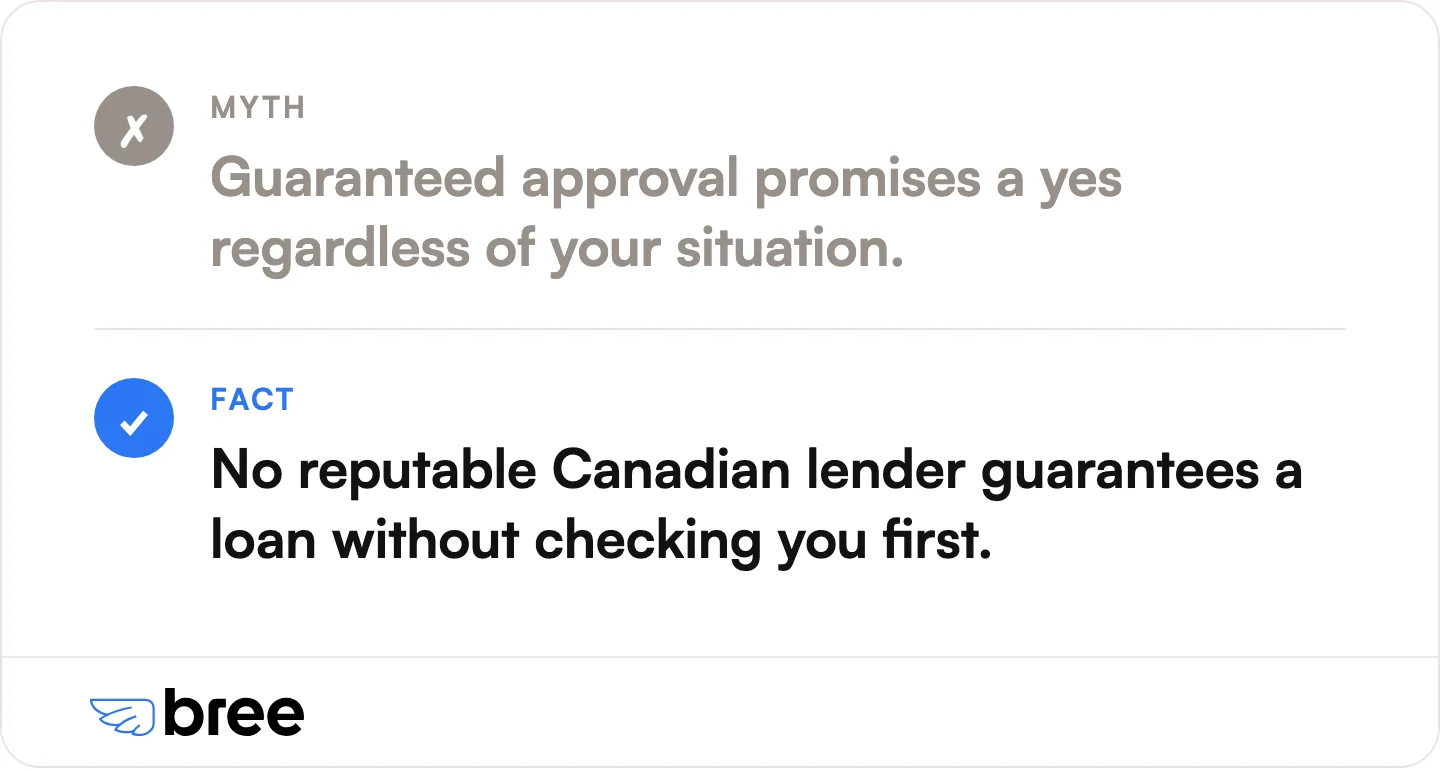
No reputable Canadian lender guarantees a loan without checking you first. Some companies use the phrase "guaranteed approval" in their ads, but a licensed lender still has to verify your income, your existing debts, and your ability to repay before approving anything. Skipping those checks is the mark of a scam or a predatory product, not a generous one.
The law backs this up. Since January 1, 2025, the federal criminal interest rate fell from 48% to 35% APR under new regulations from Justice Laws Canada. Any non-exempt lender charging more than 35% APR is breaking the law. Payday lenders are the one carve-out, still allowed to charge up to $14 per $100 borrowed. If you find a guaranteed approval offer online advertising rates above 35% APR from a non-payday lender, that is a major red flag. Many online lenders that advertise "guaranteed" or "instant" approval still run credit checks anyway, so the guarantee rarely holds.
How to Verify a Lender Is Legitimate
Always vet a lender before you hand over any personal or banking information. A few minutes of checking separates real lenders from the operations designed to take your money or your identity.
Online Research
- Check Google reviews and Better Business Bureau (BBB) ratings.
- Read customer reviews for complaints about hidden fees or poor service.
- Search the company name alongside "scam" or "complaints."
License Verification
- Confirm the lender holds proper provincial licensing.
- Look for a license number on their website.
- Use your provincial government's search directory to confirm the license is active. Payday lenders in particular must be licensed in each province where they operate.
Red Flags to Avoid
- No physical address or verifiable contact information.
- Requests for upfront fees, which are illegal in Canada. No legitimate lender charges a fee before you receive the money.
- Pressure to sign the agreement immediately.
- A promise of approval regardless of your financial situation.
- Any rate above 35% APR from a non-payday lender.
The Top Risks of Guaranteed Approval Loans
Guaranteed approval products carry risks that can cost you far more than the amount you borrow. Four stand out.
1. Very High Interest Rates
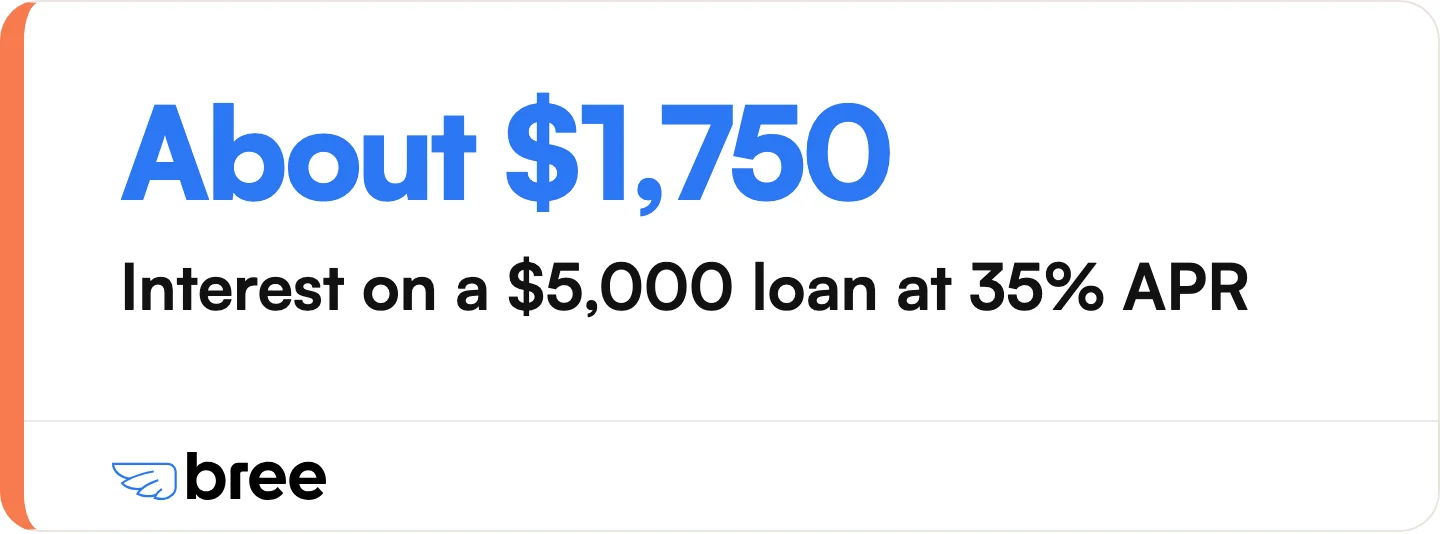
These loans often sit at or near the 35% legal cap for non-payday lenders, and payday products run far higher. A $5,000 bad-credit loan at 35% APR costs about $1,750 in interest over a single year, and that assumes you pay it off on schedule. Miss payments and the total climbs.
2. Hidden Fees
Expect costs that were not disclosed upfront. Common ones include application or administration fees, brokerage or "surety" fees baked into the payments, optional loan insurance premiums that inflate the total, late-payment penalties, and processing charges. Read the full agreement before signing, and add every fee to the interest to see the real cost.
3. Short Repayment Terms
Many of these loans demand full repayment within weeks, which makes them hard to budget for and raises the odds of default. Payday loans are the extreme case, with the full balance due by your next payday, often within two weeks. Miss it and rollover fees stack up fast.
4. Scams and Fraud
Some "lenders" exist only to collect your personal information for identity theft, or to take an upfront deposit and disappear. Loan fraud aimed at people searching for guaranteed approval is a growing problem in Canada. The Canadian Anti-Fraud Centre regularly warns about fake lending websites that copy the branding of real companies to lure in borrowers who feel they have no other choice.
How to Spot Loan Scams
Loan scams follow a small set of patterns. Learn them and most fraudulent offers become easy to spot.
Upfront Fee Demands
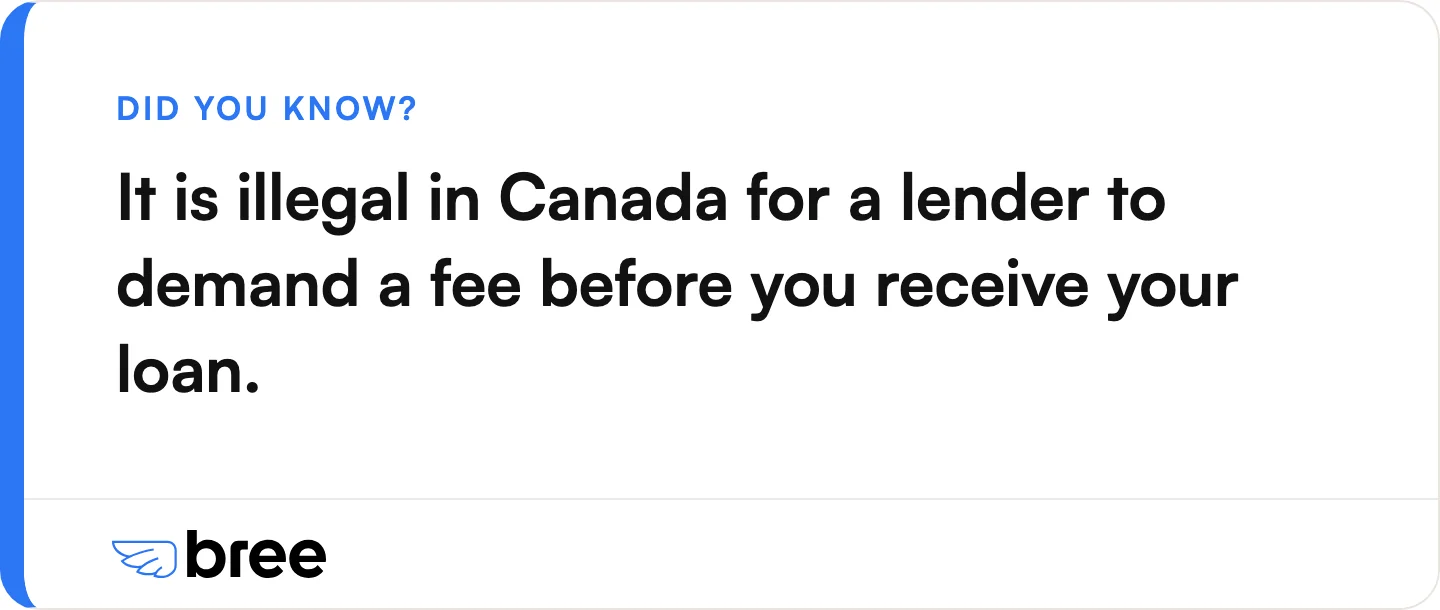
It is illegal in Canada for a lender to demand a fee before you receive your loan. Legitimate lenders deduct any fees from the loan proceeds and never ask for payment before approval.
Pressure Tactics
Legitimate lenders do not threaten you or pressure you to hand over personal information on the spot. Urgency is a manipulation tactic, not a sign of a good deal.
Suspicious Funding Methods
Be wary of any lender that asks for:
- Your online banking login credentials.
- Payment by gift cards.
- Wire transfers to foreign accounts.
- Cash payments.
What to Do If You Have Been Scammed
If you think a fraudulent lender has tricked you, act right away:
- Stop all contact with the scammer and make no further payments.
- Call your bank to freeze the account and block future withdrawals.
- Alert Equifax and TransUnion to place a fraud alert on your credit file.
- Report it to the Canadian Anti-Fraud Centre, which tracks fraudulent lenders and issues public alerts.
Safer Alternatives to Guaranteed Approval Loans
Safer options exist for borrowers with poor credit, and most cost far less than a guaranteed approval product. Here is how the main choices compare on cost and credit checks.
Secured Loans
Secured loans use an asset such as savings, a vehicle, or home equity as collateral. That collateral lowers the lender's risk, which usually means a lower interest rate than an unsecured bad-credit loan. The trade-off is real: if you default, you can lose the asset you pledged.
Credit Union Loans
Credit unions are member-owned, and they often approve borrowers with more flexible criteria and lower rates than high-risk lenders. Many run small emergency loan programs for members facing an unexpected bill. If you are not already a member, joining is usually inexpensive and worth it for the better terms.
Bree: An Interest-Free Line of Credit
Bree is an interest-free line of credit of up to $750, built for Canadians who need to cover a gap between paycheques, and we made it a straight alternative to payday loans and predatory "guaranteed approval" products. Unlike those products, a Bree line of credit comes with:
- 0% interest, versus up to 35% APR from bad-credit lenders and roughly 365% APR from payday lenders.
- No mandatory fees. Bree is free to use, and it makes money from optional tips.
- No credit check. Approval is based on your bank account history, not your score.
- No late fees and no penalties.
- Repayment on your own schedule.
- Government benefits accepted as qualifying income, including EI, CPP, CCB, ODSP, and OW.
A Bree line of credit also helps you avoid NSF fees. A bounced payment triggers an NSF charge from your bank, now capped at $10 at federally regulated banks since March 12, 2026, though provincial credit unions are not covered and can still charge more. Before that cap, these fees often ran $45 to $48, according to the Financial Consumer Agency of Canada. A 0% line of credit covers the gap without adding to your debt.
Employer Payroll Advance or Earned Wage Access
Some employers let you access wages you have already earned before payday, either directly or through an earned wage access program. When your workplace offers it, this can be one of the cheapest ways to bridge a short gap, because you are drawing your own money rather than borrowing at interest. Ask your HR or payroll department whether a program is available.
Personal Line of Credit
A personal line of credit from a bank or credit union usually carries a far lower rate than a payday or high-risk loan, and you pay interest only on the amount you actually use. Approval depends on your credit and income, so it is not an option for everyone with poor credit, but it is worth checking if your score is on the mend.
Credit-Builder Loans
Credit-builder loans are designed to raise your credit score through small, manageable payments while you build savings. The payments are reported to the credit bureaus, so paying on time actually improves your credit history over the term.
Debt Consolidation Loans
Debt consolidation loans combine several debts into one payment, usually at a lower rate. If you are carrying balances across several high-interest accounts, debt consolidation can simplify your finances into a single monthly due date and help you pay down what you owe faster.
Peer-to-Peer Lending
Peer-to-peer platforms match borrowers with individual lenders and weigh income and job stability alongside your credit score. For someone with steady income but a damaged score, the terms can beat those of a predatory lender.
Free Credit Counselling
Before taking on any new loan, consider a free session with Credit Counselling Canada at 1-866-398-5999. A counsellor can walk you through options like a debt management plan, which may reduce or eliminate interest on existing debts without a new loan at all.
What Is the Easiest Loan to Get Approved For in Canada?
The easiest loans to get approved for in Canada are the ones that look at your income instead of your credit score. No-credit-check tools, cash advance apps, and lenders that verify employment rather than pulling your credit tend to approve the widest range of applicants, including people with poor credit. That is very different from "guaranteed" approval, which no honest lender offers.
If your priority is a fast yes without a hard credit pull, an interest-free line of credit like Bree is one of the most accessible options, and we approve based on two months of bank account history rather than a credit score. Bree accepts government benefits such as EI, CPP, and ODSP as income, and the minimum requirement is consistent deposits of at least $1,200 a month. It will not approve everyone, but it approves on evidence you already have, not on a score you are still rebuilding, and it does it without the 365% APR of a payday loan.
How to Get Approved for a Loan With Poor Credit
You can improve your odds of approval with poor credit by understanding your numbers and tightening them before you apply. A few steps make a measurable difference.
Know Your Credit Score
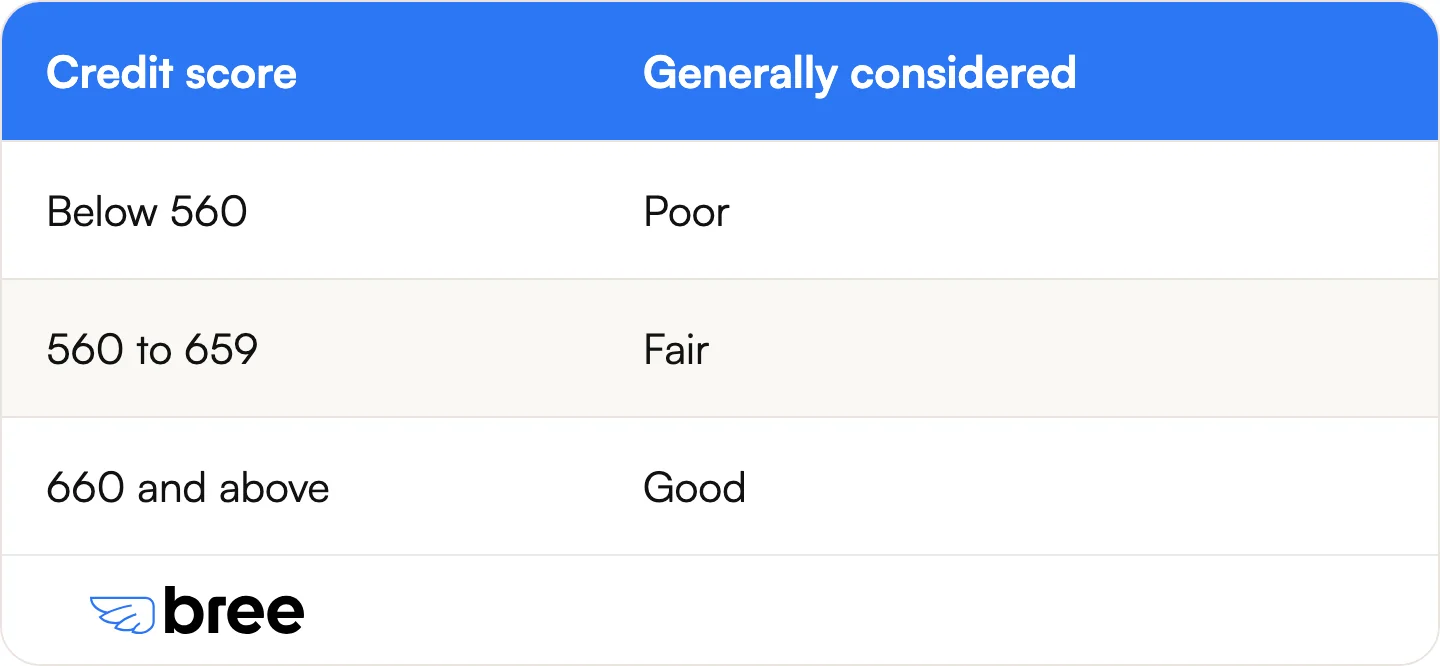
Check your score before you start applying, so you know what lenders will see. You can get a free copy of your credit report from the two bureaus through the Financial Consumer Agency of Canada. In Canada, credit scores run from 300 to 900. A score below 560 is generally considered poor, 560 to 659 is fair, and 660 and above is good. For a fuller breakdown of how lenders read these ranges, see Equifax. Negative marks like missed payments can stay on your report for years, but your score can start recovering much sooner with consistent habits.
Pay Down Your Debt
Most lenders check your debt-to-income (DTI) ratio, the share of your monthly income already going to debt payments. The lower it is, the better your odds. As a reference point, Canada Mortgage and Housing Corporation caps the total debt service ratio at 44% for insured mortgages, and many lenders use a similar ceiling. Even small reductions in what you owe can lift your approval chances.
Boost Your Income
Extra hours or a side income help you pay down debt faster and improve your DTI ratio. It is also worth checking whether you qualify for any government benefits you have not claimed yet, since those count as income with lenders that accept them.
Lower Your Credit Utilization
Carrying a lower balance relative to your available credit can help your approval odds, since lenders see less of your credit already in use. Paying down a card before you apply is one of the quicker ways to present a stronger application.
Then focus on reputable lenders: compare rates and terms from several providers, confirm each one through BBB ratings, and prepare your ID and proof of income before you apply.
Add a Co-Signer to Improve Your Chances
A co-signer with good credit can significantly raise your approval odds and secure a better rate. The co-signer agrees to repay the loan if you default, which lowers the lender's risk and strengthens your application. Make sure any co-signer fully understands the commitment, because a default damages both credit profiles and can strain the relationship.
The Benefits and Risks of Bad Credit Loans
Legitimate bad credit loans can help in an emergency, but they carry real trade-offs. Weigh both before you borrow.
The benefits:
- Access without a strong score. Many lenders use income and employment verification instead of a minimum credit score.
- Fast funding. Some approve and fund faster than a traditional bank.
- Emergency coverage. They offer a quicker route than a bank for an unexpected expense.
- A credit-building path. With some lenders, on-time payments are reported to the bureaus and help rebuild your history.
The risks:
- High interest rates. Expect rates well above those of traditional loans, up to the 35% legal cap for non-payday lenders.
- Possible credit damage. Missed payments are reported to the bureaus and can drop an already low score further.
- The debt cycle. Short terms and high costs can trap borrowers in repeat borrowing, where each loan is used to cover the last one.
Is a Bad Credit Loan Right for You?
A bad credit loan can make sense for a genuine emergency, but only after you have weighed the cost and the alternatives. Legitimate lenders will not guarantee approval, though many can approve quickly based on income rather than credit score.
Before you accept any loan:
- Research the lender's legitimacy thoroughly.
- Understand every term and every fee.
- Compare it against lower-cost options, including Bree's interest-free line of credit.
- Confirm you can repay it without pushing yourself into deeper trouble.
Frequently Asked Questions
Will a bad credit score affect my chances of loan approval?
Yes, a bad credit score reduces your chances with traditional lenders. Alternative lenders, though, tend to weigh your income and employment history more heavily than your score, so poor credit is not always a dealbreaker.
Can I get a loan without a credit check?
Yes, some legitimate lenders and no-credit-check tools skip the credit check and verify your income instead. Approval is still not guaranteed, because they confirm you can repay before lending.
How much can I borrow with poor credit?
Personal loans range from a few hundred dollars to tens of thousands, but borrowers with poor credit usually qualify for smaller amounts. The exact figure depends on your income and the specific lender.
What is the difference between guaranteed approval and instant loans?
Guaranteed approval, which does not legitimately exist, promises a yes regardless of your situation. Instant loans offer a fast decision but still require you to meet the lender's criteria. One is a marketing myth, the other is simply a quick process.
How can I avoid loan scams?
Research every lender, verify their provincial licensing, never pay an upfront fee, and be wary of pressure tactics or promises that sound too good to be true.
Who will give me a loan if no one else will?
If banks and traditional lenders have turned you down, income-based options are your best route: credit unions, no-credit-check tools, and lenders that verify employment rather than pulling your credit. An interest-free line of credit like Bree approves on your bank history and accepts government benefits, which opens the door for many people that banks reject.
Are payday loans the same as guaranteed approval loans?
No. Payday loans are accessible to borrowers with bad credit, but licensed payday lenders still verify your income and employment. They are not guaranteed, and their cost, up to $14 per $100 borrowed, makes them one of the most expensive ways to borrow.
Conclusion
Guaranteed approval loans are a marketing myth used by scammers and predatory lenders, and chasing one is how people with poor credit end up worse off. No honest lender promises approval without checking you first. The safer path is to verify any lender, understand the full cost, and compare lower-cost options before you sign anything.
Bree is an interest-free line of credit of up to $750 with no credit check, built for Canadians between paycheques, and we designed it as the opposite of a predatory loan: 0% interest, no mandatory fees, and repayment on your own schedule. Because it accepts government benefits such as EI, CPP, ODSP, and OW as income, it reaches many of the people that banks and "guaranteed approval" lenders leave behind. More than 600,000 Canadians use Bree, which holds a 4.8 out of 5 rating on Trustpilot across more than 8,007 reviews.
Focus on legitimate lenders, rebuild your credit over time, and choose products that help rather than harm your finances. With honest expectations and a bit of research, you can find fair financing even with poor credit. Get up to $750 with a Bree line of credit if you want a safer way to cover the gap.
Sources
- Justice Laws Canada: Criminal Interest Rate Regulations
- Financial Consumer Agency of Canada: Payday loans
- Financial Consumer Agency of Canada: New NSF fee regulations
- Canadian Anti-Fraud Centre
- Financial Consumer Agency of Canada: Order your credit report
- Equifax: What is a good credit score in Canada
- Canada Mortgage and Housing Corporation: Debt Service Calculator
- Credit Counselling Canada

Join our newsletter to get the latest updates
.png)
.png)

