Truly free dental care in Canada exists, but it is limited to specific groups and programs. For most low-income Canadians, the realistic route is heavily reduced-cost care through the federal Canadian Dental Care Plan (CDCP), topped up by provincial programs and low-cost dental-school clinics.
The honest version matters here. "Free" dental care usually means means-tested or reduced-cost, and even the best program can leave you with a bill. This guide covers every real free and low-cost option in Canada in 2026, who qualifies for each, and what to do if you are left out or cannot wait.
Key Takeaways
- No single program gives all Canadians free dental care. Help is layered: the federal CDCP, provincial and territorial programs, and low-cost dental-school and public-health clinics.
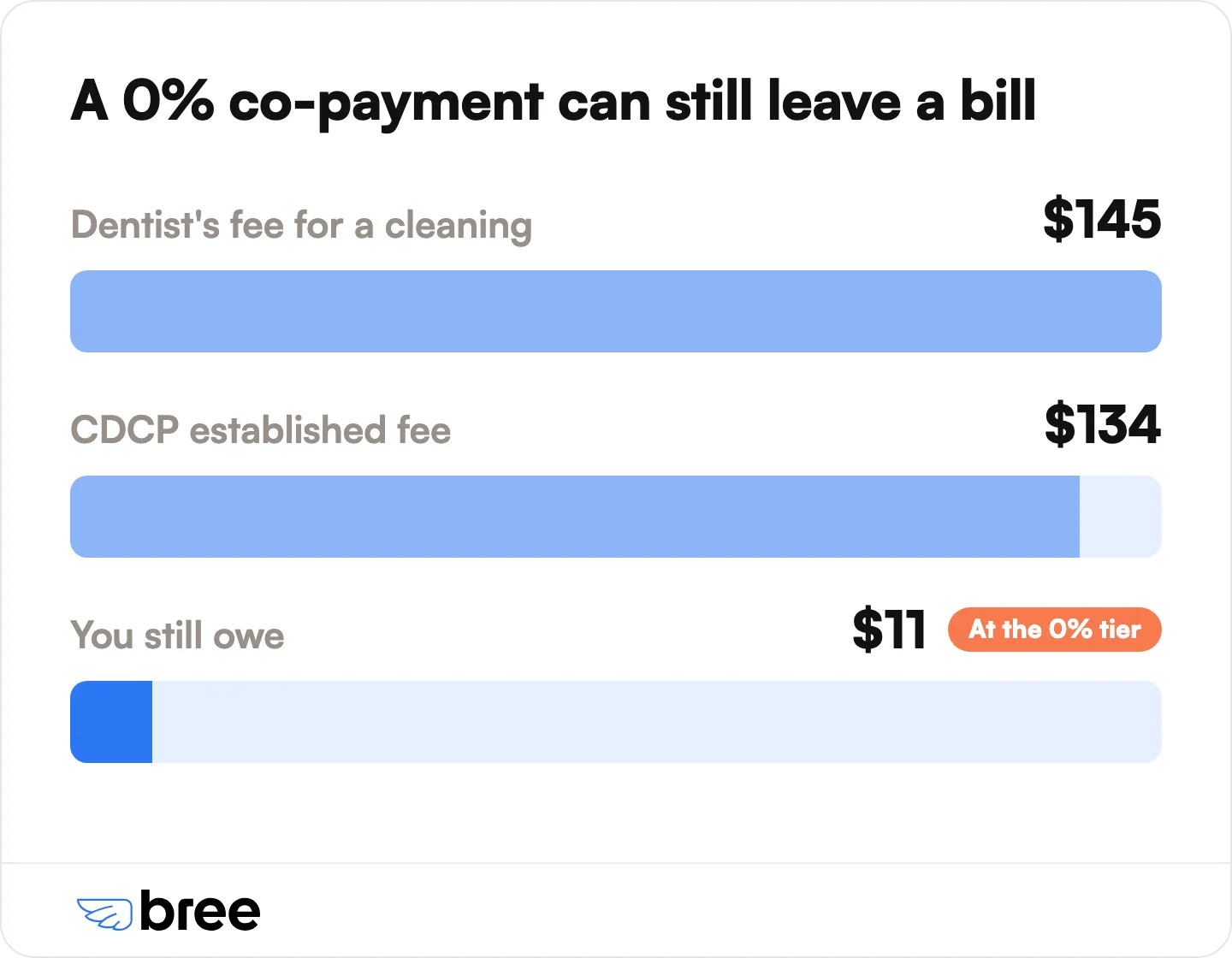
- The CDCP is reduced-cost, not free. Even at the 0% co-payment tier you can owe the gap between your dentist's fee and the plan's rate. The government's own example shows an $11 balance on a $145 cleaning.
- Family income under $90,000 and no private dental insurance are the two main gates for the CDCP. You also need to have filed your taxes and be a Canadian resident, and all ages can now apply.
- Provincial programs and dental schools come closest to free for children, low-income seniors, and people on social assistance such as ODSP, Ontario Works, or AISH.
- If you are excluded or cannot wait, dental-school clinics cut fees by roughly 30% to 40%, and there are ways to cover an urgent bill.

Is free dental care in Canada actually free?
Mostly, no. The programs Canadians call "free dental care" are almost always means-tested or reduced-cost, and the gap between "covered" and "free" catches people off guard.
The most common surprise is balance billing. When a program says it covers "100%" of a service, that means 100% of the program's own fee schedule, not 100% of what your dentist charges. Dentists set their own fees and can legally bill you the difference.
The Government of Canada shows exactly how this works. In its co-payment example for the CDCP, a dentist charges $145 for a cleaning while the CDCP established fee for that service is $134. Even a patient at the 0% co-payment tier still owes the $11 difference out of pocket. At the 40% and 60% co-payment tiers, the co-payment stacks on top of that gap.
Some routes do come genuinely free for the right person. Children under 10 in Quebec, eligible low-income children in Ontario and other provinces, and clients of some public-health clinics can receive covered care at no charge. The rest of this guide walks through each route, starting with the program that covers the most people.
The Canadian Dental Care Plan (CDCP): Canada's main dental program
The Canadian Dental Care Plan is a federal program that reduces dental costs for Canadian residents with a family income under $90,000 and no private dental insurance. It is run by Health Canada and administered by Sun Life.
It is now one of the country's largest social programs. As of 31 August 2026, 4,764,250 people were enrolled for the 2026 to 2027 benefit period, and more than 7.5 million people have been members since launch. The government estimates the plan saves an eligible person about $900 a year, according to Employment and Social Development Canada.

One point to clear up, because older articles get it wrong: the CDCP is open to all ages now. Adults aged 18 to 64 became eligible in stages through May 2025, with coverage starting 1 June 2025. The 2 June 2026 date you may have seen is simply when new applications opened for the 2026 to 2027 year, not a new age expansion.
Who qualifies for the CDCP?
You qualify for the CDCP if you meet all four requirements on the government's eligibility page: you have no access to private dental insurance, you filed your prior-year tax return (you and your spouse or common-law partner, if you have one), your adjusted family net income is under $90,000, and you are a Canadian resident for tax purposes. There is no longer any age requirement.
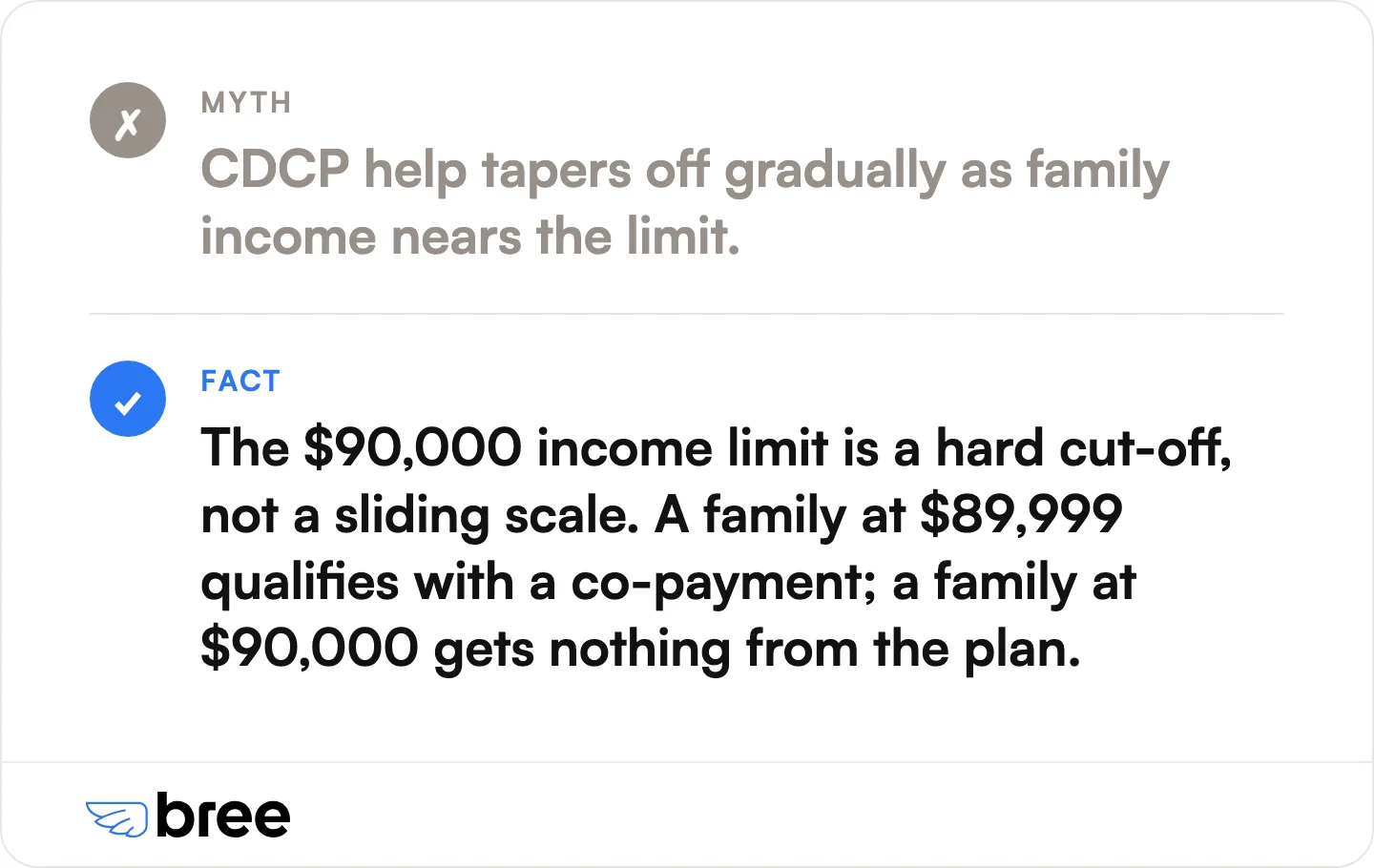
The $90,000 income limit is a hard cut-off, not a sliding scale. A family at $89,999 qualifies with a co-payment; a family at $90,000 gets nothing from the plan. This catches people who expect the amount to taper off gradually.
The "no private dental insurance" rule is stricter than it sounds. Any dental coverage through an employer, a pension, or a spouse's plan disqualifies you, even if the coverage is minimal and you never use it. If you believe you were flagged in error, one approach Canadians report is asking the plan administrator for written confirmation that no dental coverage exists, then submitting that letter with the application. Check your current status with Service Canada before relying on it.
How much does the CDCP cover?
The CDCP covers a percentage of its established fees based on your adjusted family net income. The plan pays the full rate for lower incomes and asks for a co-payment as income rises, per the coverage details on Canada.ca.
Remember that these percentages apply to the CDCP's fee schedule, not your dentist's actual bill. If your dentist charges more than the CDCP established fee, you pay that difference on top of any co-payment. That is why even a 0% co-payment patient in the government's example still owed $11 on a $145 cleaning. Ask your dentist for a written estimate before treatment so you know your real out-of-pocket cost.
What the CDCP covers, and what it doesn't
The CDCP covers a broad range of preventive, basic, and major dental services, but it excludes cosmetic work, implants, and braces. The covered list on Canada.ca includes:
- Preventive and diagnostic: exams, X-rays, cleanings, scaling, and sealants.
- Basic: fillings, root canals, and treatment for gum disease.
- Major: crowns, dentures, and oral surgery. Many major services need preauthorization before the plan will pay.
The plan does not cover orthodontics. Canada.ca states plainly that "orthodontic services are currently not available." Cosmetic procedures such as whitening and dental implants are also excluded, which matters for anyone searching whether the government pays for implants. It does not.
How to apply for the CDCP
You can apply for the CDCP online or by phone, and there is no fee to apply. The key is calling the right number, because two different organizations run two different phone lines.
- To apply or ask about eligibility: call Service Canada at 1-833-537-4342 (TTY 1-833-677-6262), or apply through the CDCP page.
- For claims, your member card, or finding a participating dentist: call Sun Life at 1-888-888-8110. Sun Life only becomes your contact after you are approved.
After you apply, Sun Life sends a welcome package with your coverage start date once your application is approved. Coverage runs on a benefit period from 1 July to 30 June, and you re-confirm your income, insurance status, and residency each year to renew. File your taxes early so a late return does not create a gap in your coverage.
How to find a dentist who accepts the CDCP
Use the Sun Life provider search, or call Sun Life at 1-888-888-8110, to find a dentist who accepts the CDCP. Not every dentist is registered with the plan, and availability varies by region, with rural areas and the territories having fewer options.
If you already have a dentist who is not registered with the plan, you may not need to switch. Ask your current office whether they will submit a claim to Sun Life on your behalf, since some will do this without formally signing up.
Provincial and territorial dental programs
On top of the CDCP, every province and territory runs its own dental programs, usually for children, low-income seniors, and people on social assistance. Where you qualify for both a provincial program and the CDCP, the CDCP is normally the primary payer and the provincial program fills gaps.
Ontario
Ontario runs separate dental programs for children and for low-income seniors, plus dental benefits through its social-assistance programs.
Healthy Smiles Ontario covers free dental care for children and youth 17 and under in low-income households. Eligibility runs on an income ladder that starts at $29,065 for a household with one child and rises with household size, according to Ontario's dental care page. It covers check-ups, cleaning, fillings, X-rays, scaling, and urgent care, but not cosmetic work or braces.
The Ontario Seniors Dental Care Program covers residents 65 and older with an annual net income of $25,480 or less for a single senior, or $42,290 or less for a couple, per the provincial seniors dental page. Applicants cannot have other dental coverage besides the CDCP. It covers exams, cleaning, fillings, X-rays, extractions, and some denture work.
Ontario Works and ODSP also include dental benefits. Children of Ontario Works recipients are enrolled automatically in Healthy Smiles, while adult dental help is determined by a caseworker, according to the Ontario Works health benefits page. On the Ontario Disability Support Program, recipients and their spouses get basic dental coverage. If you are tracking your disability payments alongside these benefits, our ODSP payment dates guide has the full schedule.
British Columbia
British Columbia covers dental care mainly through its Healthy Kids program and its income and disability assistance supplements. The province has no seniors-specific dental program, so low-income seniors in B.C. rely on the CDCP.
The Healthy Kids Program covers children under 19 in families that are not on income assistance, with an adjusted family net income of $42,000 or less. It provides up to $2,000 toward basic dental services every two years and excludes orthodontics.
For people on income or disability assistance, B.C. covers adults up to $1,000 and children up to $2,000 in basic dental over two years, with emergency pain-relief dental available to everyone on assistance.
Alberta
Alberta runs dental programs for seniors, children, low-income adults, and people on disability assistance.
Dental and Optical Assistance for Seniors covers residents 65 and older with an income of $32,690 or less for a single senior, or $65,380 or less for a couple. It provides up to $5,000 of coverage every five years for basic services such as exams, fillings, extractions, root canals, and basic dentures, but not crowns, bridges, implants, or orthodontics. The CDCP is billed first.
The Alberta Child Health Benefit covers basic and preventive dental for children in lower-income families, according to Alberta's program page. The Alberta Adult Health Benefit covers basic dental for certain low-income adults. AISH recipients receive basic dental including check-ups, cleaning, X-rays, fillings, extractions, and dentures, per Alberta's AISH coverage page. If you receive AISH, our AISH payment dates guide tracks when payments land.
Quebec
Quebec covers dental care through its public health insurance plan, RAMQ, with the most generous coverage going to young children. Children under 10 receive free exams, X-rays, fillings, extractions, root canals, and prefabricated crowns.
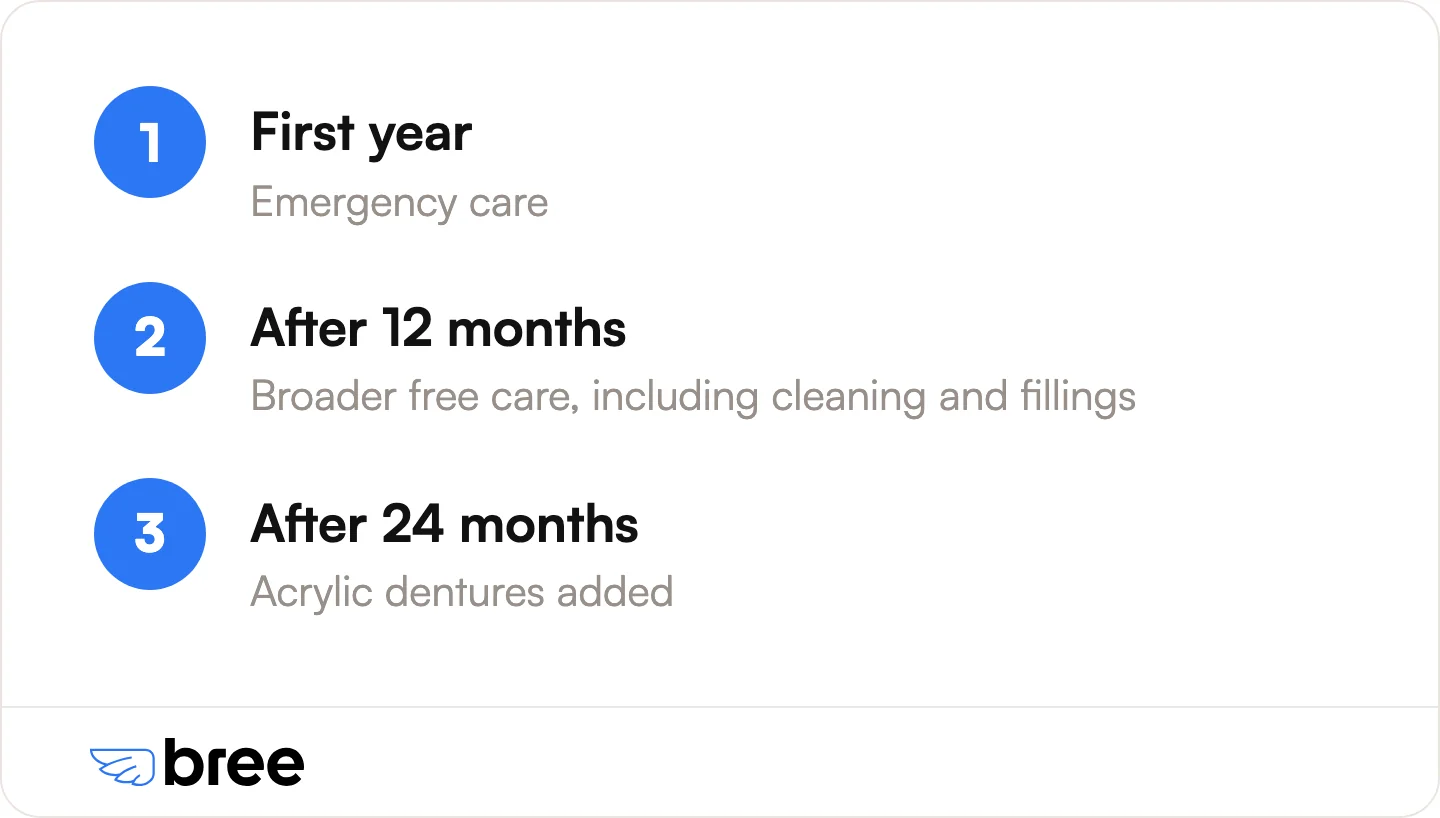
People receiving last-resort financial assistance also qualify, with coverage that widens the longer they are on assistance: emergency care in the first year, broader free care including cleaning and fillings after 12 months, and acrylic dentures added after 24 months. RAMQ does not cover orthodontics, implants, veneers, or whitening at any age.
Manitoba
Manitoba's dental coverage through Employment and Income Assistance is narrowing in 2026, so the dates matter. People already receiving EIA before 1 April 2026 keep their current dental coverage until 1 September 2026. People who start receiving EIA after 1 April 2026 pay for their own dental care unless it is an emergency.
From 1 September 2026, EIA dental coverage becomes emergency-only, and recipients are expected to apply to the CDCP for routine care. Before this transition, EIA covered basic dental such as exams, cleaning, and extractions, with a waiting period that was waived for emergencies.
Other provinces and territories
The Atlantic provinces, Saskatchewan, and the three territories run their own dental benefits through social assistance, but most low-income residents there now rely primarily on the CDCP for routine care. Check your provincial or territorial Ministry of Health or social-services website for programs specific to your area, since eligibility and coverage vary widely.
Free and low-cost dental care for seniors, children, and people with disabilities
Three groups have the most routes to free or low-cost dental care in Canada, because federal and provincial programs are built around them.
Seniors should start with the CDCP, then add a provincial seniors program where one exists. Ontario's Seniors Dental Care Program and Alberta's Dental and Optical Assistance for Seniors both top up federal coverage. In provinces without a seniors program, such as British Columbia, the CDCP plus a dental-school clinic is usually the most affordable combination. So the short answer to whether seniors get free dental care in Canada is: often reduced-cost, sometimes free, depending on income and province.
Children have the closest thing to genuinely free dental care. Healthy Smiles Ontario, B.C.'s Healthy Kids, the Alberta Child Health Benefit, and Quebec's coverage for children under 10 all provide no-cost or low-cost care for eligible kids, and many public-health units run free clinics for children and youth.
People with disabilities can access dental care through provincial disability assistance, including ODSP in Ontario, disability assistance in B.C., and AISH in Alberta, alongside the CDCP. If you receive the Canada Disability Benefit, our Canada Disability Benefit payments guide explains the schedule and how it fits with other support.
Dental schools and hygiene clinics: quality care for less
Dental schools and hygiene-program clinics treat the public at sharply reduced fees, with supervised students doing the work. You trade time for money, since appointments run longer and treatment often takes several visits, but the savings are real.
- Western University's Schulich dental clinic charges fees that are generally 60% of what a private dentist would charge, with a $20 initial screening.
- McGill University's teaching clinic charges about 30% to 40% less than a private office, and McGill also runs community clinics offering free care to Montreal residents who cannot otherwise afford it.
- The University of Toronto Faculty of Dentistry provides care at reduced fees across its clinics, treating more than 15,000 patients a year and accepting both the CDCP and Ontario Works.
- Dalhousie University offers dental care at a reduced rate compared with local dentists, with a $20 screening, and runs a grant that tops up CDCP co-payment patients to full coverage through March 2027.
- The University of Alberta runs an oral health clinic with affordable rates that accepts all CDCP coverage levels, the University of Manitoba has clinics that offer reduced fees, and the Université de Montréal offers reduced-fee care that works with CDCP coverage.
Dental schools are a legitimate first choice, not a last resort, especially for cleanings, fillings, and dentures where the extra appointment time is worth the savings.
Community and public-health dental clinics
Public-health units and community health centres offer free or low-cost dental care, mostly for children and youth and some low-income adults and seniors. Eligibility is usually assessed in person and tied to specific programs rather than a single income number.
Toronto Public Health provides free dental services to eligible children and youth up to 17, select adult and senior clients, and seniors 65 and older through its programs. Other cities run similar public-health dental services.
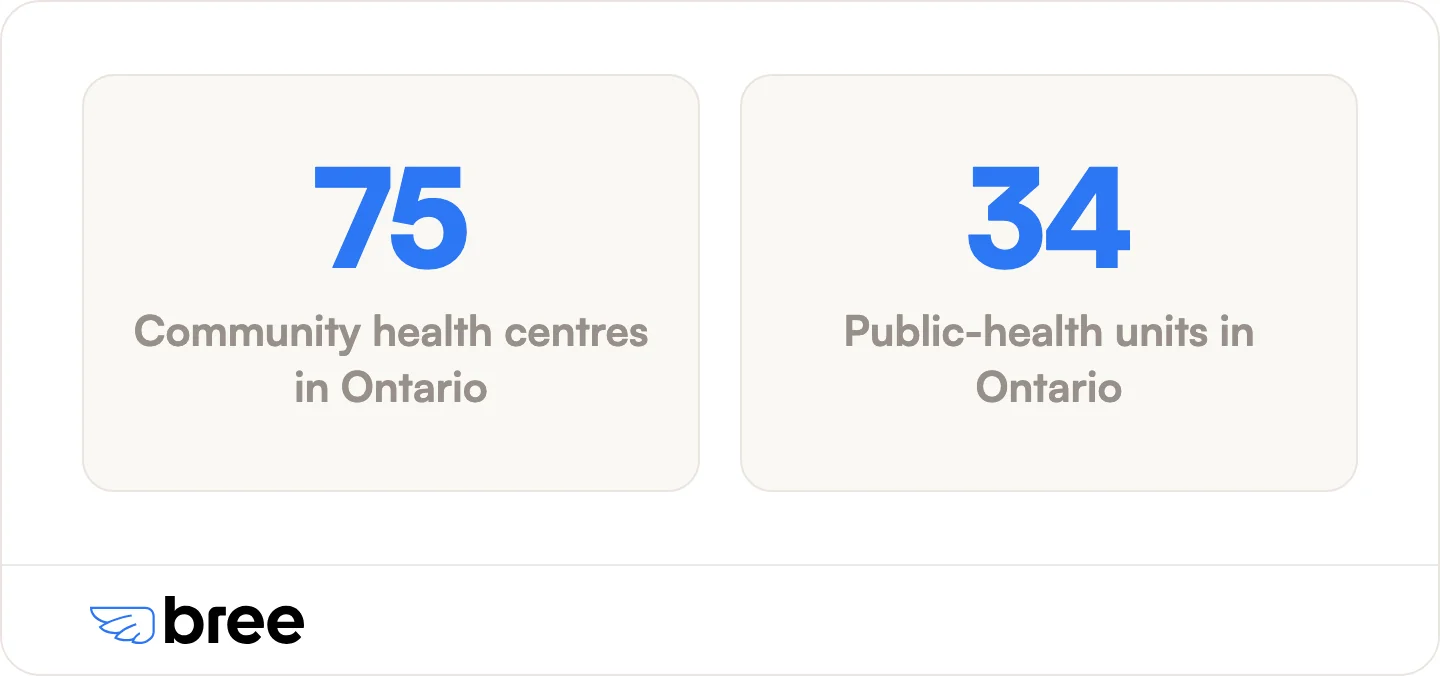
Ontario alone has 75 community health centres and 34 public-health units, many with in-house dental clinics, according to the Ontario Dental Association. To find local help quickly, call 211 or your regional public-health unit and ask what dental programs you qualify for. Some dental offices also hold free-care days, such as Free Dentistry Day, where patients can receive one free service.
What to do if you don't qualify, or can't wait
If you are just over the $90,000 income line, have any private dental insurance, are waiting for coverage to start, or need something no program covers, you still have options. The gaps are real: there can be a wait between applying and your coverage start date, and implants and orthodontics are never covered by the CDCP.
Dental-school clinics are the strongest fallback, cutting fees by roughly 30% to 40% for everyone, regardless of income. Many private dentists offer payment plans that split a bill into instalments, so ask your office what they can arrange before you assume you cannot afford treatment. And building even a small emergency fund ahead of time takes the panic out of a surprise dental bill, as our guide on why you should have an emergency fund explains.
When a dental bill cannot wait, Bree can help you bridge the gap. Bree is an interest-free line of credit of up to $750 for Canadians who need to cover a co-payment or an upfront dental cost before they can repay. There is no credit check, it is free to use with 0% APR, and government benefits such as ODSP, Ontario Works, CPP, the CCB, and EI all count as income. Funds arrive by direct deposit to your bank account, and you repay on your own schedule. More than 600,000 Canadians use Bree, which holds a 4.8 out of 5 rating on Trustpilot. If an unexpected co-payment is standing between you and treatment, you can get up to $750 with Bree.
Frequently asked questions
Will seniors get free dental care in Canada?
Seniors get reduced-cost, and sometimes free, dental care in Canada, depending on income and province. The CDCP covers low-income seniors across the country, and Ontario and Alberta add their own seniors dental programs on top. A senior under the 0% co-payment income tier pays little or nothing for covered services, though balance billing above the plan's fee can still apply.
Does the Canadian government pay for dental implants?
No. The Canadian Dental Care Plan does not cover dental implants, and neither do most provincial programs. Implants are treated as an excluded service alongside cosmetic work and orthodontics. If you need implants, the most affordable routes are a dental-school clinic or a payment plan through a private dentist.
What is the income limit for the Canadian Dental Care Plan?
The income limit for the CDCP is an adjusted family net income under $90,000. Below $70,000 you pay no co-payment, between $70,000 and $79,999 you pay a 40% co-payment, and between $80,000 and $89,999 you pay a 60% co-payment. At $90,000 or more you are not eligible.
What is the phone number for the Canadian Dental Care Plan?
There are two CDCP phone numbers for two purposes. Call Service Canada at 1-833-537-4342 to apply or ask about eligibility. Call Sun Life at 1-888-888-8110 for claims, your member card, or to find a participating dentist after you are approved.
How can I fix my teeth if I have no money?
Work through the options in order: apply for the CDCP, add any provincial program you qualify for, and use a dental-school clinic or public-health clinic for the rest. Dental schools charge roughly 30% to 40% less than private dentists, and public-health units offer free care to eligible children and some adults. For an urgent bill you cannot delay, a payment plan or a short-term interest-free option can cover the cost until you can repay.
What is the 2-2-2 rule in dentistry?
The 2-2-2 rule is a commonly cited oral-health reminder: brush twice a day, for two minutes each time, and see a dentist twice a year. It is a habit guideline, not a program, but regular check-ups catch small problems before they become the expensive treatments the programs in this guide help pay for.
The Bottom Line
There is no single button that makes dental care free in Canada, but there is a clear path. Start with the Canadian Dental Care Plan if your family income is under $90,000, stack any provincial program you qualify for, and use dental-school or public-health clinics for whatever is left. Know your rights on balance billing, and always ask for a written estimate before treatment.
The hardest moment is usually a bill that lands before your coverage does, or a co-payment on care you need now. That is where Bree fits: an interest-free line of credit of up to $750 that helps Canadians bridge an unexpected dental cost, with no credit check, 0% APR, and government benefits accepted as income. If you are facing a dental expense you cannot cover today, you can sign up for Bree and get the gap covered while your coverage catches up.
Sources
- Government of Canada: Canadian Dental Care Plan
- Government of Canada: CDCP eligibility
- Government of Canada: CDCP coverage
- Government of Canada: CDCP co-payment examples
- Government of Canada: Apply for the CDCP
- Government of Canada: Renew your CDCP coverage
- Government of Canada: CDCP statistics
- Health Canada: CDCP expansion news release
- Employment and Social Development Canada: CDCP renewal season
- Government of Ontario: Get dental care
- Government of Ontario: Dental care for low-income seniors
- Government of Ontario: Ontario Works health benefits
- Government of Ontario: ODSP health and disability benefits
- Government of British Columbia: Healthy Kids dental and eyeglasses
- Government of British Columbia: Dental supplements
- Government of Alberta: Dental and Optical Assistance for Seniors
- Government of Alberta: Alberta Child Health Benefit
- Government of Alberta: Alberta Adult Health Benefit
- Government of Alberta: AISH coverage
- RAMQ: Dental services
- Government of Manitoba: Employment and Income Assistance
- Western University: Schulich dental clinic treatment costs
- McGill University: Undergraduate teaching clinic
- McGill University: Community clinics
- University of Toronto Faculty of Dentistry: Patient information
- Dalhousie University: Faculty of Dentistry patients
- City of Toronto: Free dental care
- Ontario Dental Association: Government dental programs
- University of Alberta: Oral Health Clinic
- University of Manitoba: Centre for Community Oral Health
- Université de Montréal: Clinique dentaire
- Free Dentistry Day

Join our newsletter to get the latest updates