Buy now, pay later (BNPL) lets you split a purchase into smaller payments at checkout, usually four payments over six weeks, with no interest if you pay on time. In Canada the main providers are Affirm, PayPal Pay in 4, Klarna, Afterpay and Sezzle, plus bank-run options like PayPlan by RBC.
There is one thing worth knowing before you start: BNPL only works to buy a product at a participating store. It cannot put cash in your account for rent, a utility bill, or an emergency. That gap matters, and it is where a lot of people get stuck.
Bree is our interest-free line of credit of up to $750 for Canadians when money runs short between paycheques, so we spend a lot of time explaining where tools like BNPL help and where they fall short. This guide covers what BNPL is, how it works in Canada, every major provider compared, the fees and credit-score impact, and what to do when the real need is cash, not a checkout split.
Key Takeaways
- BNPL splits a purchase, not your paycheque. It only works at checkout with participating retailers, so it cannot cover rent, bills, or a cash emergency.
- "Interest-free" comes with conditions. Short Pay in 4 plans are 0%, but longer monthly financing runs up to 31.99% APR, and a missed payment can trigger late fees or interest.
- "No credit check" is not the same as guaranteed approval. Most providers run a soft check or verify your bank and identity, and some report missed payments to Equifax and TransUnion.
- Stacking plans is the real risk. Each provider checks you on its own, so it is easy to run several plans at once. Ratehub reports that about 46% of surveyed Canadians had more than one BNPL plan active at the same time.
- If the real need is cash, BNPL is the wrong tool. An interest-free line of credit deposits money you can spend anywhere, which a store checkout split cannot do.

What Is Buy Now, Pay Later (BNPL)?
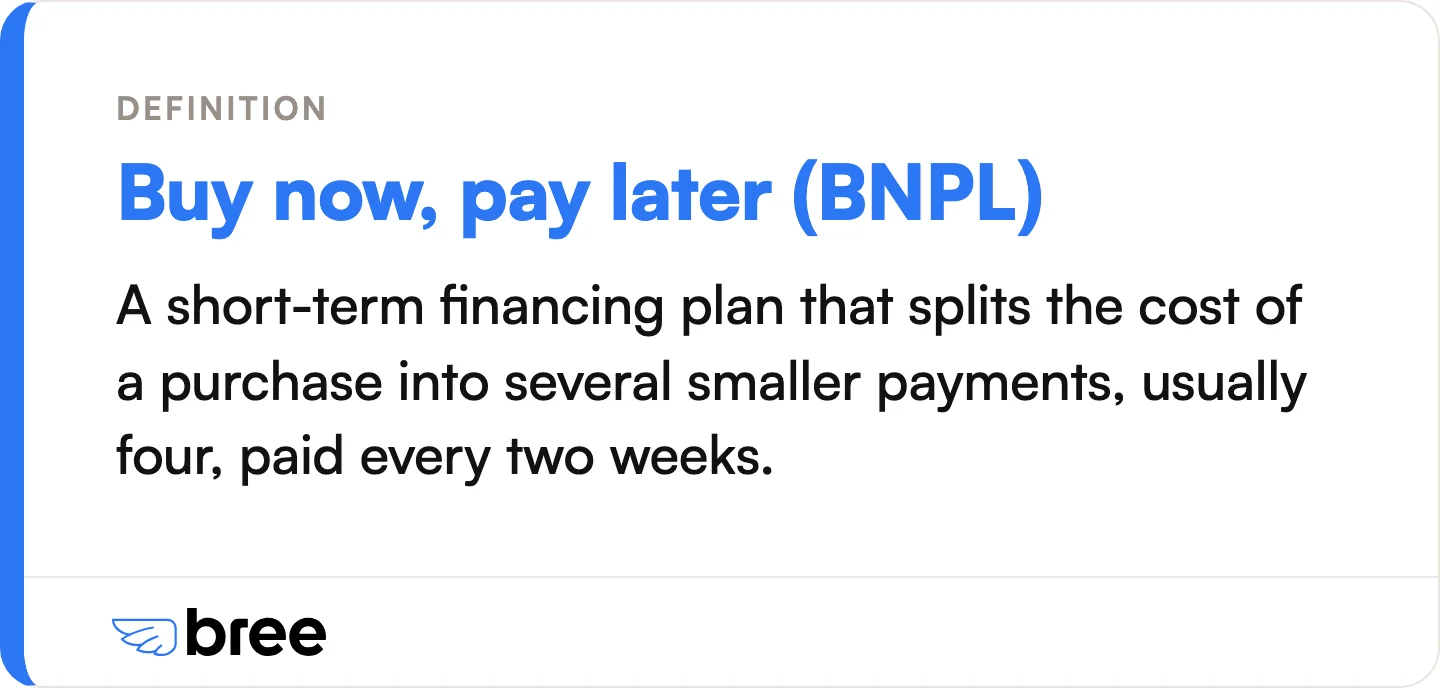
Buy now, pay later is a short-term financing plan that splits the cost of a purchase into several smaller payments, usually four, paid every two weeks. You get the item right away and pay the balance off over the following weeks.
The standard model is called "Pay in 4." On a $200 purchase, you pay about $50 at checkout, then three more payments of about $50 every two weeks. Short Pay in 4 plans are usually interest-free.
The Financial Consumer Agency of Canada (FCAC) groups BNPL into two types. An equal payment plan splits the cost into regular equal payments. A deferred payment plan lets you delay paying for a set period, but interest can be charged back to the original purchase date if you do not clear the balance in time.
BNPL has grown quickly in Canada over the past few years. It is now offered by dedicated apps, major payment companies, and Canadian banks alike, and it skews heavily toward younger shoppers.
How Buy Now, Pay Later Works in Canada
You choose BNPL as your payment method at checkout, get a quick approval, pay the first installment, and the remaining payments come out automatically. The whole process usually takes a minute or two.
Here is the typical flow:
- Choose BNPL at checkout. Select the provider (Affirm, PayPal Pay in 4, Klarna, Afterpay or Sezzle) on the retailer's website or app, or pay through the provider's own app in-store.
- Apply in seconds. Most providers run a soft credit check or verify your identity and bank details. This step decides your approval and spending limit.
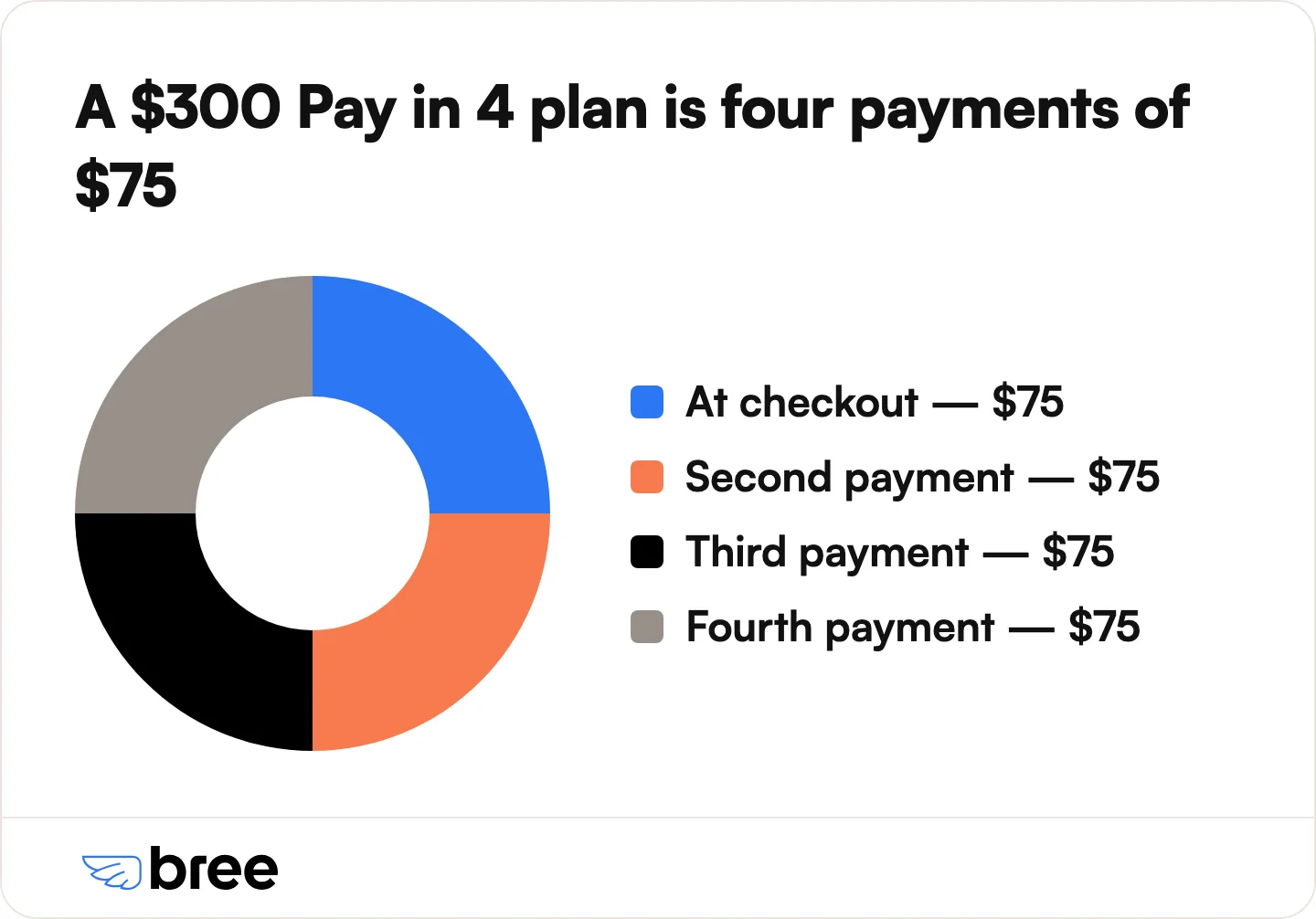
- Make the first payment. For Pay in 4, you usually pay 25% at checkout.
- The rest auto-debit. The remaining payments come out of your card or bank account every two weeks until the balance is paid.
As NerdWallet Canada explains, BNPL lets you divvy up a purchase into multiple payments, usually at 0% interest. On a $300 Pay in 4 plan, that means $75 at checkout, then three more payments of $75 every two weeks.
Payments come out on a fixed schedule, so set a reminder and keep enough in your account on each due date to avoid a missed payment.
Buy Now, Pay Later Providers in Canada
The major BNPL providers in Canada are Affirm, PayPal Pay in 4, Klarna, Afterpay and Sezzle, with PayPlan by RBC as a bank-backed option. They work in similar ways but differ most on interest, credit checks and late fees. This comparison includes an interest-free line of credit (Bree) as the cash alternative, since that is a different tool for a different job.
Bank-backed options exist too, covered below.
Provider terms are current as of October 2026 and change often. Confirm the latest interest, limits and fees on each provider's own site before you commit.
Affirm (formerly PayBright)
Affirm offers interest-free Pay in 4 plans and longer monthly financing. Monthly plans carry rates from 0% to 31.99% APR depending on the purchase and your eligibility, and Affirm states it charges no late fees. PayBright, a name you may still see at some Canadian checkouts, is now Affirm.
PayPal Pay in 4
PayPal Pay in 4 splits a purchase between $10 and $2,000 CAD into four interest-free payments, with the first due at checkout. PayPal states Pay in 4 has no sign-up, late, or non-sufficient funds fees. Its separate Pay Monthly product covers larger amounts over 3 to 24 months and is interest-bearing, with approval subject to a credit check.
Klarna
Klarna offers Pay in 4 interest-free installments paid every two weeks. Klarna runs a credit check and states that late or missed payments can have a negative impact on your credit score.
Afterpay
Afterpay splits a purchase into four interest-free payments over six weeks, with 25% due at checkout. Afterpay states it does not run credit checks or report late installment payments to credit bureaus. New accounts start with a low spending limit that grows with your payment history.
Sezzle
Sezzle takes 25% down, then three more payments of 25% every two weeks over six weeks, interest-free. Sezzle runs a soft check at signup, and it notes that some options may not be available in every province.
Bank BNPL and credit card installment plans
Canadian banks offer two bank-backed routes. PayPlan by RBC is a pay-over-time option built into RBC banking, split into equal monthly payments at checkout. Separately, cards like American Express Plan It, CIBC Pace It, MBNA Payment Plans and Scotia SelectPay let you convert a purchase you already made into fixed monthly installments, with no new application but terms and any fees set by your card issuer.
Interest, Fees, and Late Payments Explained
Short Pay in 4 plans are 0% interest, but longer financing and missed payments are where BNPL gets expensive. This is the part of the fine print most shoppers skip.
Monthly financing from Affirm and PayPal Pay Monthly can run up to 31.99% APR. Late fees vary by provider. According to Ratehub, Afterpay's late-fee structure starts at a $10 charge plus a further fee of up to $7. Klarna can charge a delay fee and report the miss to the credit bureaus, while Affirm and PayPal Pay in 4 state they charge no late fees at all.
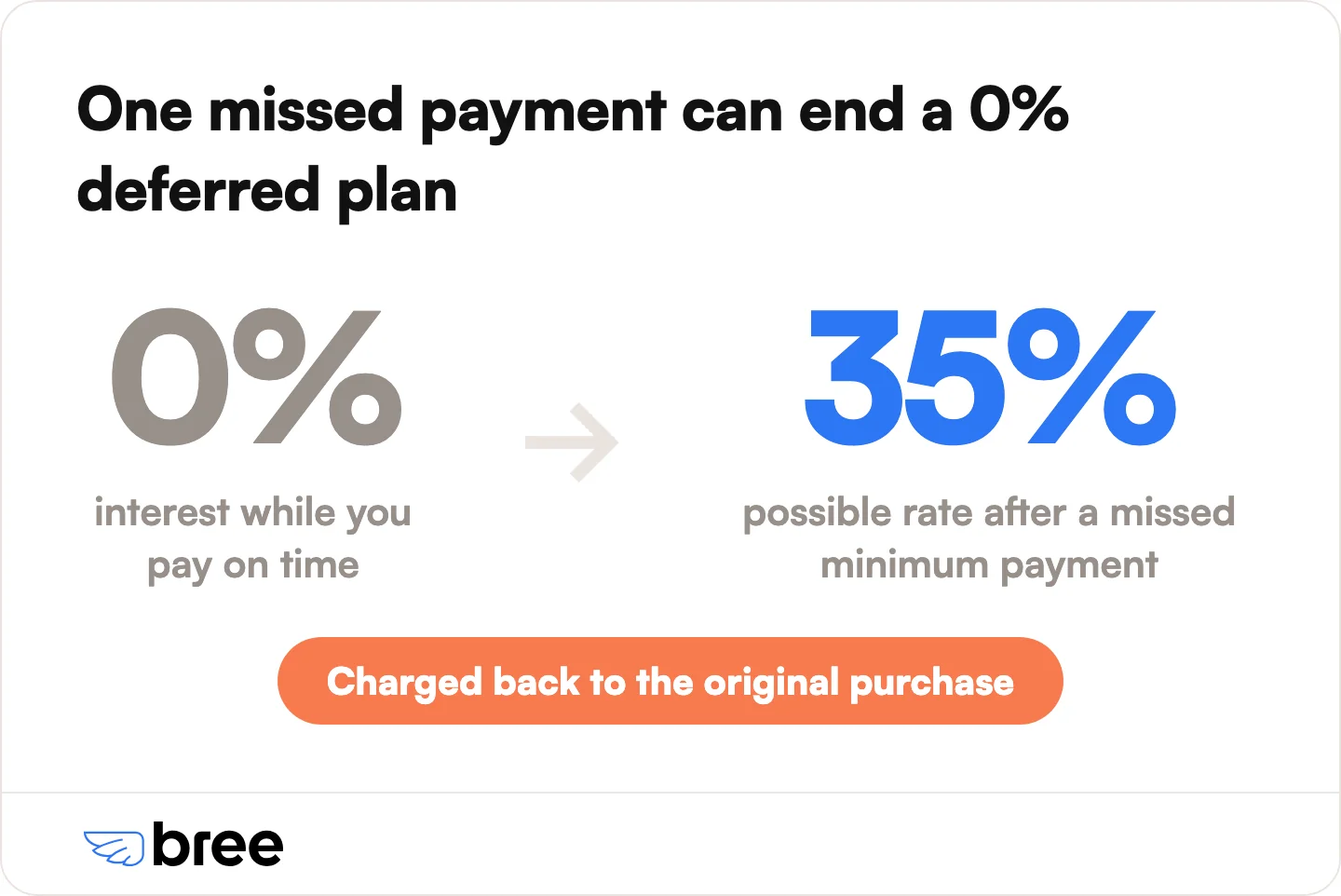
Deferred plans on retail credit cards carry a sharper risk. The FCAC warns that on this type of plan the interest rate "may go from 0% to 35% if you miss the minimum payment due date," charged back to the original purchase.
There is also a cost that has nothing to do with the provider. If an auto-debit comes out and your account is short, your own bank can charge you a non-sufficient funds (NSF) or overdraft fee on top of anything the BNPL provider charges.
Credit Checks, Approval, and Your Credit Score
Most BNPL providers run a soft credit check or verify your identity and bank, so applying for a short Pay in 4 plan usually will not hurt your score. Larger or longer plans are different, and missed payments can cause real damage.
Pay in 4 products generally use a soft check or no credit check. Larger financing, like Affirm's monthly plans or PayPal Pay Monthly, can trigger a hard credit inquiry and need full credit approval.
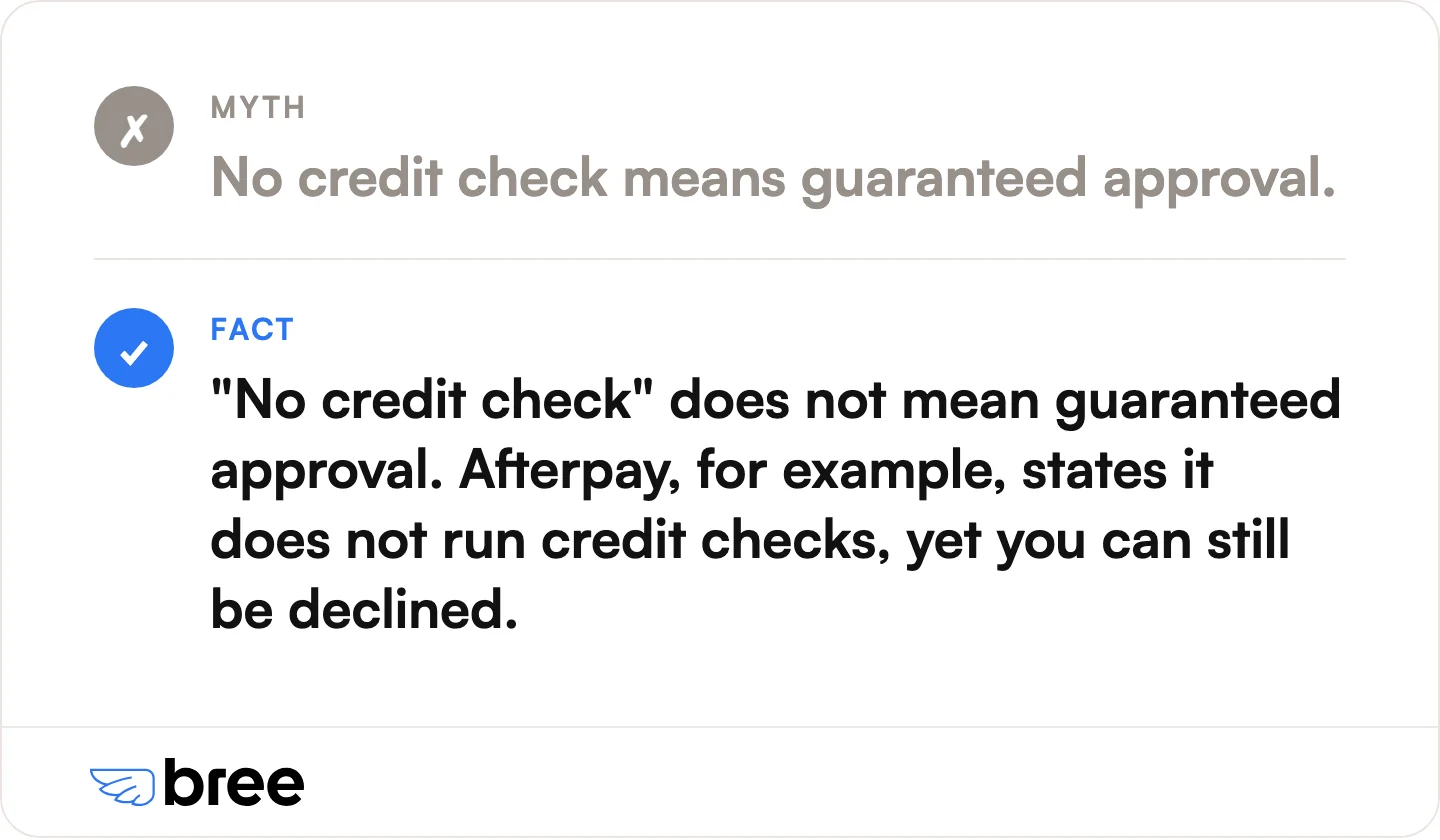
"No credit check" does not mean guaranteed approval. Afterpay, for example, states it does not run credit checks, yet you can still be declined. Denials usually come from identity or bank-account verification, your recent transaction history, prior history with the provider, or a purchase that is large relative to your income. People with good credit are sometimes surprised to be turned down for exactly these reasons.
Your score can still move. Providers increasingly report to Equifax and TransUnion, so on-time payments may help and missed ones can hurt. In the FCAC's pilot study of BNPL users, based on 2021 survey data, 44% of the 66 users surveyed said they found the potential impact on their credit score difficult to understand.
If you keep getting declined because of your credit and what you actually need is cash rather than a store purchase, there is a no-credit-check route covered further down.
The Pros and Cons of Buy Now, Pay Later
BNPL works well for a planned, one-off purchase you can comfortably repay. It becomes a problem when it is used to stretch a budget that is already tight.
The upsides:
- Spreads the cost of a purchase interest-free when you pay on time.
- Fast, low-friction approval at checkout.
- No interest on short Pay in 4 plans.
- Works for a planned purchase you have already budgeted for.
The downsides:
- It is easy to overspend. Splitting a $600 purchase into four payments of $150 makes it feel smaller than it is, which can nudge you toward buying more than you planned.
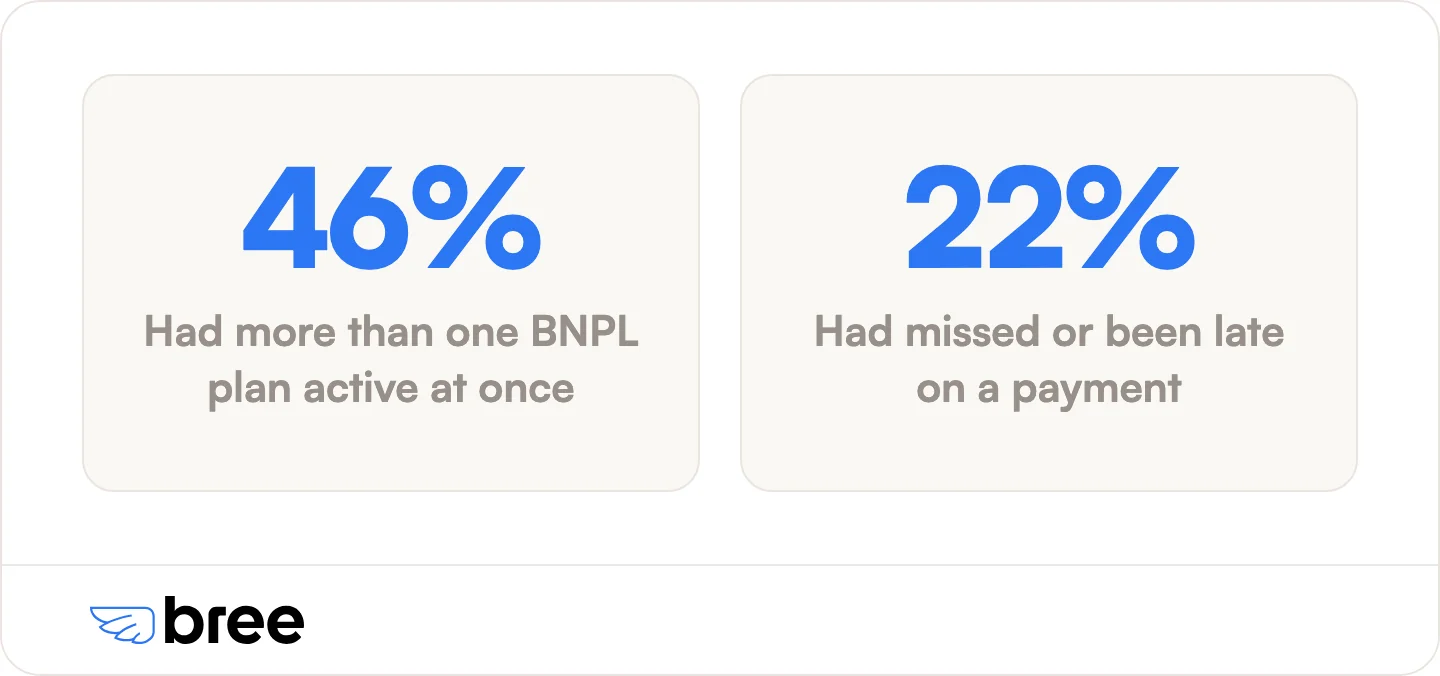
- Stacking plans creates "phantom debt." Because each provider checks you in isolation, you can run several plans at once. Ratehub, citing insolvency trustee Spergel, reports that about 46% of surveyed Canadians had more than one BNPL plan active at the same time, and about 22% had missed or been late on a payment.
- Late fees and possible interest add up quickly once you fall behind.
- Returns and refunds are harder than with a credit card, and you may owe installments on an item you have already sent back until the refund clears.
- A failed auto-debit can trigger your own bank's NSF fee.
The trade-offs are real even for careful users. The FCAC's 2021 pilot found that 15% of users who paid on time and in full still reported making unfavourable financial trade-offs, such as delaying another bill or going into overdraft. Reaching for BNPL to cover necessities like groceries is a warning sign on its own: it usually means the budget is already stretched too thin.
When You Need Cash, Not a Checkout Split
BNPL can only pay a participating store at checkout. It cannot put money in your account for rent, a utility bill, a government payment, or a cash emergency. When the real need is cash, a purchase-splitting tool does not help.
This is the moment a lot of people hit. You are reaching for BNPL to cover groceries or a bill, which is really a cash-flow problem, not a shopping one. For that, an interest-free line of credit fits better than a checkout plan.
Bree is an interest-free line of credit up to $750, built for exactly this gap. It is not BNPL and it is not a loan. It is free to use, with 0% APR. The only costs are an optional tip and an optional express fee for faster funding.
Here is how it works for a cash shortfall:
- No credit check, not even a soft pull. Approval is based on your bank transaction history.
- Government benefits count as income, including ODSP, OW, CPP, CCB and EI, which most BNPL providers do not assess.
- Funds arrive by direct deposit to your bank account. Express delivery can get you cash in minutes.
- Repay on your own schedule. You will see your terms before you accept.
More than 600,000 Canadians use Bree, and it holds a Trustpilot rating of 4.8 out of 5 across 8,007+ reviews. If you need money now rather than a way to split a store purchase, you can get up to $750 with Bree or read what members say.
Other Alternatives to Buy Now, Pay Later in Canada
If BNPL is not the right fit, a few other tools can spread or cover a cost in Canada. Each suits a different situation.
- Credit card installment plans convert a purchase you already made on your card into fixed monthly payments (Amex Plan It, CIBC Pace It, MBNA Payment Plans, Scotia SelectPay).
- Personal loans give you a lump sum repaid over months, usually with interest and a credit check.
- Lines of credit offer revolving access to funds that you draw on as needed.
- A sinking fund means saving a little each month ahead of a known expense, so you do not need to finance it at all.
For a closer look at borrowing a fixed amount over time, see our guide to the best installment loans in Canada.
How to Use Buy Now, Pay Later Responsibly
Used with a few guardrails, BNPL can be a convenient way to spread a planned purchase. The rules below keep it from turning into debt.
- Run only one plan at a time. Stacking plans is how people lose track.
- Budget each installment like a bill, not like free money.
- Set payment reminders and keep a buffer in the account on due dates.
- Use the 48-hour rule before any non-essential purchase. If you still want it in two days, buy it.
- Never use BNPL for essentials like groceries or bills. That is a sign to look at cash flow instead.
Frequently Asked Questions
What is the easiest buy now, pay later to get approved for?
Pay in 4 products that use a soft check or no credit check are generally the easiest to get approved for, including Afterpay, which states it runs no credit checks. No provider guarantees approval, and your spending limit usually starts low and grows with your payment history.
Where can I borrow money immediately in Canada?
BNPL only pays a store at checkout, so it cannot give you cash. For money you can spend anywhere, an interest-free line of credit like Bree deposits funds to your bank account with no credit check, and Express can get you cash in minutes.
Which buy now, pay later doesn't check your credit?
Afterpay states it does not run credit checks or report late payments to the credit bureaus. Most other providers use a soft check for Pay in 4 plans. Remember that no credit check does not mean guaranteed approval.
Does PayPal Pay in 4 do a hard credit pull?
PayPal Pay in 4 uses a soft credit check, which does not affect your credit score. PayPal's separate Pay Monthly product covers larger amounts and is subject to full consumer credit approval, which is a hard pull.
Can you be denied for buy now, pay later?
Yes. Denials usually come from identity or bank-account verification, your recent transaction history, or a purchase that is large relative to your income, not just your credit score. A good credit score does not guarantee approval.
Does buy now, pay later build your credit?
Generally no for on-time short Pay in 4 plans, which many providers do not report to the bureaus. Missed payments are a different story and can be reported to Equifax and TransUnion, where they hurt your score.
The Bottom Line
Buy now, pay later is a convenient way to split a planned purchase interest-free, as long as you pay on time, avoid stacking plans, and keep it away from essentials. The risks are real: longer financing carries interest up to 31.99% APR, late fees and your own bank's NSF charges add up, and missed payments can land on your credit report.
The one thing BNPL cannot do is give you cash. When rent, a bill, or an emergency is the problem, splitting a store purchase does not help. That is the gap we built Bree to fill: an interest-free line of credit up to $750, with no credit check and no interest, trusted by more than 600,000 Canadians who needed money between paycheques, not another way to shop.
If cash is what you actually need, you can get started with Bree in a few minutes.
Sources

Join our newsletter to get the latest updates