
.png)
The next Canada Pension Plan (CPP) payment date is August 27, 2026. CPP is paid once a month by direct deposit, near the end of each month. This guide lists every 2026 CPP payment date, how much CPP pays, and what to do if your payment is late or does not stretch far enough.
If you live on a fixed income, knowing the exact date your money lands makes it far easier to plan rent, bills, and groceries around it. Below are the confirmed dates straight from Service Canada, plus the current payment amounts and a few options for the weeks when money runs tight.
Key Takeaways
- The next CPP payment is August 27, 2026. Payments land near the end of each month, usually in the final week.
- CPP is paid by direct deposit into your bank account. If you have not set up direct deposit, a cheque is mailed instead and can take a few days longer to arrive.
- The maximum CPP retirement pension at age 65 is $1,507.65 per month as of January 2026. The average new payment at 65 is $877.01 per month as of April 2026.
- CPP, Old Age Security (OAS), and the Guaranteed Income Supplement (GIS) all arrive on the same day each month.
- CPP amounts rise every January to keep pace with inflation, so your monthly payment can go up year over year.

CPP Payment Dates for 2026
CPP payments in 2026 are deposited on these dates, according to the Service Canada benefits payment calendar:
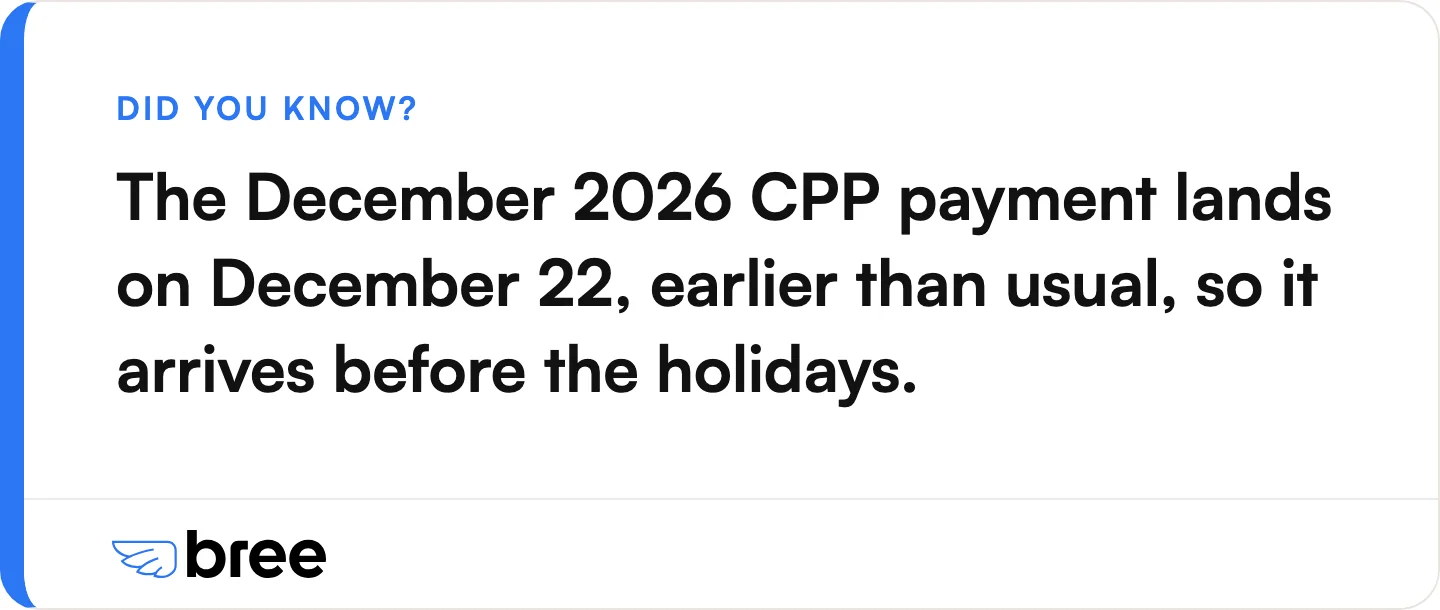
CPP lands in the last full week of most months, which is why the exact date shifts from month to month. Always go by the published dates above rather than estimating. December is the exception. The December payment lands on December 22, 2026, earlier than usual so it arrives before the holidays. Old Age Security and the Guaranteed Income Supplement are paid on these same dates.
How Much Is CPP in 2026?
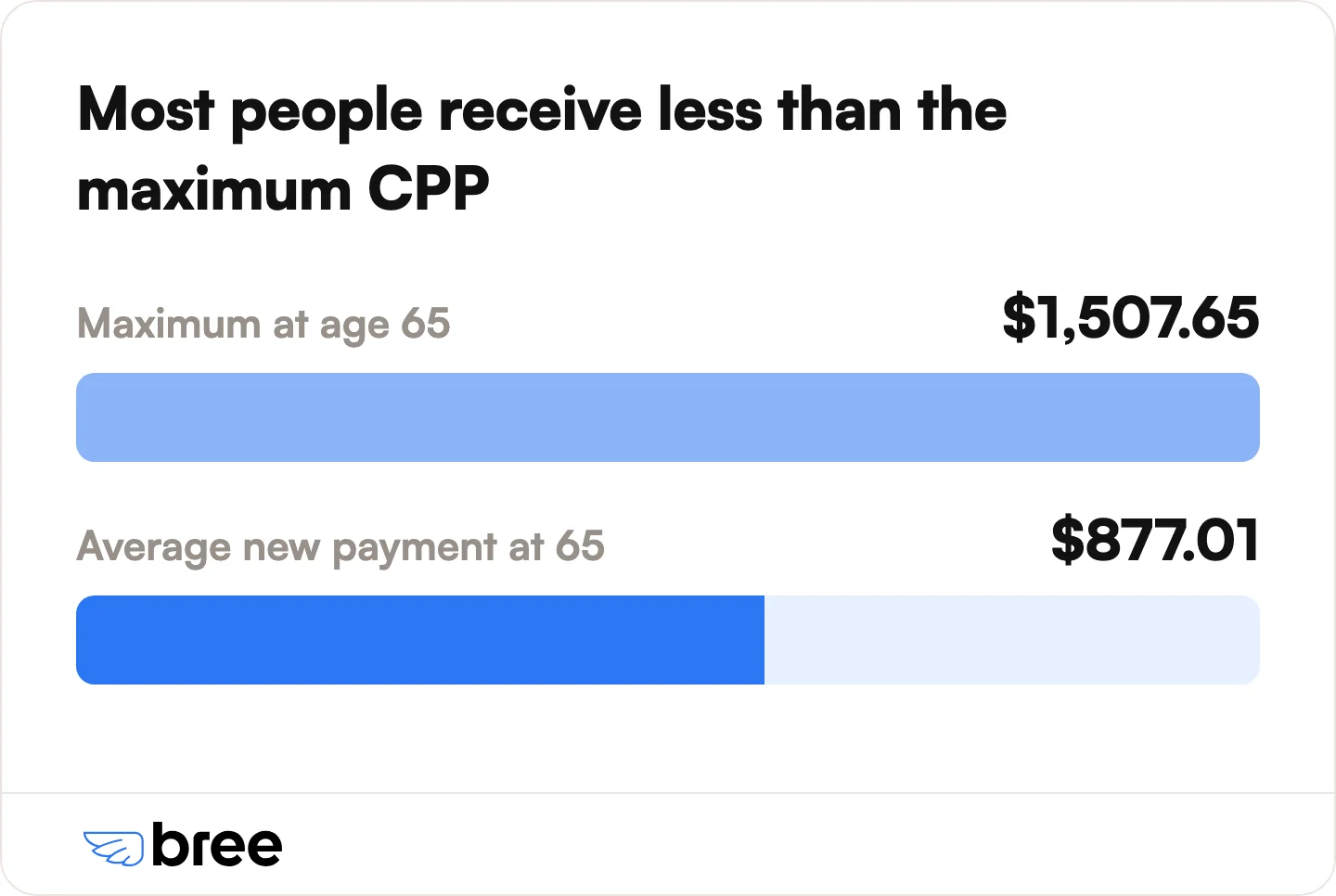
The maximum CPP retirement pension for someone starting at age 65 is $1,507.65 per month as of January 2026, according to Service Canada. Most people receive less than the maximum. The average amount for a new retirement pension at age 65 is $877.01 per month as of April 2026.
Your own payment depends on three things: how much you contributed to CPP, how many years you contributed, and the age you start taking it. Because few people contribute the maximum for their whole working life, the average sits well below the ceiling.
How CPP Payments Are Deposited
CPP is paid by direct deposit into your bank account on the scheduled date. Direct deposit is the fastest and most secure way to get paid, and the money is available the same day it is issued.
If you have not signed up for direct deposit, Service Canada mails a cheque instead, which takes longer to arrive than a direct deposit. You can set up or update direct deposit through your My Service Canada Account, or by calling Service Canada at 1-800-277-9914.
Who Qualifies for CPP
CPP has two main benefits with different rules: the retirement pension and the disability benefit. You cannot receive both at the same time.
To qualify for the CPP retirement pension, you must meet two rules, according to Service Canada:
- Be at least 60 years old
- Have made at least one valid contribution to CPP
To qualify for the CPP disability benefit, you must:
- Be under 65 years old
- Have contributed enough to CPP in recent years
- Have a severe and prolonged mental or physical disability that regularly stops you from doing any type of substantially gainful work
If you receive the disability benefit, it automatically converts to a retirement pension when you turn 65. You can read the full rules on the Service Canada CPP disability benefit page.
When Should You Start Taking CPP?
You can start CPP any time between age 60 and 70, and the age you choose changes your monthly amount for life. The standard age is 65.
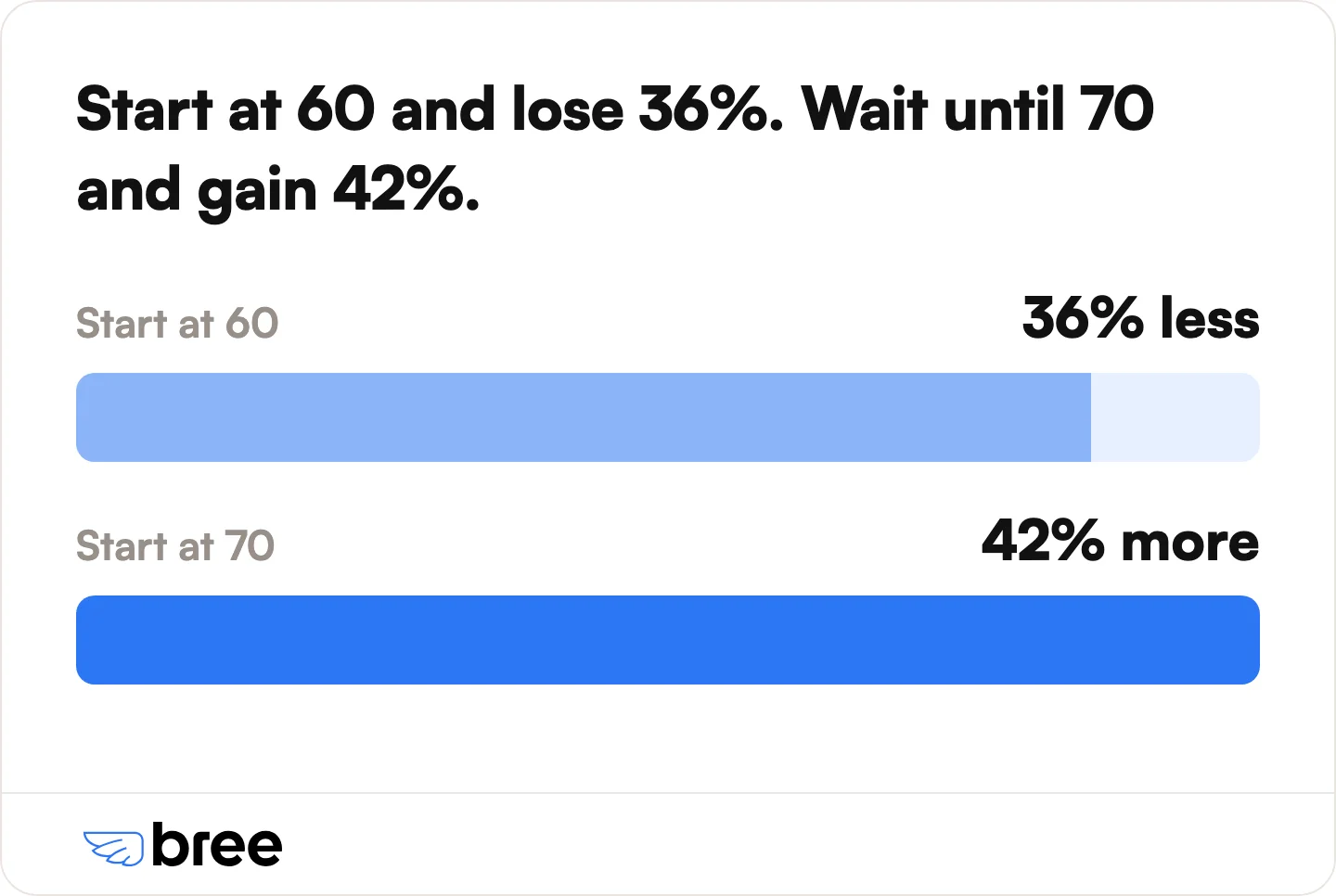
- Start before 65: your payment drops by 0.6% for each month you take it early, up to a 36% reduction if you start at 60.
- Start at 65: you receive the full amount you qualify for.
- Start after 65: your payment rises by 0.7% for each month you wait, up to a 42% increase if you start at 70.
These adjustments are permanent, according to Service Canada. Taking CPP early means smaller cheques for longer. Waiting means larger cheques but fewer years of them, so the right choice depends on your health, savings, and whether you are still working.
2026 CPP Contribution Changes
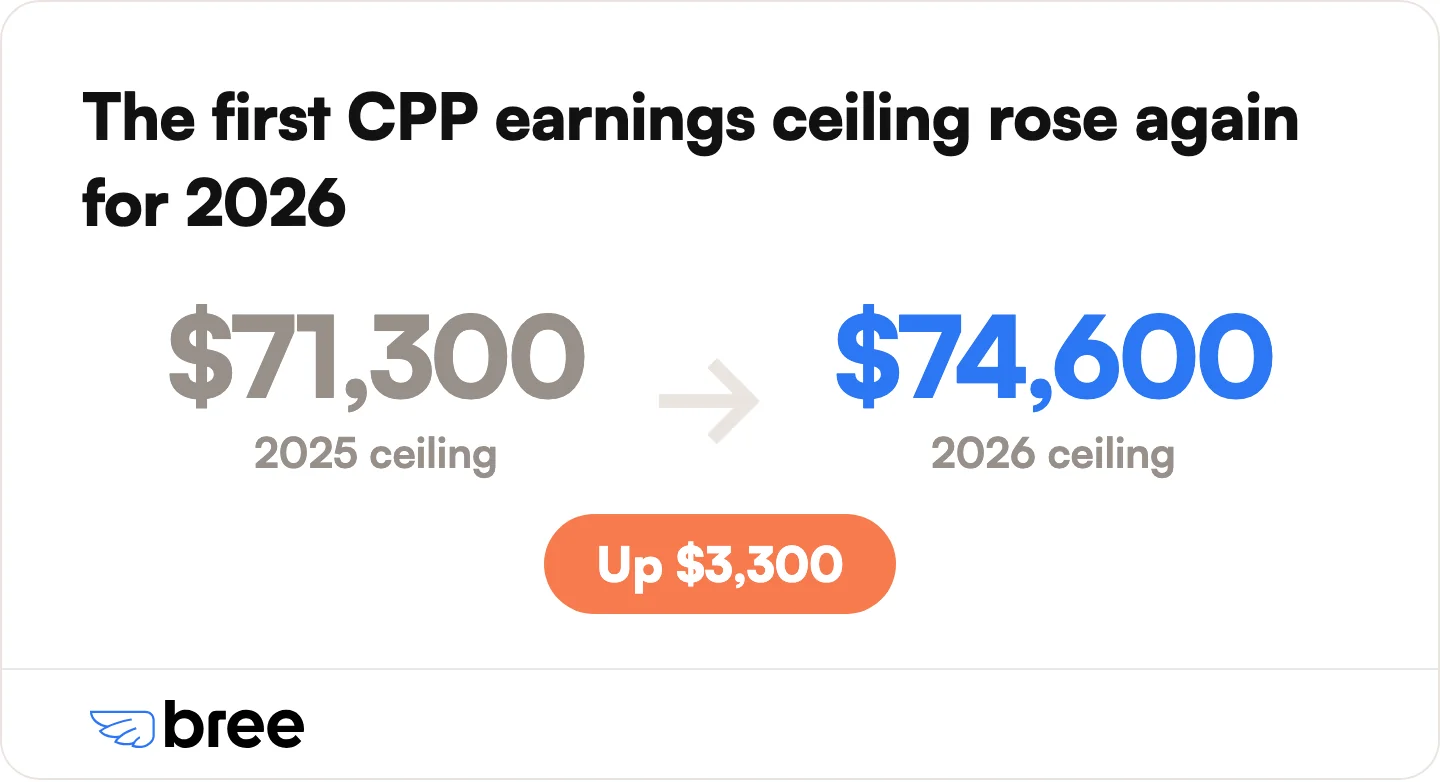
CPP contribution limits went up again in 2026. The first earnings ceiling, called the Year's Maximum Pensionable Earnings (YMPE), rose to $74,600 for 2026, up from $71,300 in 2025, according to the Canada Revenue Agency.
- Contribution rate: 5.95% for employees, matched by employers. Self-employed workers pay both halves, for a total of 11.9%.
- Second earnings ceiling (CPP2): earnings between $74,600 and $85,000 are subject to an extra 4% contribution in 2026, per the Canada Revenue Agency.
These higher contributions are part of the CPP enhancement, a gradual change that will raise future retirement payments for people working today. It takes many years of contributing at the new levels before the full effect shows up in a pension.
What to Do If Your CPP Payment Is Late or Falls Short
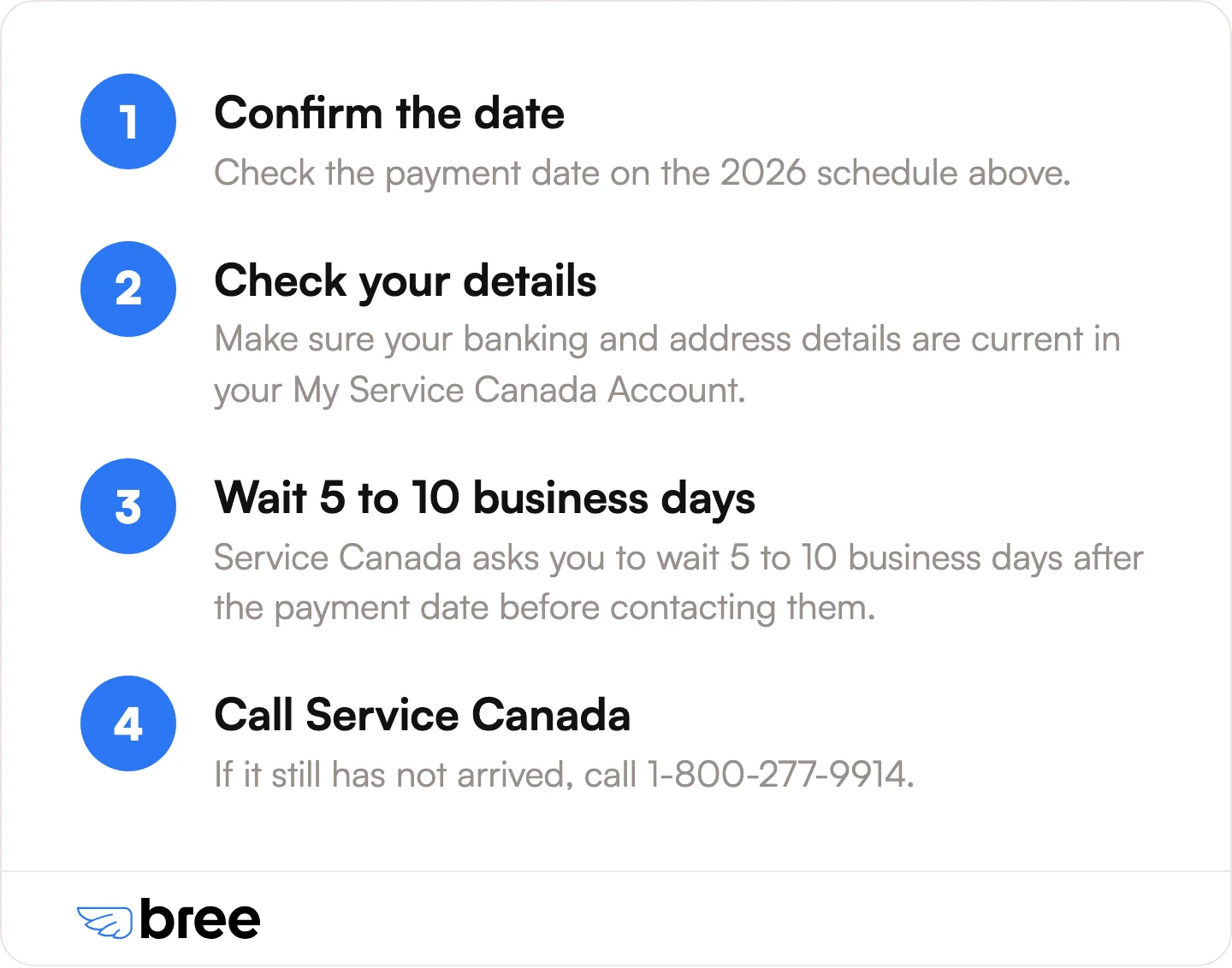
If your CPP payment has not arrived, the most common reason is a normal processing or mail delay. Service Canada asks you to wait 5 to 10 business days after the payment date before contacting them, since deposits and cheques can take a few days to land. First, confirm the date on the schedule above, then check that your banking and address details are current in your My Service Canada Account. If it still has not arrived, call Service Canada at 1-800-277-9914.
A late payment is stressful when rent is due and your account is already low. So is a payment that simply does not cover an unexpected bill. When that happens, a line of credit can bridge the gap without the interest of a payday loan.
We built Bree, a Canadian line of credit, to help with exactly these moments. Bree offers up to $750 in interest-free funds with 0% interest, no credit check, and no mandatory fees. Government benefits like CPP count as qualifying income, so you can be approved on your pension alone, which many lenders will not do. The money is sent by direct deposit to your bank account, and there is only ever an optional tip and an optional express fee if you want it faster. You can see how it works on our page or read the details on our FAQ.
Frequently Asked Questions
How much is the maximum CPP payment in 2026?
The maximum CPP retirement pension at age 65 is $1,507.65 per month as of January 2026. Most people receive less. The average new payment at 65 is $877.01 per month as of April 2026, because the amount depends on how much and how long you contributed.
Do CPP and OAS arrive on the same day?
Yes. CPP, Old Age Security, and the Guaranteed Income Supplement are all paid on the same date each month. For example, the August 2026 payment for all three is August 27, 2026. You can see the full OAS payment schedule for the year.
Are CPP payments going up in 2027?
CPP payments are adjusted every January to keep pace with inflation, measured by the Consumer Price Index. The exact 2027 amount had not been published by Service Canada at the time of writing, so any specific 2027 figure you see quoted is an estimate, not an official number.
Are seniors getting extra money in 2026?
There is no confirmed one-time bonus or extra senior payment for 2026 beyond the regular CPP and OAS amounts. CPP already rises each January with inflation. Be cautious of posts promising a specific "$500" or "$1,350" senior bonus, as these are usually not official.
Can I receive CPP while living outside Canada?
Yes. You can receive CPP while living abroad if you meet the eligibility rules. Payments can be deposited into a Canadian bank account or sent to your address in another country, and direct deposit is available in many countries.
How do I apply for CPP retirement benefits?
You can apply through your My Service Canada Account online or with a paper application. CPP does not start automatically, so apply in advance of the date you want payments to begin. Processing can take several months, so applying well ahead avoids a gap.
Are CPP payments taxable?
Yes. CPP counts as taxable income and must be reported on your tax return. You can ask Service Canada to take federal income tax off your monthly payment so you do not owe a large amount at tax time.
Can I receive the CPP retirement pension and disability benefit at the same time?
No. You cannot receive both at once. If you are on the CPP disability benefit when you turn 65, it automatically converts to a retirement pension.
How does taking CPP early or late change my payment?
Starting before 65 reduces your payment by 0.6% for each month early, up to 36% less at age 60. Starting after 65 increases it by 0.7% for each month you wait, up to 42% more at age 70. The change is permanent.
What happens to CPP when someone dies?
CPP may pay a one-time death benefit to the estate, a monthly survivor's pension to a spouse or common-law partner, and a children's benefit to dependent children. You can read more about CPP survivor benefits and how long they last.
The Bottom Line
Knowing your CPP payment dates for 2026 takes the guesswork out of budgeting on a fixed income. Payments land near the end of each month, the next one is August 27, 2026, and the maximum at 65 is $1,507.65 per month with an average of $877.01. Set your bills to follow those dates and most months will run smoothly.
For the months that do not, we make it simple to cover the gap. Bree is an interest-free line of credit for Canadians who need up to $750 between payments, with 0% interest, no credit check, and government benefits accepted as income. If a late or short CPP payment ever leaves you stuck, you can join Bree and get the money by direct deposit, then repay it on your next payday.
Sources
- Canada.ca: Benefits payment dates
- Canada.ca: Canada Pension Plan retirement pension amounts
- Canada.ca: Deciding when to start your CPP retirement pension
- Canada.ca: CPP contribution rates, maximums and exemptions
- Canada.ca: Second additional CPP contribution rates and maximums
- Canada.ca: CPP disability benefit
- Canada.ca: Who can receive a CPP retirement pension

Join our newsletter to get the latest updates

.png)

