.png)
The fastest e-transfer payday loans in Canada send money to your bank account within minutes to an hour by Interac e-Transfer, after a five-minute online application and no document uploads. They are available 24/7 from online lenders with no traditional credit check, but they are also one of the most expensive ways to borrow: the cost is capped at $14 per every $100 you borrow, which works out to roughly 365% APR on a two-week loan.
That speed is real, and so is the price. We built Bree to give Canadians a cheaper path to emergency cash without the payday-loan price tag, so we spend a lot of time helping people understand exactly what these loans cost before they commit. This guide covers how e-transfer payday loans work, who qualifies, the risks, the provincial rules, and the cheaper options worth checking first.
Key Takeaways
- E-transfer payday loans cost $14 per $100 borrowed in every province with a licensed payday-lending regime, the federal maximum since January 1, 2025. On a typical 14-day term that equals about 365% APR.
- No documents means instant bank verification. Instead of uploading pay stubs, you log into your bank through a secure connection and the lender reviews your recent deposits. Approvals often take minutes.
- Funding is fast but capped. Money usually lands by Interac e-Transfer within 15 minutes to a few hours, and most first loans are limited to $1,500 maximum, repaid within 14 to 62 days.
- "No refusal" and "guaranteed approval" are marketing, not real offers. No licensed Canadian lender can legally promise approval to everyone. Treat that language as a warning sign.
- A line of credit is the cheaper alternative. Bree offers up to $750 at 0% APR in interest-free funds with no credit check and no mandatory fees, funded by direct deposit to your bank account.

What Are E-Transfer Payday Loans?
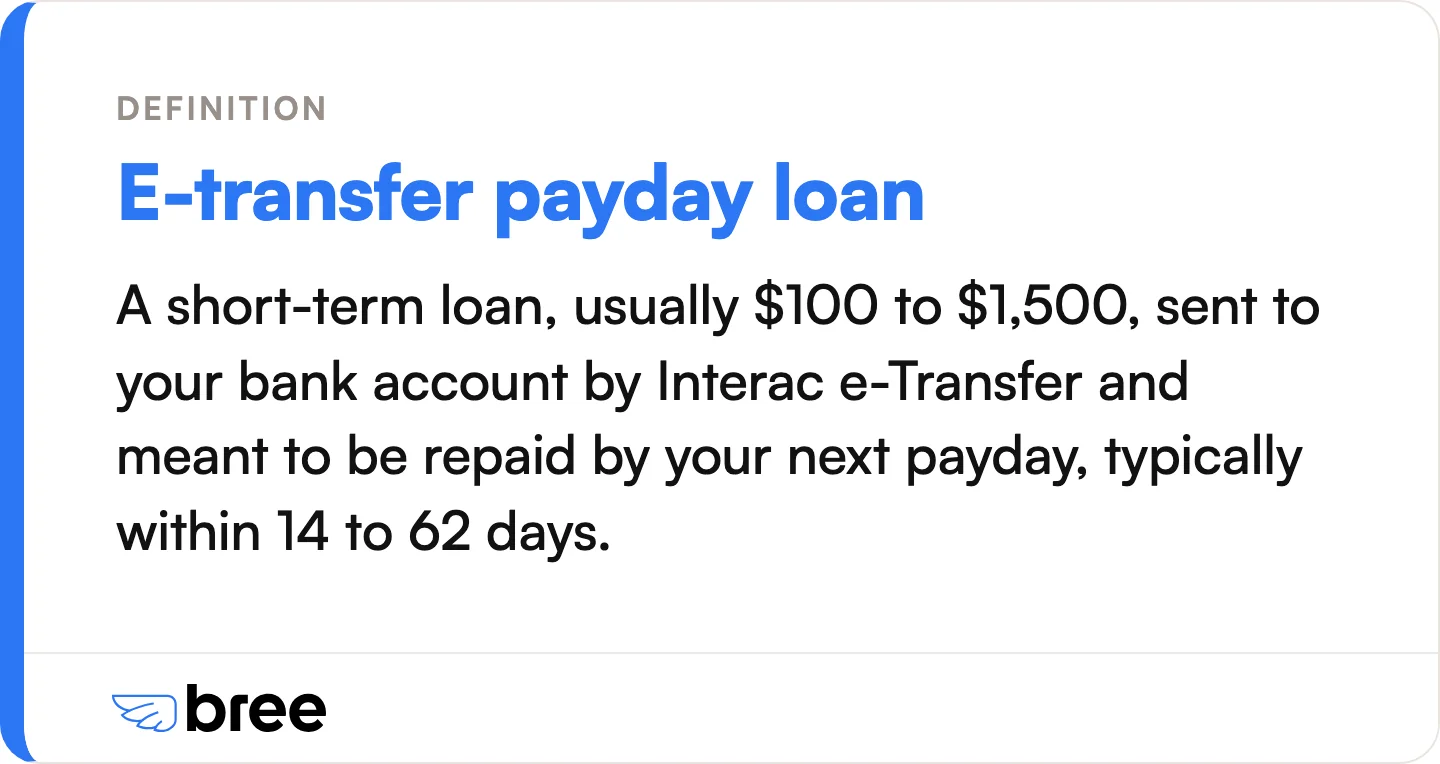
E-transfer payday loans are short-term loans, usually $100 to $1,500, sent to your bank account by Interac e-Transfer and meant to be repaid by your next payday, typically within 14 to 62 days. They are marketed on speed: apply online, get approved in minutes, and receive the money the same day.
The "no documents" part refers to instant bank verification (IBV). Instead of emailing pay stubs or bank statements, you log into your online banking through a secure portal. The lender reads your recent transactions to confirm you have steady income and an active account. Your banking password is never stored, and the connection is read-only.
Interac is the rail, not the lender. Interac e-Transfer is only the delivery method that moves the money into your account. The loan, the fees, and the terms all come from the payday lender, not from Interac or your bank. A fast e-Transfer says nothing about whether the loan itself is a fair deal.
How Much Do E-Transfer Payday Loans Cost in Canada?
E-transfer payday loans cost $14 for every $100 you borrow. This is the maximum a licensed payday lender can charge under federal rules that took effect on January 1, 2025, and it applies across every province with an approved payday-lending regime, according to the Financial Consumer Agency of Canada. On a standard 14-day loan, that fee is the same as an annual interest rate of roughly 365%.
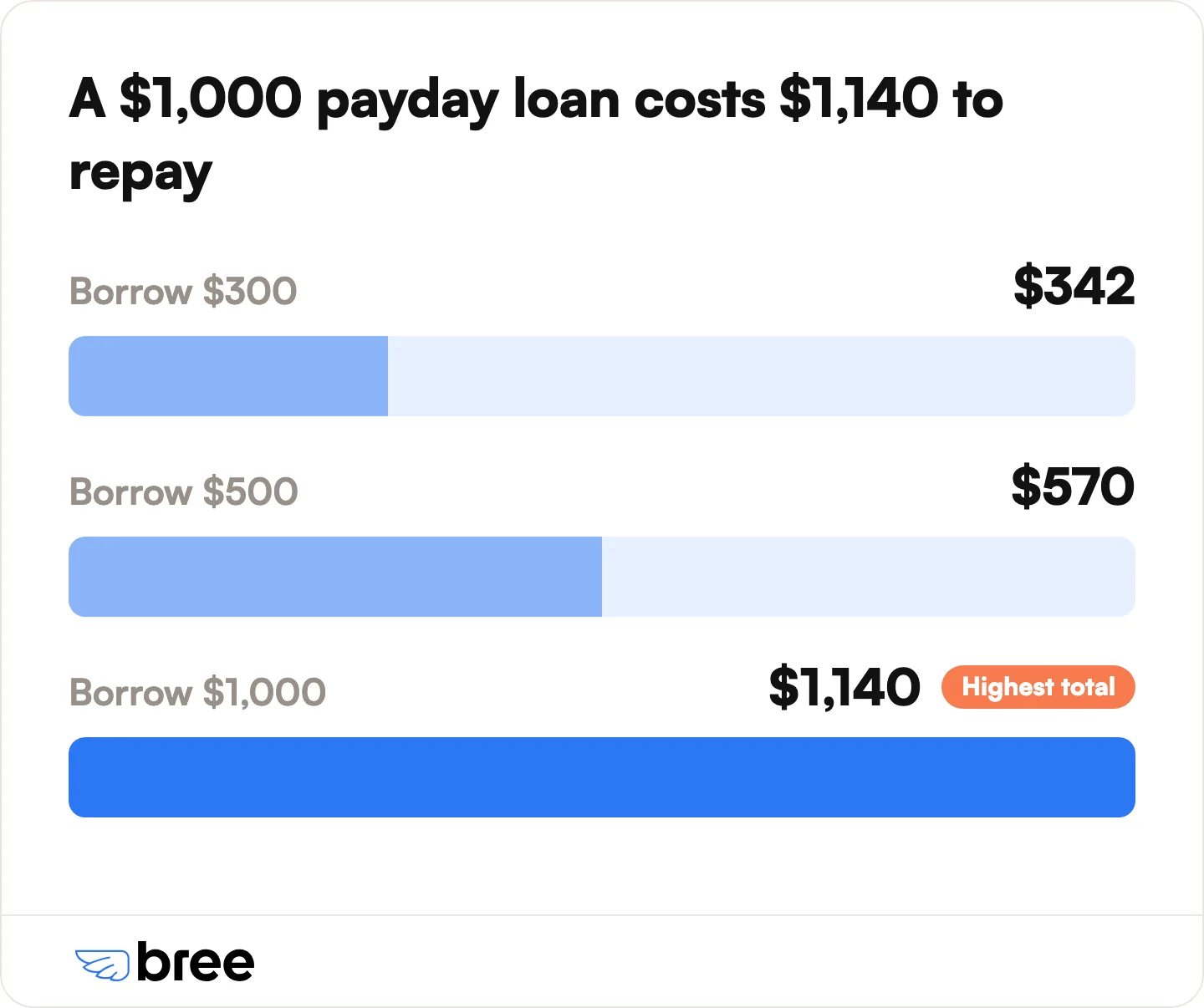
Here is what the maximum cost looks like on common loan amounts:
- $300 loan: $42 in fees, $342 total repayment
- $500 loan: $70 in fees, $570 total repayment
- $1,000 loan: $140 in fees, $1,140 total repayment
Two extra costs can push the total higher:
- Dishonoured payment fee: If your pre-authorized repayment bounces, the lender may charge a one-time fee of up to $20.
- Bank NSF fee: Your own bank may add a non-sufficient-funds fee. At federally regulated banks this is now capped at $10 since March 12, 2026, down from the $45 to $48 that was typical before, per the Department of Finance Canada. Provincial credit unions are not covered by that cap.
Payday loans are expensive by design. Canada lowered its criminal interest rate from an effective 48% to 35% APR on January 1, 2025, but licensed payday loans stay exempt from that ceiling as long as they charge no more than $14 per $100 and follow provincial rules, as MoneySense reported when the change took effect.
How Do 24/7 E-Transfer Payday Loans Work?
The fastest e-transfer payday loans work through an online application that takes minutes and replaces paperwork with an instant bank check. Here is the process from start to funded:
- Choose a licensed lender. Confirm the lender holds a valid licence with your provincial consumer-protection office. Licensed lenders must display their licence number.
- Complete the online application. You provide your name, address, contact details, income information, and banking details. This step usually takes 5 to 10 minutes.
- Verify your income with instant bank verification. Instead of uploading documents, you connect your bank through a provider like Flinks or Inverite. The lender reviews your recent income deposits, account balance, and payment patterns to judge whether you can repay. The access is read-only and your login is not stored.
- Receive a decision. Many lenders approve automatically in minutes. First-time borrowers or applications that need manual review can take a few hours, even at a 24/7 lender.
- Get your funds. Once you sign the agreement electronically, money arrives by Interac e-Transfer, usually within 15 minutes to a couple of hours. Some lenders fund any time of day or night; others accept applications 24/7 but only send transfers during business hours, so a weekend request may not land until Monday.
Who Qualifies for No-Document Payday Loans?
Most e-transfer payday loans have low eligibility bars compared to a bank loan. Typical requirements are:
- Age: 18 or older, or the age of majority in your province.
- Residency: Canadian citizen or permanent resident.
- Income: Regular deposits, often a minimum of $800 to $1,200 per month from work, self-employment, or benefits.
- Bank account: An active Canadian chequing account with online access.
- Contact details: A valid email address and phone number.
These loans do not require a good credit score. Many lenders run only a soft credit check for identity, and some skip credit checks entirely, which is why they reach Canadians with bruised or thin credit who would not qualify for a personal loan.
Government benefits usually count as income. Regular deposits from Employment Insurance, the Canada Pension Plan, Old Age Security, or the Canada Child Benefit are generally accepted, and we cover the benefit angle in detail for Ontario Works recipients, for people on social assistance, and for ODSP recipients specifically. If your income comes from a benefit, an option that accepts it without a credit check matters more than raw speed.
Cash Advance Apps vs. E-Transfer Payday Loans
Cash advance apps are the cheaper answer to the same problem an e-transfer payday loan solves: quick money before payday, without a credit check. The core difference is price. A payday lender charges $14 per $100. A cash advance app like Bree charges 0% interest and no mandatory fees, so you repay only what you borrowed.
The trade-off is the limit: payday lenders will advance up to $1,500, while a cash advance app caps lower. For most between-paycheque gaps, a smaller interest-free advance beats a larger one that costs $14 per $100. If you need more than an app offers, it is still worth borrowing the smallest payday amount that covers the gap rather than the maximum on offer.
Are "No Refusal" or "Guaranteed Approval" Loans Real?
No. No licensed lender in Canada can legally guarantee approval for everyone, and "no refusal payday loans" is a marketing phrase, not a real product. Every legitimate lender has to assess whether you can repay, which is why they run instant bank verification in the first place.
When you see "guaranteed approval," "everyone approved," or "no refusal," treat it as a warning sign rather than a feature. Lenders that lean on that language are often unlicensed, charge above the legal maximum, or bury fees you only discover after you sign. The honest version of "easy to get" is a lender or app that does not require a credit check and accepts more income types, not one that pretends risk does not exist. For a full breakdown of what to use instead, see our guide to safer alternatives to no-refusal payday loans.
What Are the Risks of E-Transfer Payday Loans?
E-transfer payday loans carry real financial risk, mostly because the cost is high and the repayment window is short. The main dangers are:
High effective interest. At $14 per $100 for a 14-day term, the effective annual rate reaches about 365%. Borrowing $500 costs $70 in fees, money that could have gone to groceries or a bill.
Stacked fees when a payment fails. A bounced repayment can trigger a dishonoured-payment fee of up to $20 from the lender plus an NSF fee from your bank. The bank fee is capped at $10 at federally regulated banks since March 12, 2026, but a missed payment still adds cost on top of a loan that was already expensive.
The repeat-borrowing trap. Because the term is short and the cost is high, many borrowers cannot repay in full and still cover the next two weeks, so they borrow again. Borrow $500, pay $70 in fees, then come up short and re-borrow $500, and you have paid $140 in fees on the same $500. Debt-help organizations like the Credit Counselling Society describe this cycle as the single biggest harm from payday lending.
Lower financial wellbeing over time. Research from the Financial Consumer Agency of Canada found that payday-loan use is linked to lower financial wellbeing: 88% of payday-loan users report having no emergency savings, compared to 50% of non-users. The convenience of instant cash can hide a budget gap that a one-time loan will not fix.
Cheaper Alternatives to Payday Loans
Before you take an e-transfer payday loan, it is worth checking options that cost far less. Ranked roughly from cheapest to most expensive:
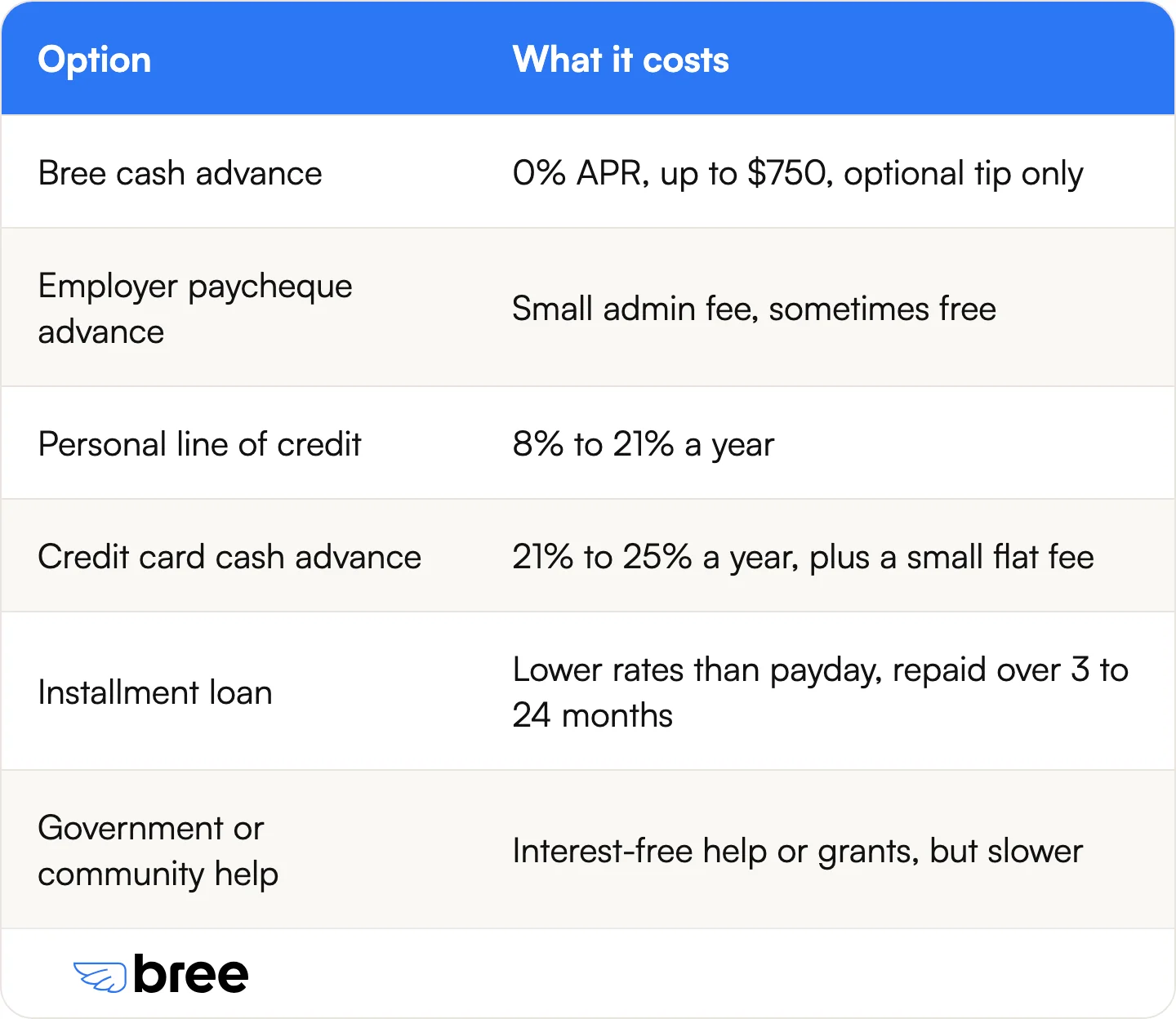
Interest-free cash advance. Bree offers up to $750 at 0% APR through its line of credit with no credit check and no mandatory fees. Instead of a forced $14-per-$100 charge, we make money from optional tips, so you repay exactly what you borrowed within up to 90 days. Funds arrive by direct deposit to your bank account: standard delivery is free and takes 1 to 3 business days, and optional Express delivery lands within minutes for a fee. You need consistent monthly deposits of at least $1,200, including government benefits, and an active bank account. You can see the full terms on our page or read real customer reviews first.
Employer paycheque advance. Many employers will advance earned wages for a small administrative fee, sometimes free. This lets you reach money you have already earned without any loan.
Personal line of credit. With decent credit, a line of credit from your bank typically charges 8% to 21% annual interest, a fraction of a payday loan's rate, and you pay interest only on what you use.
Credit card cash advance. More expensive than a line of credit but far cheaper than a payday loan, credit card cash advances usually run 21% to 25% annual interest plus a small flat fee. Skip this one if your card is already near its limit.
Installment loan. Online installment loans of $500 to $5,000 spread repayment over 3 to 24 months at lower rates than payday products, which makes the monthly payment easier to manage.
Government and community assistance. Provincial emergency-assistance programs, utility payment plans, and community organizations sometimes offer interest-free help or grants for specific needs. These take longer but cost nothing.
Payday Loan Rules by Province
Payday lending is regulated province by province, though the federal $14-per-$100 maximum now applies everywhere licensed payday loans are allowed. The key provincial rules:
Ontario. The maximum cost is $14 per $100 borrowed. Borrowers get a two-business-day cooling-off period to cancel without penalty, extended payment plans after three loans in 63 days, and protection from rollover loans, per the Government of Ontario. Licensed lenders must display their licence number.
British Columbia. The cost cap is $14 per $100, and a single loan cannot exceed 50% of your net pay. The maximum amount is $1,500, the maximum term is 62 days, and lenders cannot roll over a loan or issue you more than one at a time, according to Consumer Protection BC.
Nova Scotia. Nova Scotia lowered its cap in stages, from $19 per $100 down to $17, then $15, and finally to $14 by January 1, 2025. The Province of Nova Scotia also caps the default fee at $20 and requires full disclosure of all fees and terms.
Quebec and the territories. Quebec effectively caps consumer lending at 35% APR, which leaves no room for a payday-loan market, so licensed e-transfer payday lenders do not operate there. Yukon, the Northwest Territories, and Nunavut have no dedicated payday regime, so lenders there must stay under the federal 35% criminal-interest ceiling. We cover the Quebec situation in more detail separately.
How to Borrow Responsibly With Payday Loans
If an e-transfer payday loan is still your best option, a few habits limit the damage:
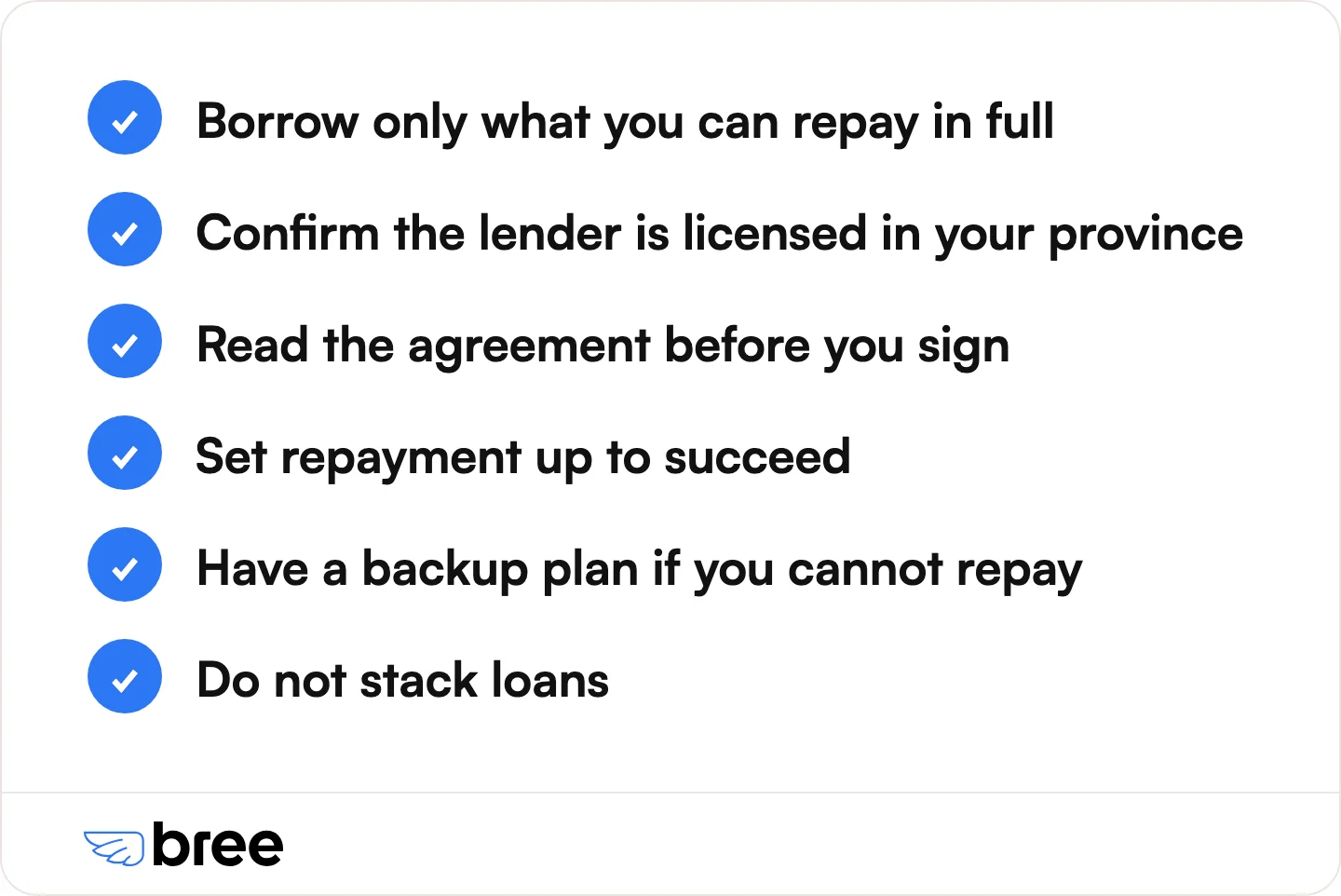
Borrow only what you can repay in full. Check that your next paycheque will cover the loan plus the fee and still leave you enough to live on. If it will not, the loan will likely turn into two.
Confirm the lender is licensed. Check your provincial consumer-protection website for the lender's licence. Unlicensed lenders may charge above the legal cap, use aggressive collection tactics, or offer no consumer protection at all.
Read the agreement before you sign. Confirm the total you are borrowing, every fee the lender charges (borrowing cost, any express-funding fee, any subscription), the repayment date and method, and the penalty for a missed payment.
Set repayment up to succeed. Most lenders pull repayment by pre-authorized debit. Make sure the money is there on the date, because a bounced payment triggers a dishonoured-payment fee of up to $20 and a bank NSF fee of up to $10 at a federally regulated bank.
Have a backup plan. If you cannot repay on time, contact the lender right away. Some offer payment extensions or hardship arrangements, which beat a default that lands in collections.
Do not stack loans. Taking a new payday loan to pay off an old one is how the debt cycle starts, and most provinces prohibit holding more than one payday loan at a time.
Also read: EI Payday Loans in Canada
Frequently Asked Questions
Can I get an e-transfer payday loan with no credit check?
Yes. Most e-transfer payday loans skip the traditional hard credit check. Lenders either run a soft check for identity, which does not affect your score, or no credit check at all. Approval instead depends on income verification through instant bank verification, which confirms steady deposits into an active account. A line of credit without a credit check works the same way.
How fast can I get money with 24/7 e-transfer payday loans?
With instant approval and automated funding, money can arrive by Interac e-Transfer within 15 minutes to two hours if you apply during business hours. True 24/7 systems can fund any time, including nights and weekends. Many lenders advertise 24/7 applications but only send transfers during business hours, so a weekend request may not land until the next business day.
What is the easiest e-transfer loan to get in Canada?
The easiest options to qualify for are the ones that skip the credit check and accept the widest range of income, including government benefits. That describes both no-credit-check payday lenders and cash advance apps. "Easiest" should not mean "guaranteed," though. Any lender promising approval to everyone is a warning sign, not a genuinely accessible option.
What happens if I can't repay my payday loan on time?
A missed payment stacks costs quickly. Your bank charges an NSF fee, capped at $10 at federally regulated banks since March 12, 2026, and the lender charges a dishonoured-payment fee of up to $20. The lender may contact you repeatedly, and if the debt stays unpaid it can go to collections, damage your credit, and lead to legal action.
Are payday loans legal in Canada?
Yes. Payday loans are legal and regulated by provincial governments. Since January 1, 2025, federal rules cap the cost at $14 per $100 borrowed and limit the dishonoured-payment fee to $20. The details vary by province, so always confirm your lender holds a valid provincial licence before you borrow.
Can I get a payday loan with government benefits as income?
Yes. Most online payday lenders accept government benefits as qualifying income, including Employment Insurance, the Canada Pension Plan, Old Age Security, disability benefits, and the Canada Child Benefit. You will need to show consistent deposits through instant bank verification, usually at least $800 to $1,200 per month.
What's better, a payday loan or a cash advance app?
For most borrowers, a cash advance app is the better deal. Bree's line of credit costs 0% interest with an optional tip instead of a mandatory $14-per-$100 fee, and there is no credit check. A payday loan only makes sense when you need more than an app's limit, since payday lenders advance up to $1,500 against Bree's $750, and you can repay the full balance plus the fee on your own schedule.
Conclusion
The fastest e-transfer payday loans in Canada deliver on speed, funding your account by Interac e-Transfer within minutes to an hour after a no-document online application. They deliver on cost too: at $14 per $100 borrowed, or about 365% APR, they are among the most expensive ways for a Canadian to borrow, and the short repayment window is what pulls people into repeat borrowing.
Before you take one, check the cheaper options first. As a Canadian line of credit app serving more than 600,000 people, we built Bree to bridge the gap between paycheques without the payday-loan price tag: up to $750 at 0% APR, no credit check, no mandatory fees, and direct deposit to your bank account. If a payday loan is on your shortlist, it is worth seeing whether an interest-free line of credit covers the gap instead. You can get started with Bree in a few minutes.
Sources
- Financial Consumer Agency of Canada: Payday loans
- Financial Consumer Agency of Canada: Understanding payday loan use in Canada
- Department of Finance Canada: New $10 cap on NSF fees
- MoneySense: Canada's new rules for high-interest payday loans
- Justice Laws Canada: Criminal Interest Rate Regulations
- Government of Ontario: Payday loans, your rights
- Consumer Protection BC: Payday loans
- Province of Nova Scotia: Payday loans, your rights
- Credit Counselling Society: How to escape the payday loan nightmare

Join our newsletter to get the latest updates
.png)