If rent is eating more of your paycheque than you can handle, you are not out of options. Canada has rental assistance programs in every province and territory that put money toward your rent each month, plus emergency help if you are already behind. The catch is that there is no single national program you can apply to. Help is run province by province, and you have to know where to look.
This guide maps every program, who qualifies, how much it pays, and how to apply, current for 2026. We put it together at Bree, an interest-free line of credit of up to $750 that Canadians use to cover rent between paycheques or benefit payments, including the many people on government benefits that most lenders turn down. All dollar figures here are in Canadian dollars.
Key Takeaways
- There is no single Canada-wide rental assistance program. The federal government funds rental help through the Canada Housing Benefit, but every province and territory runs its own version. There is no national form to fill out.
- The "$500 rental assistance" is closed. That was a one-time payment in 2022 and 2023. It ended on March 31, 2023, and any "Rent Relief" offer promising a new $500 today is a scam.
- Most programs tie help to your rent-to-income ratio. You usually need to be spending roughly 30% to 45% of your income on rent, fall under an income and asset limit, and live in private (unsubsidised) housing.
- Amounts vary a lot by province. They range from Quebec's shelter allowance of up to $170 a month to Saskatchewan's $210 to $390 a month to British Columbia's separate subsidies for families and seniors.
- These programs are slow and often waitlisted. If rent is already late, a local rent bank (dial 2-1-1) is usually the fastest route. Apply before you fall behind, not after.

Is There a Federal Rental Assistance Program in Canada?
No. There is no single federal rental assistance program and no national application form. The federal government funds rental help, but each province and territory decides who gets it and pays it out under its own name.
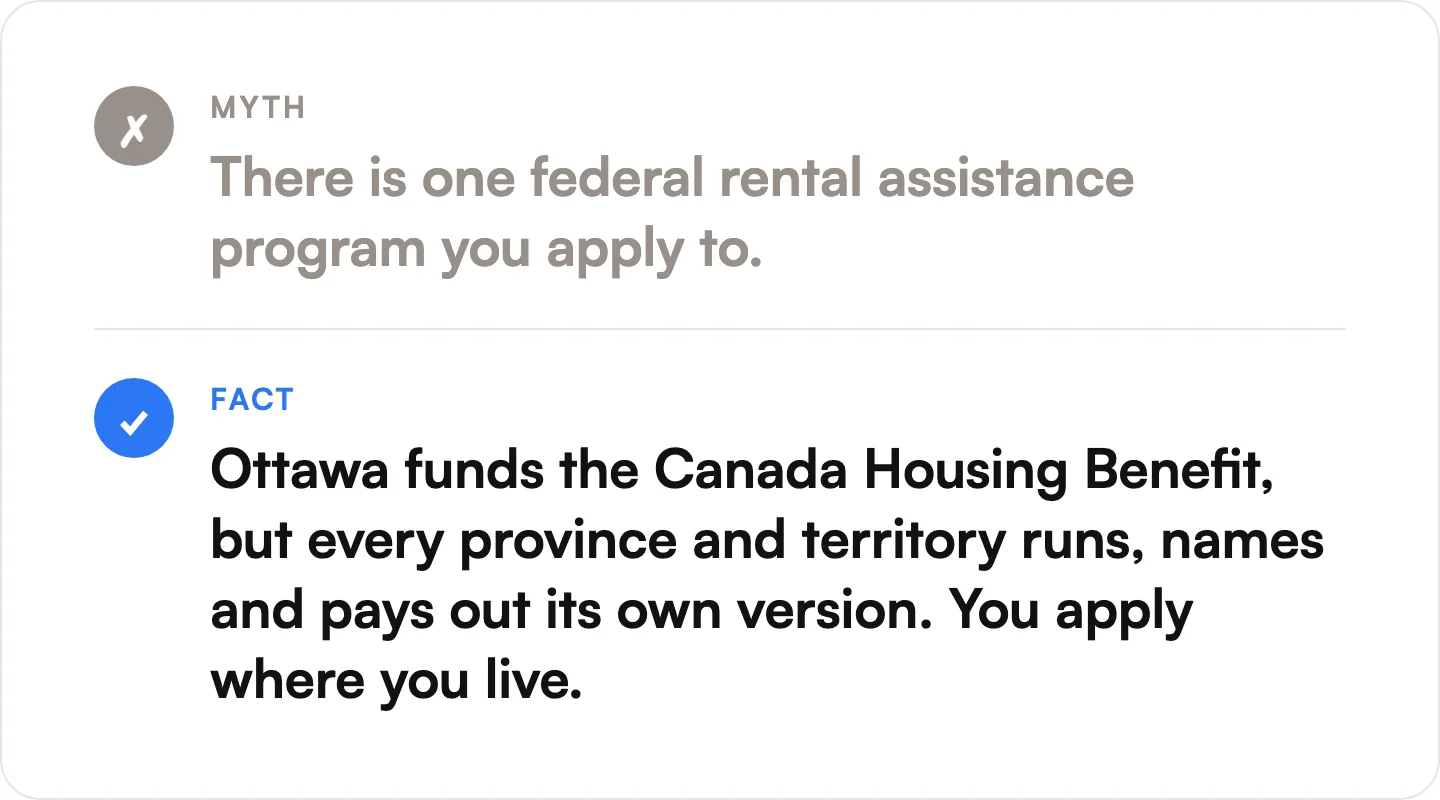
The main federal piece is the Canada Housing Benefit. It was created under the National Housing Strategy, and the Canada Mortgage and Housing Corporation (CMHC) cost-matches it with the provinces and territories through bilateral agreements. Every province and territory then delivers its own version, which is why the same federal money shows up as the Canada-Ontario Housing Benefit in Ontario, Rent Assist in Manitoba, and the Rental Assistance Program in British Columbia.
What this means for you is simple. You do not apply to Ottawa. You apply to the program in the province or territory where you live, using the sections below. A renter in Calgary and a renter in Halifax are looking at two completely different applications, two different income limits, and two different payment amounts.
What Happened to the $500 Rental Assistance Payment?
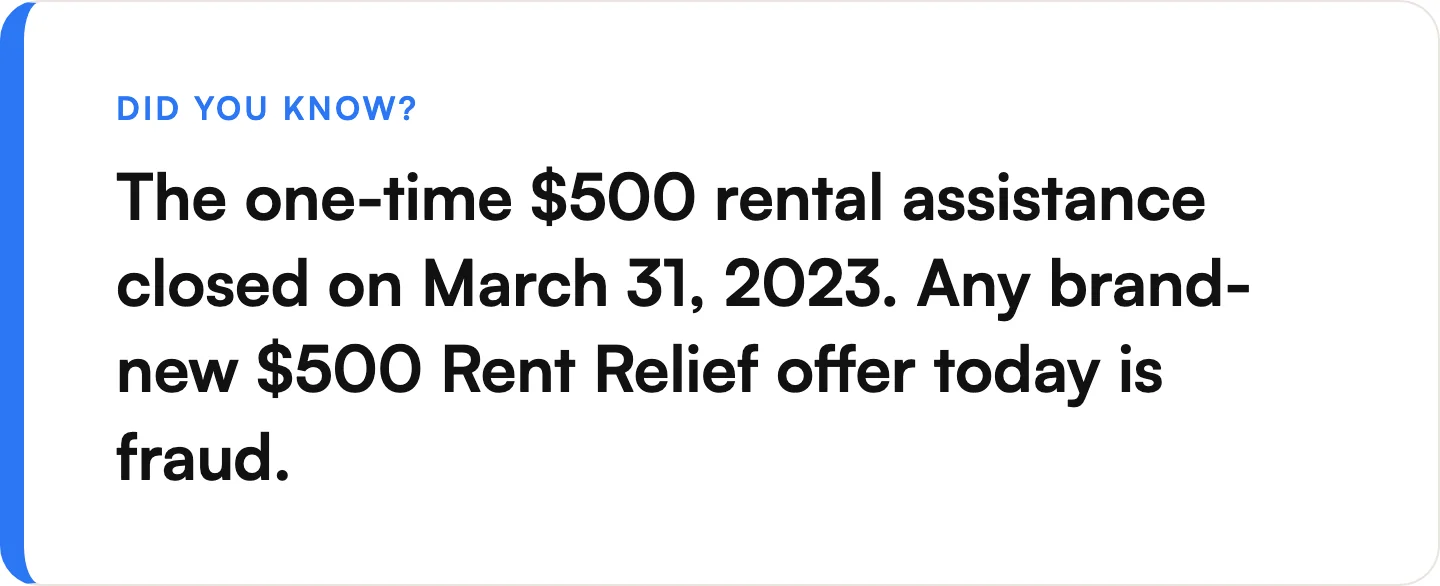
The $500 rental assistance payment is closed and is no longer available. It was a one-time, tax-free payment of $500 to help low-income renters, and applications were only open from December 12, 2022 to March 31, 2023, according to the Government of Canada. You can no longer apply for it.
To qualify back then, you had to be a renter who paid at least 30% of your income on rent, with an adjusted net income under $35,000 for families or $20,000 for individuals. That program is finished. You cannot apply for it now.
This matters because the "$500" number still circulates online. If you see a post, text, or email offering a brand-new $500 "Rent Relief" payment, treat it as fraud. There is no such payment in 2026, and the Canada Revenue Agency does not ask for your banking details by text to release rent money. Real rental help today comes from the provincial programs below, not a surprise $500 cheque.
Rental Assistance Programs by Province (2026)
Each province and territory runs its own rental assistance, with its own name, income limits, and payment amounts. Find your province in the comparison for the quick view, then read its full details.
British Columbia
British Columbia runs two separate monthly subsidies through BC Housing, one for families and one for seniors. Both pay cash by direct deposit and must be renewed each year.
The Rental Assistance Program (RAP) is for low-income working families with at least one dependent child. You qualify if your household has a total before-tax income of $60,000 or less, less than $100,000 in assets, has lived in B.C. for 12 months, and pays more than 30% of income on rent, according to BC Housing. Payments are made by direct deposit, and for 2025 the program used rent ceilings of $1,950 for households of up to three people and $2,200 for four or more.
SAFER (Shelter Aid for Elderly Renters) is the seniors' version. You qualify if you are age 60 or older, have lived in B.C. for 12 months, and have a gross monthly income under $3,333.34 (about $40,000 a year), again paying more than 30% of income on rent, per BC Housing's SAFER page. The subsidy pays at least $50 a month, with a rent ceiling of $1,150 as of April 2025.
If you are behind on rent right now, the BC Rent Bank offers interest-free loans toward rent, utilities, or a damage deposit. If you are approved, the funds are provided and a repayment plan is set, as described on bcrentbank.ca.
Alberta
Alberta offers two rent subsidies for low-income and working households, both paid directly to the tenant and renewed yearly. There is no single published dollar amount, because the subsidy is set case by case.
The Rent Assistance Benefit is the long-term option for low-income Albertans. The Temporary Rent Assistance Benefit (TRAB) is the short-term one, aimed at working households with low income or people between jobs. To get TRAB you must be employed or have been employed in the last 24 months and not be receiving Income Support, AISH, or Old Age Security, according to the Government of Alberta.
TRAB is available in participating cities including Calgary, Edmonton, Fort McMurray, Grande Prairie, Lethbridge, Medicine Hat, and Red Deer, plus some surrounding areas. You apply through a local housing provider. If you are not sure where to start, call Alberta Supports at 1-877-644-9992.
Ontario
Ontario's main rent subsidy is the Canada-Ontario Housing Benefit (COHB), a monthly payment made directly to the household. It is portable, which means it moves with you anywhere in Ontario, according to the Government of Ontario.
COHB is for households that are on, or eligible to be on, a social housing waitlist and are in financial need. Priority goes to survivors of domestic violence and human trafficking, people experiencing or at risk of homelessness, Indigenous people, seniors, and people with disabilities. The amount is based on your income compared with the average market rent in your area. You apply through your local Service Manager, and the Ontario Ministry of Finance decides eligibility.
If you are on social assistance, the Ontario Works and ODSP shelter allowance already helps with rent. The maximum monthly shelter amount under Ontario Works runs from $390 for one person to $844 for a household of six or more, per the province's Ontario Works shelter directive.
For a rent emergency, the Ontario Rent Bank provides a one-time grant, not a loan, for renters facing eviction. Start by dialling 2-1-1, which connects you to the right local program.
Quebec
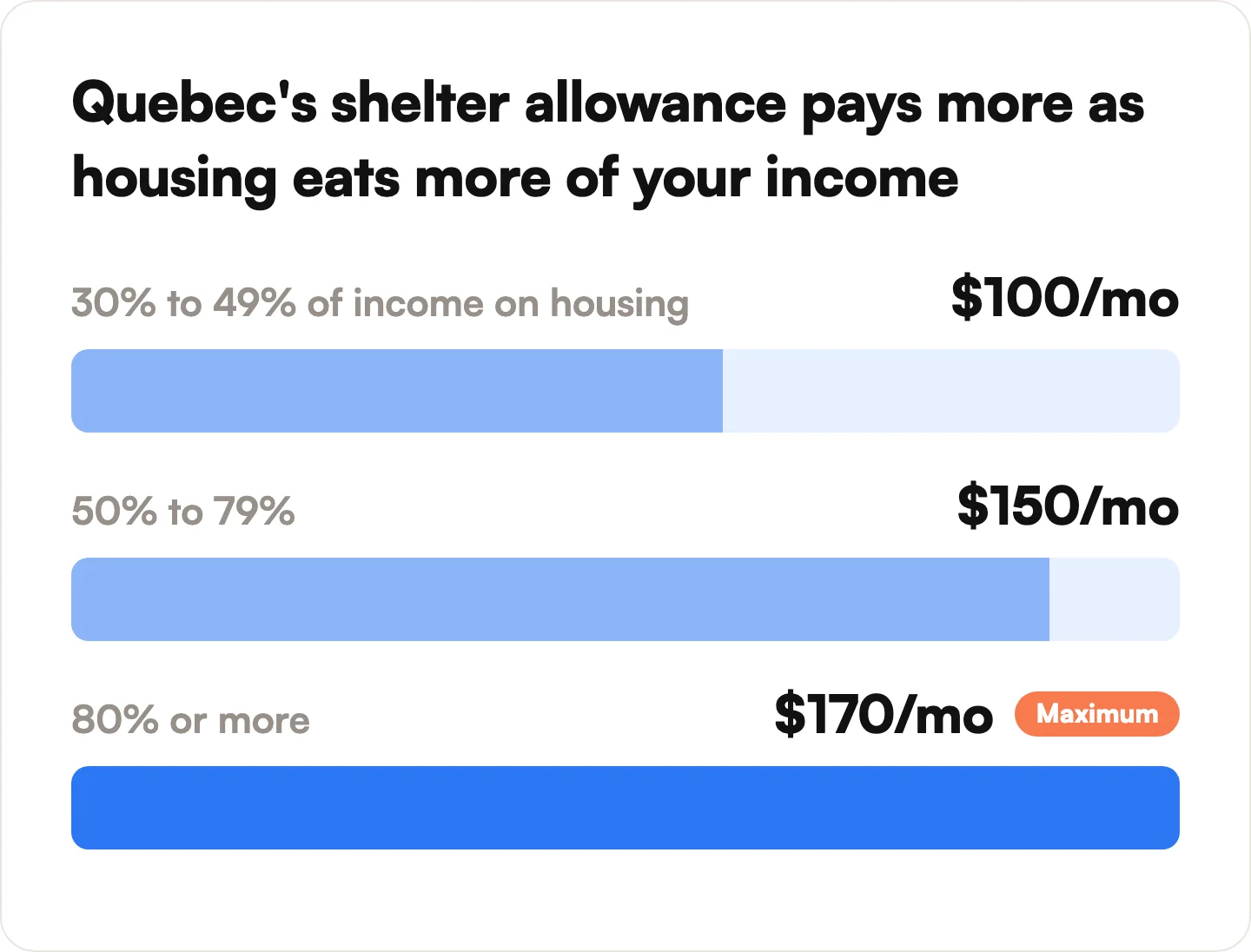
Quebec runs the Shelter Allowance Program (Allocation-logement), a monthly payment of up to $170 for low-income families and older renters. For the period from October 1, 2026 to September 30, 2027, the amount depends on how much of your income goes to housing, according to Revenu Québec.
If you spend 80% or more of your income on housing, you receive $2,040 for the year ($170 a month). Spending 50% to 79% pays $1,800 ($150 a month), and 30% to 49% pays $1,200 ($100 a month).
To qualify you must live in Quebec, have at least one dependent child or be 50 or older by September 30, 2027, have spent at least 30% of your 2025 family income on housing, and have $50,000 or less in savings and investments. You apply online through My Account for individuals.
Manitoba
Manitoba's Rent Assist helps low-income renters in the private market cover their housing costs. It can be paid alongside Employment and Income Assistance (EIA), or on its own to other low-income renters.
The income limits depend on household size. A single person qualifies with income under $29,120, rising to under $60,768 for a household of five or more, according to the Province of Manitoba. You must be a Canadian citizen or permanent resident and rent in unsubsidised housing. You cannot apply if you rent from Manitoba Housing, already receive another housing subsidy, or live in a care facility or student housing.
One note for Manitoba renters: the Canada-Manitoba Housing Benefit stream has paused taking new applications, but the provincial Rent Assist program continues.
Saskatchewan
Saskatchewan runs the Saskatchewan Housing Benefit, a monthly payment of $210 to $390 for renters who spend a large share of income on housing. The exact amount depends on your household type and how much of your income goes to shelter, effective July 1, 2026, per the Government of Saskatchewan.
To qualify you must spend 35% or more of your annual before-tax household income on shelter costs, have less than $300,000 in household assets, and fall under the income limits of $43,100 for a single person or couple, $52,900 with one dependant, and $63,800 with two or more. You cannot qualify if you already receive other provincial shelter support, live in social housing, or are a full-time post-secondary student.
Saskatchewan's older Rental Housing Supplement closed back in 2018, so if you are searching for that by name, the Housing Benefit above is its replacement.
Nova Scotia
Nova Scotia offers the Canada-Nova Scotia Targeted Housing Benefit, a monthly rent supplement for renters whose housing costs are high relative to their income. You qualify if you spend more than 40% of your pre-tax household income on the average market rent in your area, are a Nova Scotia resident, and fall under the income limit, according to the Government of Nova Scotia.
One thing worth knowing: you can apply before you have signed a lease, with roughly 90 days to find a place once approved. The provincial housing line is 1-833-424-7711.
New Brunswick, Newfoundland and Labrador, and Prince Edward Island
The Atlantic provinces each deliver rental help through their own housing offices, so the right move is to contact the province directly.
New Brunswick runs a Rent Supplement Program where your rent is set at about 30% of your adjusted household income, plus a rent bank that offers a one-time grant for a short-term crisis such as a looming eviction. Start with Housing NB.
Newfoundland and Labrador delivers a Rental Housing Program, where rent is set as a share of your household income, along with a portable Canada-Newfoundland and Labrador Housing Benefit applied for through that program. Contact Newfoundland and Labrador Housing for the current rate and income limits.
Prince Edward Island does not publish a clear-cut, standalone rental assistance program on an official page as of late 2026, though it does deliver Canada Housing Benefit funding. If you live in P.E.I., contact the provincial housing office directly to ask what is currently open.
The Territories
Yukon, the Northwest Territories, and Nunavut each deliver the Canada Housing Benefit through their own housing corporations. Amounts and rules differ from the provinces and change with local housing conditions. Contact your territorial housing authority to find out what is available and how to apply.
Who Qualifies for Rental Assistance?
Eligibility is set program by program, but four tests show up again and again across the country. If you meet most of them, it is worth applying.
- Your rent-to-income ratio. Most programs want to see that rent is a heavy burden, usually more than 30% of your income, sometimes 35%, 40%, or 45%. The higher your rent relative to income, the more likely you qualify.
- Income and asset limits. Each program caps the income you can earn and, often, the savings and assets you can hold. B.C.'s family program caps assets at $100,000, Saskatchewan at $300,000, and Quebec at $50,000 in savings.
- Residency and status. You generally need to live in the province and be a Canadian citizen or permanent resident, though some programs also accept protected persons and newcomers.
- Private, unsubsidised housing. Most subsidies are for renters in the regular private market. If you already live in social housing or rent-geared-to-income housing, you usually cannot stack a second subsidy on top.
A few common questions clear up fast. Can you get rental assistance if you work? Yes. Several programs, like Alberta's TRAB and B.C.'s family program, are built specifically for working households. Can a single person qualify? Yes, programs such as Manitoba's Rent Assist have single-person income limits. Is there help for seniors? Yes, B.C.'s SAFER and similar provincial programs target renters 60 and up. What if you are on disability or benefits? Benefits generally count as income for these programs, and provincial social assistance already includes a shelter allowance.
How to Apply for Rental Assistance
You apply to your province's program, not to the federal government. The steps are similar across the country, even though the forms differ.
- Find your province's program. Use the province comparison in this guide, or go straight to your provincial housing body: BC Housing, Alberta Supports, your Ontario Service Manager, Revenu Québec, and so on.
- Check the eligibility rules. Confirm the income limit, the rent-to-income ratio, and any residency or housing requirements before you start, so you are not wasting time on a program you cannot get.
- Gather your documents. You will typically need proof of income (most often your most recent tax return or Notice of Assessment, plus pay stubs or benefit statements), valid ID, and your current lease or rental agreement showing what you pay.
- Submit the application. Many provinces now take applications online. Quebec, for example, lets you apply through My Account for individuals. Others ask you to apply through a local housing office or Service Manager.
- Get on the waitlist early. Subsidised housing and rent-geared-to-income programs often have long waitlists, and even cash subsidies can take weeks to months to process. Apply as soon as you think you might qualify, not when you are already in crisis.
What to Do If You're Already Behind on Rent
If rent is already late or an eviction notice is on the table, the ongoing programs above are too slow to save you this month. You need emergency help, and it exists.
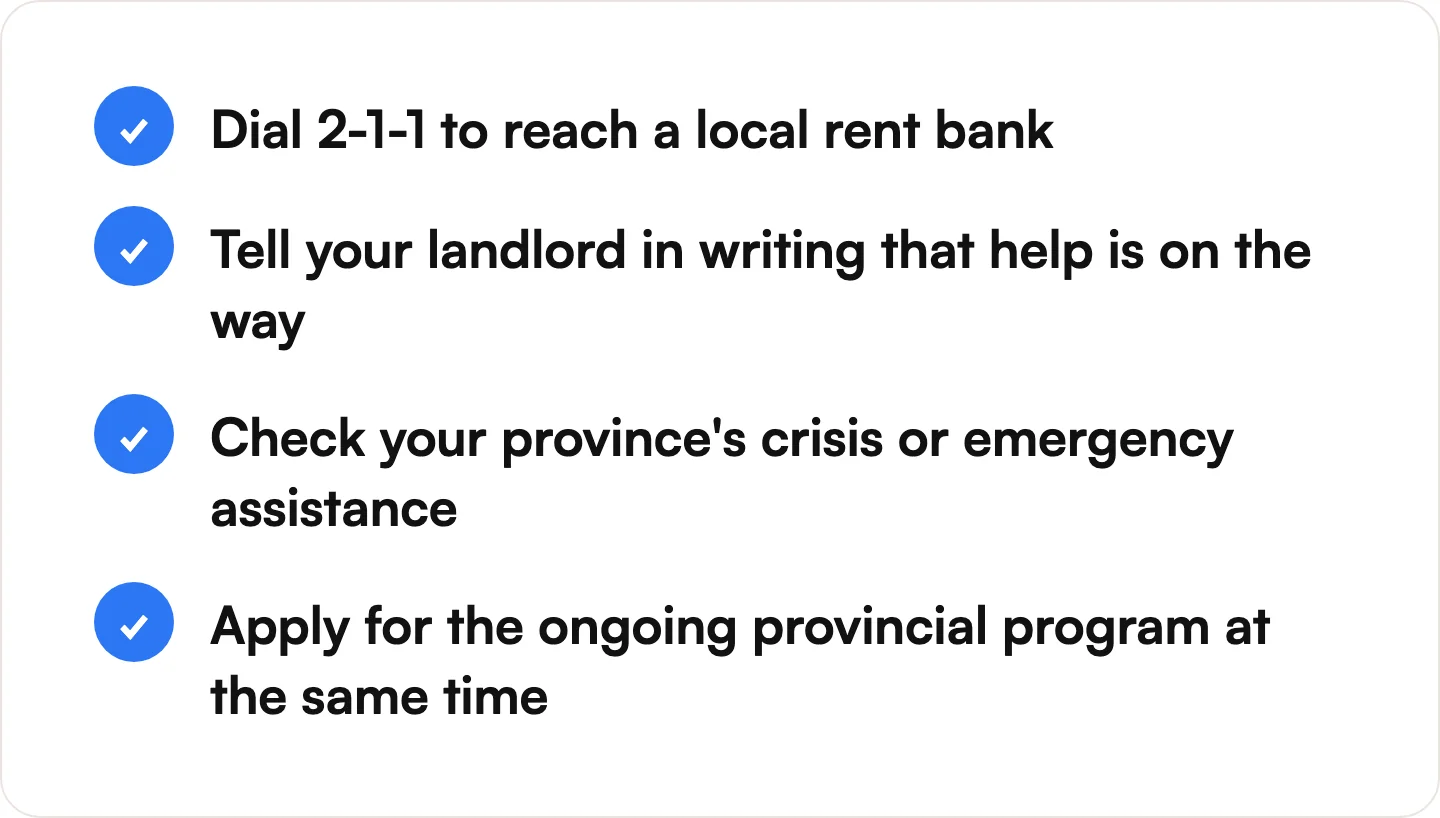
Dial 2-1-1. This free, confidential line connects you to local emergency programs, including rent banks. A rent bank offers an emergency loan or a one-time grant that goes straight toward your rent, usually within days to about two weeks. In Ontario, the Ontario Rent Bank gives a one-time grant you do not repay. In British Columbia, the BC Rent Bank offers an interest-free loan with a repayment plan.
Tell your landlord, in writing, that help is on the way. Many landlords will hold off on an eviction filing if they know a rent bank payment or benefit is coming. A short email creates a record and buys goodwill.
Check your province's crisis or emergency assistance. Provincial social assistance programs often have an emergency stream for a sudden shortfall. If you are in Ontario, look into Ontario Works emergency assistance for an immediate crisis.
Apply for the ongoing program at the same time. Emergency help covers this month. The provincial subsidy covers the months after. Start both now, because these programs move slowly and the waitlist clock only starts once you apply.
If You're Waiting on a Program, or Between Benefit Payments
Most rental assistance is a monthly subsidy or a waitlisted program, and even an emergency rent bank can take a week or two to pay out. If you live on a fixed income, that gap between your payment date and your rent due date is painfully predictable.
This is where Bree fits in. Bree is an interest-free line of credit of up to $750, built for Canadians who need to cover a bill before the next deposit lands. There is no credit check, no interest, and no late fees, and it accepts government benefits as income, including ODSP, Ontario Works, CPP, CCB, and EI, which most lenders reject. You request funds, they arrive by direct deposit to your bank account, and you repay on your own schedule. It is free to use, and Bree makes money from optional tips. It is not a replacement for rental assistance, it is a bridge to hold you over while a program or a benefit payment catches up.

If a fixed payment date is the problem, it can help to know exactly when your money lands. Our guides to CPP payment dates, EI payment dates, and ODSP payment dates lay out the schedules so you can plan around them. You can also see if you qualify for up to $750 in a few minutes.
Frequently Asked Questions
Is there a Canada-wide rental assistance program you can apply to?
No. There is no single national rental assistance program or application. The federal government funds help through the Canada Housing Benefit, but each province and territory runs and pays out its own version, so you apply in the province where you live.
What is the $500 rental assistance program in Canada?
The "$500 rental assistance" was a one-time, tax-free top-up to the Canada Housing Benefit, open only from December 2022 to March 2023. It is closed and cannot be applied for now. Any offer of a new $500 "Rent Relief" payment today is a scam.
Can you get rental assistance if you work?
Yes. Several programs are designed for working households, including Alberta's Temporary Rent Assistance Benefit and British Columbia's Rental Assistance Program for working families with children. Having a job does not disqualify you, as long as your income falls under the program's limit.
Is there rental assistance for seniors?
Yes. British Columbia's SAFER program pays a monthly subsidy to renters aged 60 and older with low to moderate income, and other provinces have similar seniors' streams. Seniors on fixed income who spend a large share of it on rent are a priority group for most programs.
Can a single person get rental assistance?
Yes. Many programs set income limits by household size and include single-person thresholds. Manitoba's Rent Assist, for example, serves single renters under its income limit. You do not need dependants to qualify for most provincial programs, though a few family-specific ones do require children.
Is rental assistance taxable?
It depends on the program and the type of help. Some rent subsidies are treated as taxable income and reported on a tax slip, while certain emergency grants are not taxed at all. Because the rules vary from one program to the next, confirm how your specific benefit is treated with the program itself or the Canada Revenue Agency before you file.
Can you apply for rental assistance online?
In many provinces, yes. Quebec takes Shelter Allowance applications through My Account for individuals, and several other provinces offer online or downloadable forms. A few still require you to apply in person or through a local housing office, so check your province's page first.
Can a landlord refuse a tenant who's on rental assistance?
In several provinces, no. Many provinces protect source of income in their human rights law, which means a landlord cannot turn you down just because your income comes from assistance or benefits. The protection is stronger in some provinces than others, so check your provincial tenancy and human rights rules.
How long does it take to get approved?
For ongoing subsidies, expect several weeks to a few months, and sometimes a waitlist on top of that. Emergency rent banks are much faster, often paying out within days to about two weeks. This is why applying early, before you fall behind, makes such a difference.
The Bottom Line
Rental assistance in Canada is real, but it is scattered. Every province and territory has at least one program that puts money toward your rent, from British Columbia's family and senior subsidies to Quebec's shelter allowance to Saskatchewan's monthly benefit. What there is not is a single national cheque, so you have to go to your own province to claim it. And because these programs are slow and often waitlisted, the single best thing you can do is apply early and lean on a rent bank through 2-1-1 if you are already behind.
While an application is in process or a benefit payment is still days away, Bree can bridge the gap with an interest-free line of credit of up to $750, with no credit check and government benefits accepted as income. Get started when you need to cover rent before your next deposit arrives.
Sources
- Government of Canada: Closed one-time top-up to the Canada Housing Benefit
- BC Housing: Rental Assistance Program (RAP)
- BC Housing: Shelter Aid for Elderly Renters (SAFER)
- BC Rent Bank
- Government of Alberta: Rent assistance
- Government of Ontario: Affordable housing and the Canada-Ontario Housing Benefit
- Government of Ontario: Ontario Works policy directive 6.3 Shelter
- Revenu Québec: Shelter Allowance Program
- Province of Manitoba: Rent Assist
- Government of Saskatchewan: Saskatchewan Housing Benefit
- Government of Nova Scotia: Canada-Nova Scotia Targeted Housing Benefit
- 211 Ontario: Rent and Housing Assistance Programs

Join our newsletter to get the latest updates