.png)
Consumer debt in Canada reached a record $2.66 trillion in the first quarter of 2026, up 3.8% from a year earlier. Households now owe roughly $1.80 for every dollar of disposable income, and about $1 of every $7 they earn goes to debt payments. This page pulls together the most current Canadian consumer debt numbers in one place: totals, averages by age, province and city, credit cards, mortgages, insolvencies, and how Canada stacks up against the rest of the G7. Every figure is dated and sourced to a named authority, from Statistics Canada and Equifax Canada to the Office of the Superintendent of Bankruptcy.
Key Takeaways
- Total consumer debt hit a record CA$2.66 trillion in Q1 2026, up 3.8% year over year, according to Equifax Canada.
- Canadians owe about $1.80 for every $1 of disposable income. The household debt-to-income ratio climbed to 179.6% in Q1 2026, its sixth straight quarterly rise (Statistics Canada).
- Consumer insolvencies are at a 17-year high. 37,523 Canadians filed for insolvency in Q2 2026, the most in a single quarter since 2009 (Office of the Superintendent of Bankruptcy).
- The average Canadian carries $22,278 in non-mortgage debt, but the load peaks between ages 46 and 55 at $34,775 (Equifax Canada, Q1 2026).
- The debt-service ratio reached 14.75%, meaning close to one in seven income dollars now goes straight to debt payments (Statistics Canada).
Consumer Debt in Canada at a Glance (2026)
Canadian households are carrying more debt than ever, and the pressure shows up across every measure of borrowing. Here are the headline numbers as of Q1 and Q2 2026.
Here are the numbers behind that snapshot, and what they mean for real households.
- Total consumer debt reached CA$2.66 trillion in Q1 2026. That is an all-time high, up 3.8% year over year, per Equifax Canada.
- The stock of household credit market debt hit CA$3,253.4 billion. This broader measure, which includes mortgages, consumer credit and loans, set a fresh record in Q1 2026, according to Statistics Canada.
- Non-mortgage debt actually fell by more than CA$487 million in Q1 2026. Equifax Canada notes the dip came as lenders tightened credit, not because households felt flush.
- Household net worth rose 1.3% to just over CA$18.6 trillion. Statistics Canada reported the increase in Q1 2026, a reminder that assets and debt both climbed.
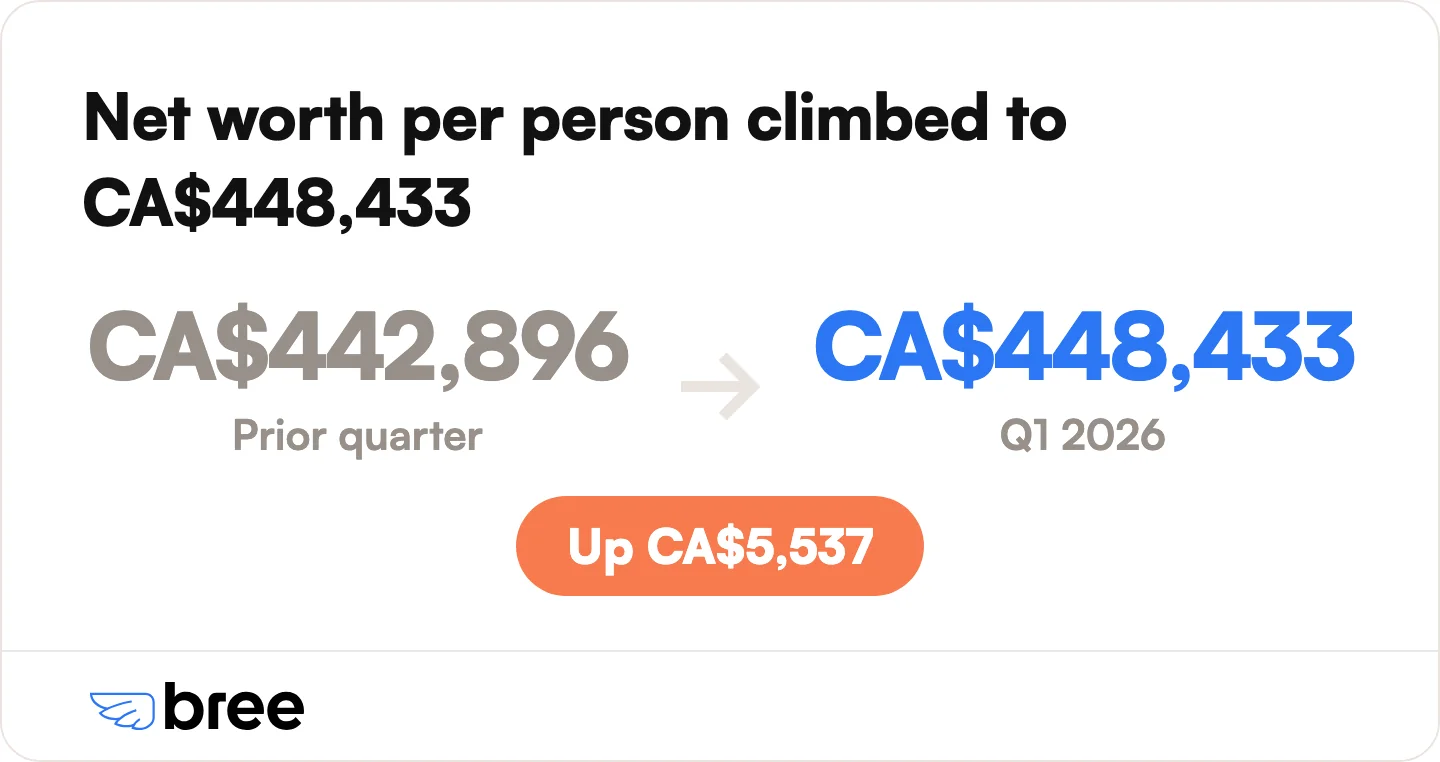
- Net worth per capita reached CA$448,433. Statistics Canada put the per-person figure up from $442,896 in the prior quarter.
- The household saving rate dropped to 3.5%. That was the lowest saving rate since Q1 2024, Statistics Canada reported, leaving families with a thinner cushion.
- Households borrowed CA$35.5 billion in credit market debt in Q1 2026. Statistics Canada showed borrowing edged up on the quarter, led by mortgage demand.
How Much Debt Does the Average Canadian Owe?
The average Canadian carries CA$22,278 in non-mortgage debt as of Q1 2026, based on Equifax Canada data. Non-mortgage debt covers credit cards, auto loans, lines of credit and instalment loans, but not a home mortgage.
- Average non-mortgage debt per consumer was CA$22,278 in Q1 2026. This is the national average across all credit-active Canadians, per Equifax Canada.
- Lenders cut average credit limits for higher-risk borrowers by 15% to 20%. Equifax Canada reported the pullback in Q1 2026, which helped push non-mortgage balances lower.
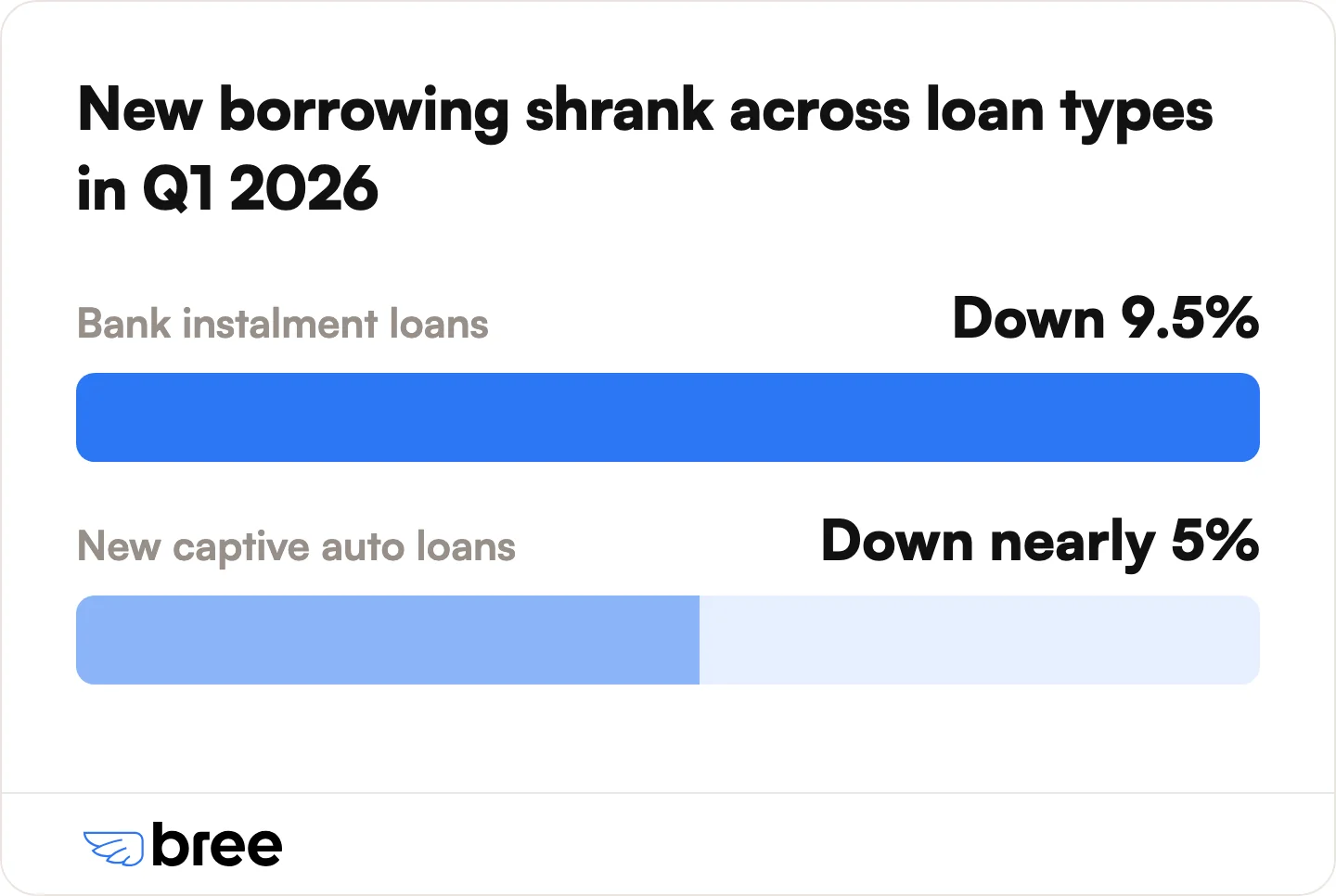
- New captive auto loans fell nearly 5% year over year to a three-year low. Equifax Canada linked the drop to affordability pressure on big-ticket purchases.
- Bank instalment loan volumes dropped 9.5%. Equifax Canada recorded the decline in Q1 2026 as households pulled back on new borrowing.
- The household saving rate sits at just 3.5%. With so little set aside, an unexpected bill often lands on credit. Statistics Canada confirmed the Q1 2026 rate.
Debt-to-Income and Debt-Service Ratios in Canada
Canadian households owe about $1.80 for every $1 of disposable income, one of the heaviest debt loads in the developed world. Two ratios track this burden: the debt-to-income ratio measures how much is owed against income, and the debt-service ratio measures how much income goes to actually paying debt down.
- The household debt-to-disposable-income ratio rose to 179.6% in Q1 2026. Statistics Canada reported the ratio climbed 0.9 percentage points, its sixth consecutive quarterly increase.
- Households owe roughly $1.80 in credit market debt for every dollar of disposable income. Statistics Canada framed the 179.6% ratio this way in its Q1 2026 release.
- The household debt-service ratio finished Q1 2026 at 14.75%. Statistics Canada reported the ratio rose from 14.68% in Q4 2025, meaning close to one in seven income dollars now goes to principal and interest.
- Households took on CA$35.5 billion in new credit market debt in the quarter. Statistics Canada attributed most of the Q1 2026 borrowing to mortgages.
Average Consumer Debt by Age Group
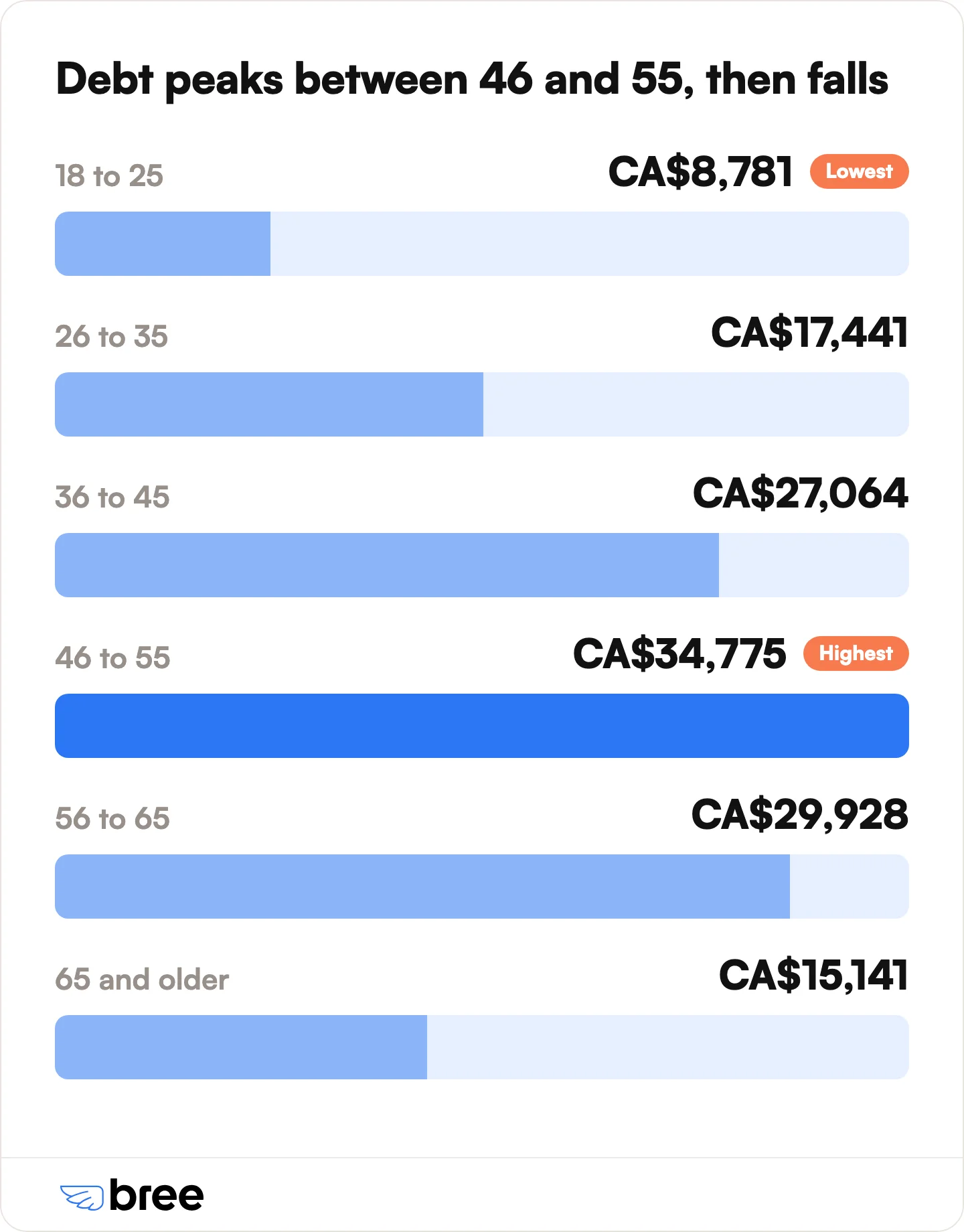
Debt in Canada peaks in middle age, then falls as Canadians pay it down heading into retirement. Canadians aged 46 to 55 carry the most non-mortgage debt at CA$34,775, while those just starting out at 18 to 25 carry the least at CA$8,781. The load then eases again in retirement, dropping to CA$15,141 for those 65 and older, per Equifax Canada's Q1 2026 data.
- Canadians aged 46 to 55 carry the highest average non-mortgage debt at CA$34,775. This is the peak-earning, peak-spending stage, per Equifax Canada.
- Gen Z Canadians aged 18 to 25 carry the least, at CA$8,781. Younger borrowers have had less time to accumulate balances, according to Equifax Canada.
- Debt among the youngest adults grows fast into their 30s. The average jumps from CA$8,781 for those 18 to 25 to CA$17,441 for those 26 to 35, Equifax Canada data shows.
- Younger borrowers face the highest delinquency rates. Equifax Canada flagged Canadians aged 26 to 35 as most likely to fall behind on payments in Q1 2026.
- Older Canadians are accelerating their payoffs. Credit card payoff rates reached 52.3% for the 56-to-65 bracket, Equifax Canada reported.
- Canadians 65 and older paid off 62.6% of their card balances. That was the strongest payoff rate of any age group, per Equifax Canada.
Average Consumer Debt by Province
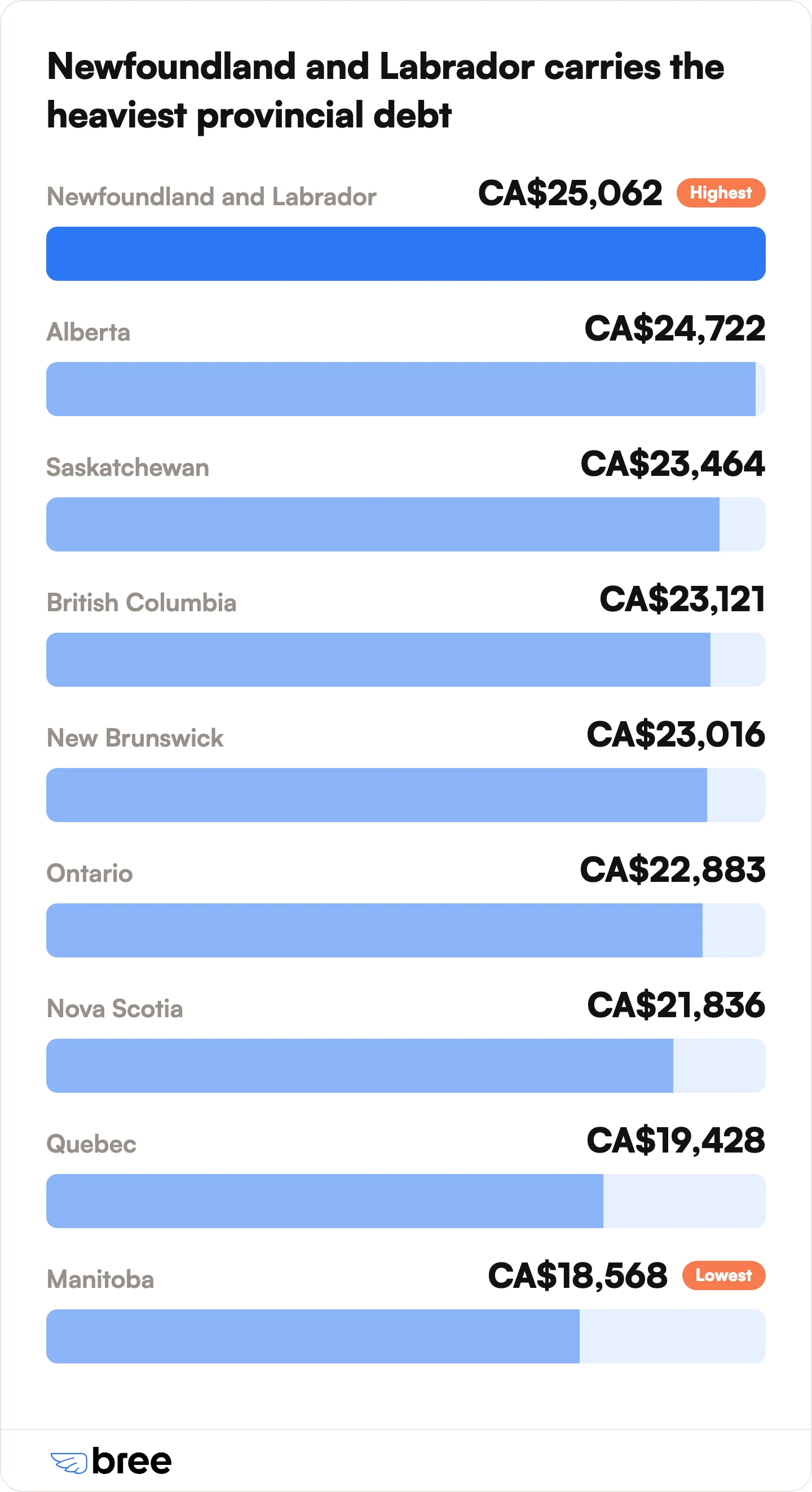
Provincial debt loads vary widely, from CA$25,062 in Newfoundland and Labrador down to CA$18,568 in Manitoba. Average non-mortgage debt per consumer by province in Q1 2026, from Equifax Canada, breaks down as follows.
- Newfoundland and Labrador has the highest average non-mortgage debt at CA$25,062. Equifax Canada ranked it first among provinces in Q1 2026.
- Quebec and Manitoba carry the lightest loads. Quebec averages CA$19,428 and Manitoba CA$18,568, the two lowest provincial figures, per Equifax Canada.
- Mortgage delinquencies jumped 52% year over year in Ontario. Equifax Canada tied the spike to renewal pressure as fixed-rate terms reset higher.
- British Columbia mortgage delinquencies rose 36%. Equifax Canada reported the increase alongside Ontario's in Q1 2026.
Average Consumer Debt by City
Among major cities, Fort McMurray tops the list at CA$37,496 in average non-mortgage debt, far above the national figure, while Montreal sits lowest at CA$17,394, per Equifax Canada's Q1 2026 report.
- Fort McMurray leads all major cities at CA$37,496 in average non-mortgage debt. The Alberta oil-sands hub sits well above every other city Equifax Canada tracks.
- Montreal has the lowest big-city debt at CA$17,394. Equifax Canada ranked it below Toronto, Ottawa and Vancouver in Q1 2026.
- Toronto's average non-mortgage debt is CA$21,465, below the national figure. High mortgage costs there leave less room for other borrowing, per Equifax Canada.
Credit Card Debt in Canada
Credit cards make up only a small share of total household debt but carry the highest costs. Credit card debt accounts for about 5% of all household debt in Canada, according to the Canadian Bankers Association, far behind mortgages and lines of credit.
- Credit cards represent about 5% of total household debt. The Canadian Bankers Association puts mortgages at 74% and lines of credit at 10% of the total.
- 67% of Canadians pay their credit card balance in full every month. The Canadian Bankers Association reports that two-thirds avoid carrying interest at all.
- 90% of Canadian adults had at least one credit card as of 2019. A Bank of Canada staff analytical note documented near-universal card ownership.
- About 46% of cardholders carry a balance for at least two consecutive months. The Bank of Canada found nearly half do not clear their statements in full.
- The median balance carried was CA$1,150. Among Canadians who revolve a balance, the Bank of Canada put the typical amount owed at CA$1,150.
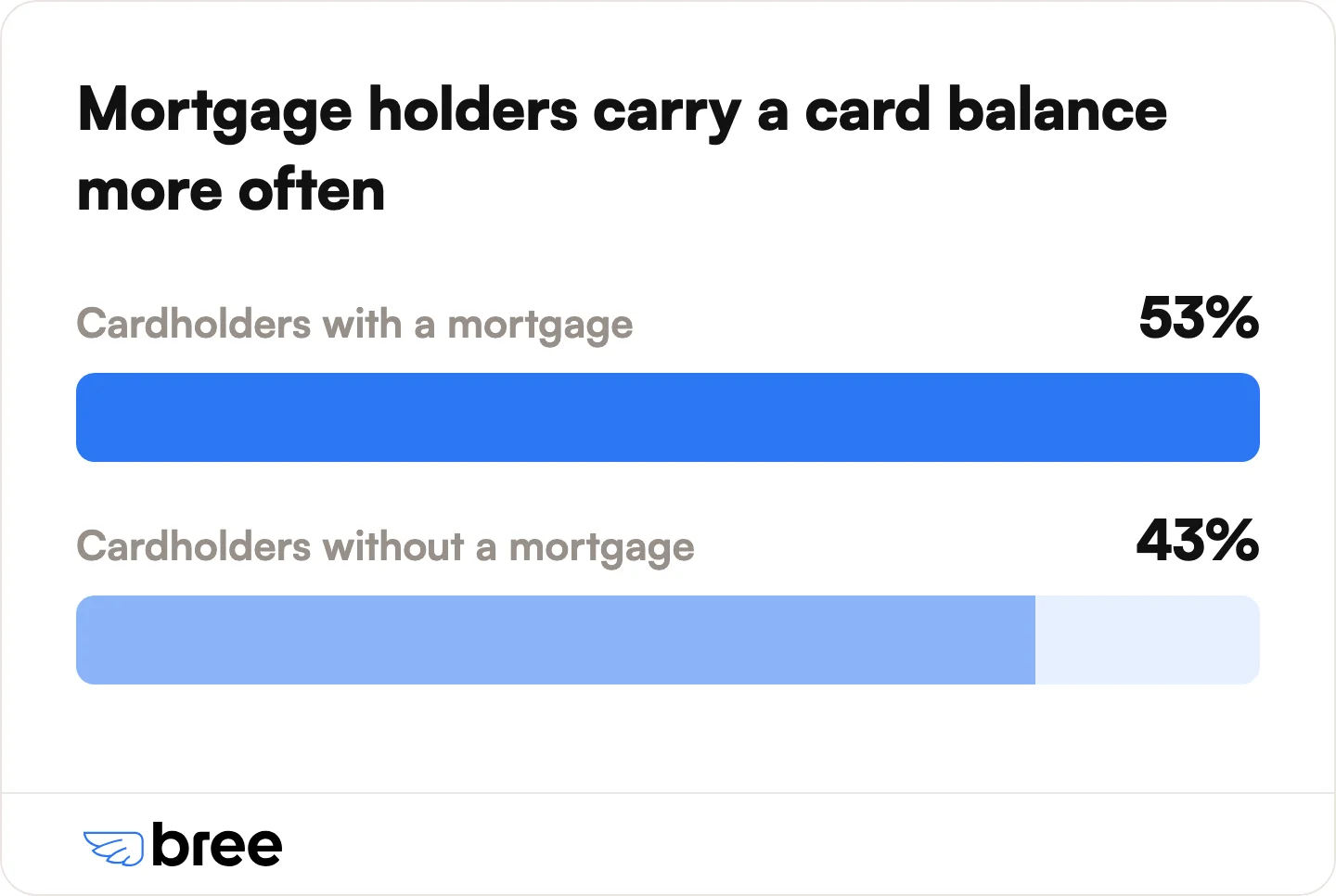
- Cardholders with a mortgage are likelier to carry a balance than those without. The Bank of Canada found 53% of mortgage-holders revolve a balance versus 43% of non-mortgage-holders.
- A cash advance on a credit card starts charging interest immediately. Canada's Financial Consumer Agency explains that a cash advance has no interest-free grace period, so interest builds from the day you take out the money, usually at a higher rate than regular purchases.
There is no single reliable national figure for the average credit card balance per cardholder, so treat headline "average balance" numbers with caution. The most solid figures are the Bank of Canada's median carried balance of CA$1,150 and, among Canadians who file for insolvency, a median credit card debt of CA$13,359 (Office of the Superintendent of Bankruptcy).
Mortgage Debt and Delinquencies
Mortgages dominate Canadian household debt, making up 74% of everything households owe, per the Canadian Bankers Association. Most borrowers stay current, but delinquencies are climbing as renewals reset at higher rates.
- Residential mortgages make up 74% of all household debt in Canada. Lines of credit add another 10% and credit cards 5%, according to the Canadian Bankers Association.
- National mortgages in arrears remain near a quarter of one percent. The Canadian Bankers Association reports arrears have stayed at just over 0.25% or lower since 2020.
- The 90-plus-day mortgage volume delinquency rate is 0.22%. Equifax Canada reported the Q1 2026 rate for missed mortgage payments.
- The mortgage balance delinquency rate climbed 32% year over year to 0.28%. Equifax Canada flagged the rise even as the overall rate stayed low.
- Insolvent mortgage holders carried an average CA$82,400 in non-mortgage debt. Equifax Canada reported this was up 19% compared with two years earlier, a sign of stretched homeowners.
- Homeowner insolvency volumes jumped more than 11% over the prior quarter. Equifax Canada recorded the Q1 2026 increase as renewal costs bit.
Auto, Student, and Tax Debt
Beyond mortgages and credit cards, Canadians carry auto loans, student debt and tax arrears. The clearest breakdown of these balances comes from Canadians who file for insolvency, profiled in the Office of the Superintendent of Bankruptcy's consumer debtor report.
- 57% of insolvent debtors held bank loans, with a median of CA$20,000. The Office of the Superintendent of Bankruptcy recorded this in its 2024 debtor profile.
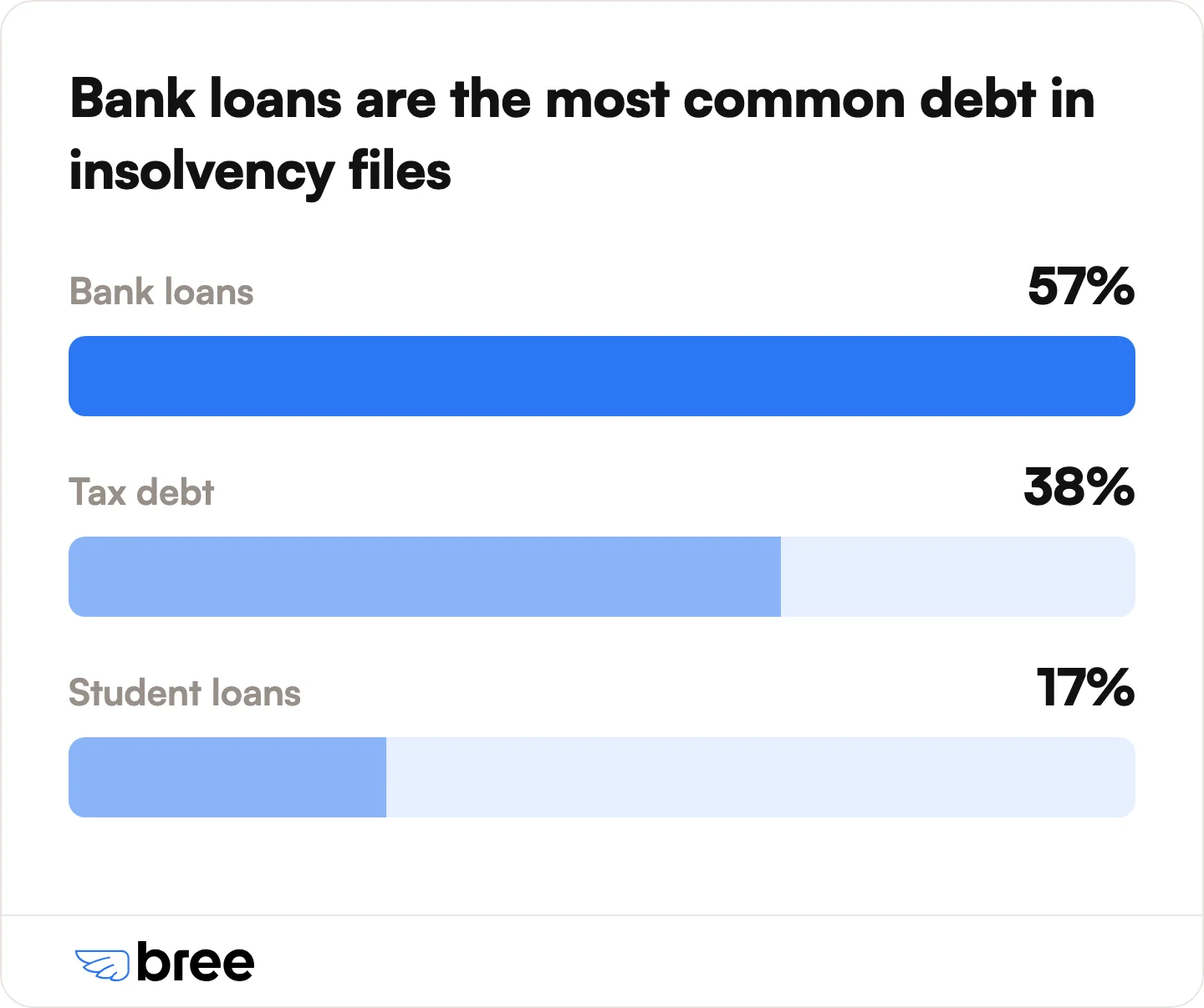
- 17% of insolvent debtors carried student loans, with a median of CA$11,702. The Office of the Superintendent of Bankruptcy reported student debt as a common burden among filers.
- 38% of insolvent debtors owed tax debt, with a median of CA$6,440. Unpaid taxes showed up in more than a third of 2024 insolvency files, per the Office of the Superintendent of Bankruptcy.
- New captive auto loans fell to a three-year low in Q1 2026. Equifax Canada reported the roughly 5% year-over-year drop as buyers balked at prices and rates.
Consumer Insolvencies and Bankruptcies in Canada
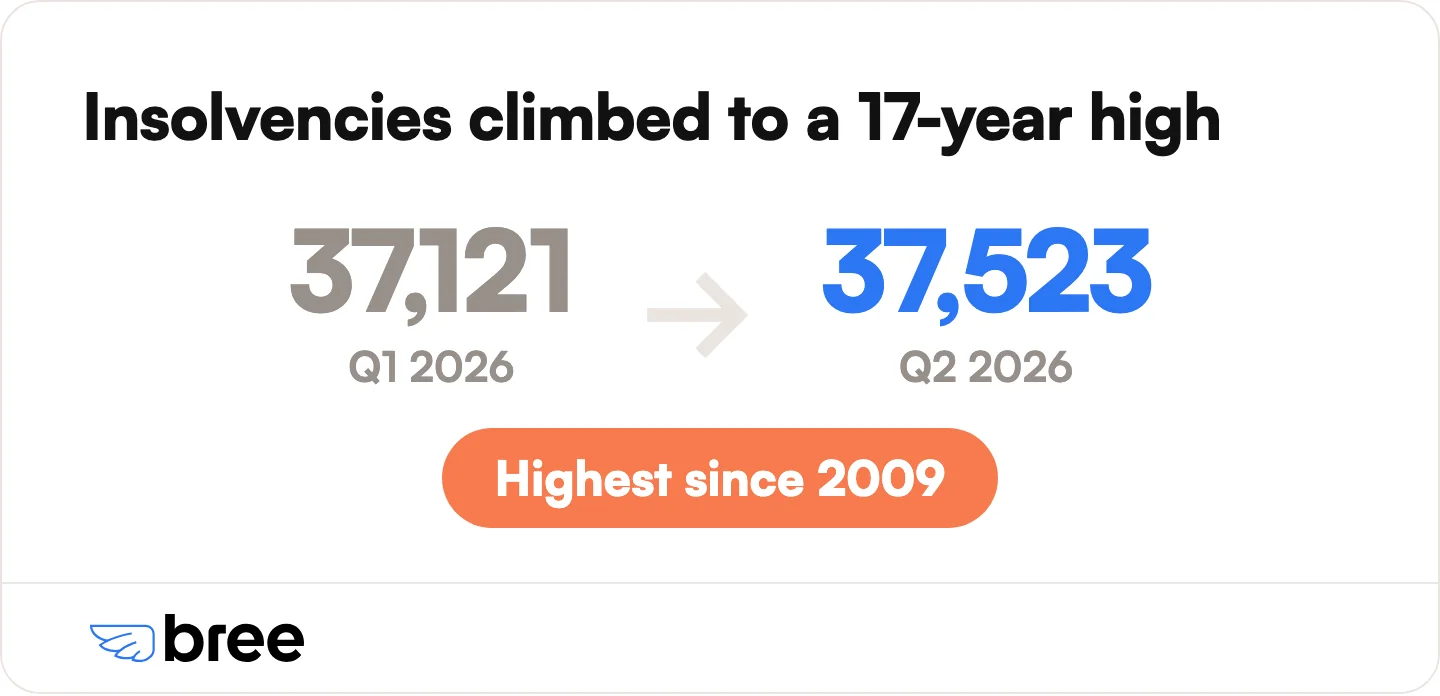
Consumer insolvencies have surged to their highest level in nearly two decades. 37,523 Canadians filed for insolvency in Q2 2026, the most in any quarter since 2009, according to the Office of the Superintendent of Bankruptcy. An insolvency is either a bankruptcy or a consumer proposal, a negotiated deal to repay part of what is owed.
- Consumer insolvencies reached 37,523 in Q2 2026. The Office of the Superintendent of Bankruptcy reported the quarterly total was up 6.9% year over year and the highest since 2009.
- Q1 2026 saw 37,121 consumer insolvencies. The Office of the Superintendent of Bankruptcy figure shows filings held near record levels through the first half of the year.
- Total insolvencies, including businesses, reached 150,505 over the 12 months ending June 2026. This combined figure was up 5.3% year over year, per the Office of the Superintendent of Bankruptcy.
- Insolvency volumes are up 18.8% year over year, a 17-year high. Equifax Canada confirmed the surge in Q1 2026.
- 79% of insolvent Canadians chose a consumer proposal over bankruptcy. The Office of the Superintendent of Bankruptcy 2024 debtor profile shows proposals now make up the large majority, with 21% filing straight bankruptcy.
- More than 90% of insolvent homeowners chose a consumer proposal. Equifax Canada reported homeowners overwhelmingly picked proposals to keep their homes in Q1 2026.
- The median household liabilities of an insolvent debtor were CA$53,997. The Office of the Superintendent of Bankruptcy reported this in its 2024 profile.
- 89% of insolvent debtors had credit card debt, with a median of CA$13,359. Among Canadians deep enough in debt to file, cards were nearly universal, per the Office of the Superintendent of Bankruptcy.
- The average insolvent debtor is 46 years old. The Office of the Superintendent of Bankruptcy also found a 20% repeat-bankruptcy rate and a 10-year average insolvency rate of 3.9%.
- The median insolvent debtor spends CA$175 more than they earn each month. The Office of the Superintendent of Bankruptcy put median monthly income at CA$3,089 against expenses of CA$3,264.
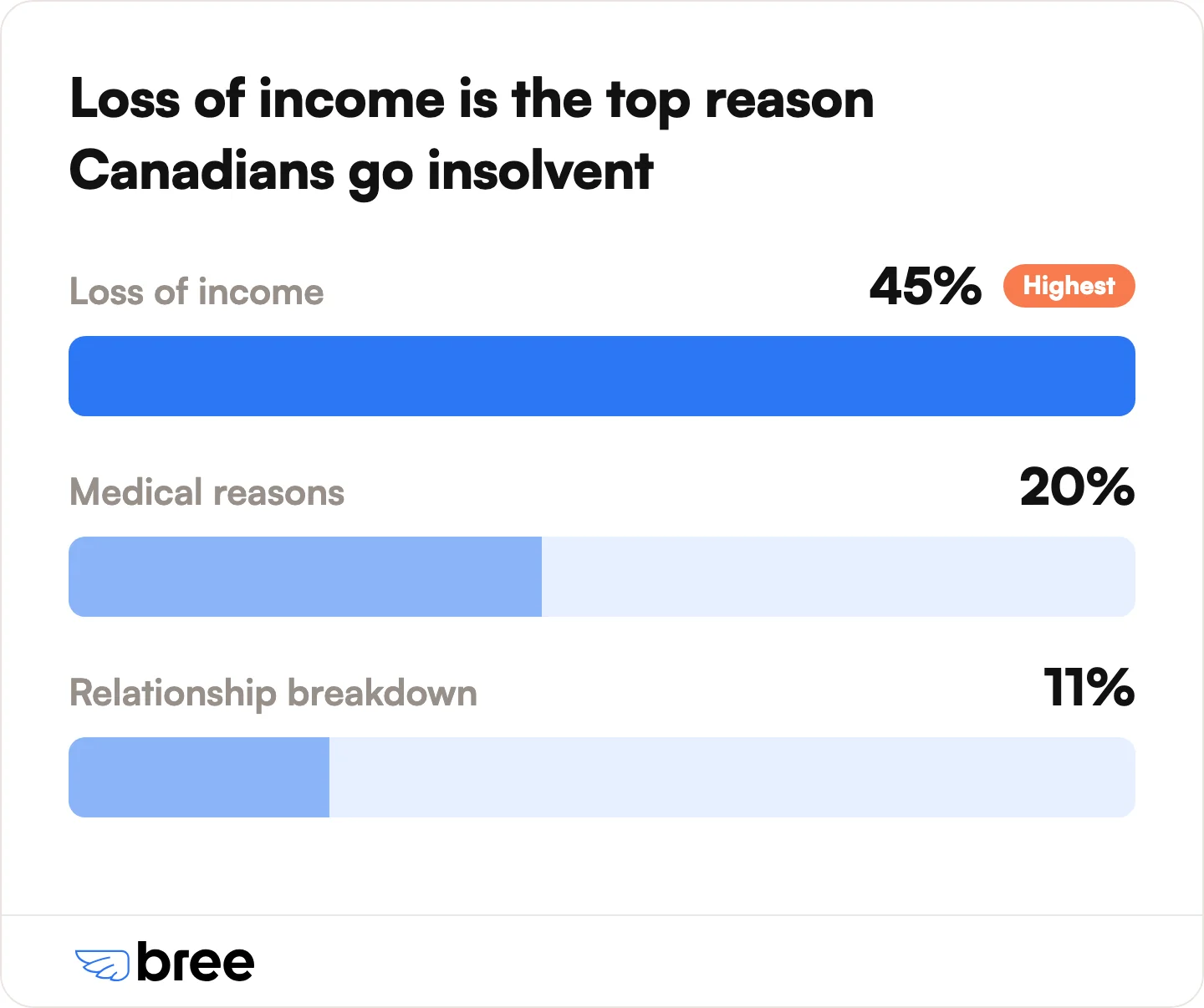
Loss of income is the single biggest reason Canadians end up insolvent, well ahead of overspending. The top reasons, from the Office of the Superintendent of Bankruptcy's 2024 debtor profile, break down as follows.
How Canada's Household Debt Compares Globally
Canada carries one of the heaviest household debt loads in the developed world. With a debt-to-income ratio of 179.6%, Canada ranks as having the highest household debt among G7 countries, per Sun Life.
- Canada has the highest household debt level in the G7. Sun Life notes Canadian households owe more relative to income than peers in the United States, United Kingdom, Germany, France, Italy and Japan.
- Canada's debt-to-income ratio of 179.6% sits well above 100%. Statistics Canada data means the average household owes far more than a full year of after-tax income.
Why More Canadians Are Falling Behind
Rising debt is colliding with a high cost of living and almost no savings buffer. That combination is why so many Canadians feel stretched even when they have steady income. For the full picture on how many Canadians live paycheque to paycheque, see our guide to living paycheque to paycheque in Canada.
- Nearly half of Canadians, about 49%, feel they are living paycheque to paycheque. A national consumer survey put nearly half of the country in that group, as reported by CTV News.
- The household saving rate is just 3.5%. With so little set aside, Statistics Canada data shows many families have no cushion for an emergency expense.
- Loss of income drives 45% of insolvencies. The Office of the Superintendent of Bankruptcy finding shows how a single missed paycheque can cascade into deeper debt.
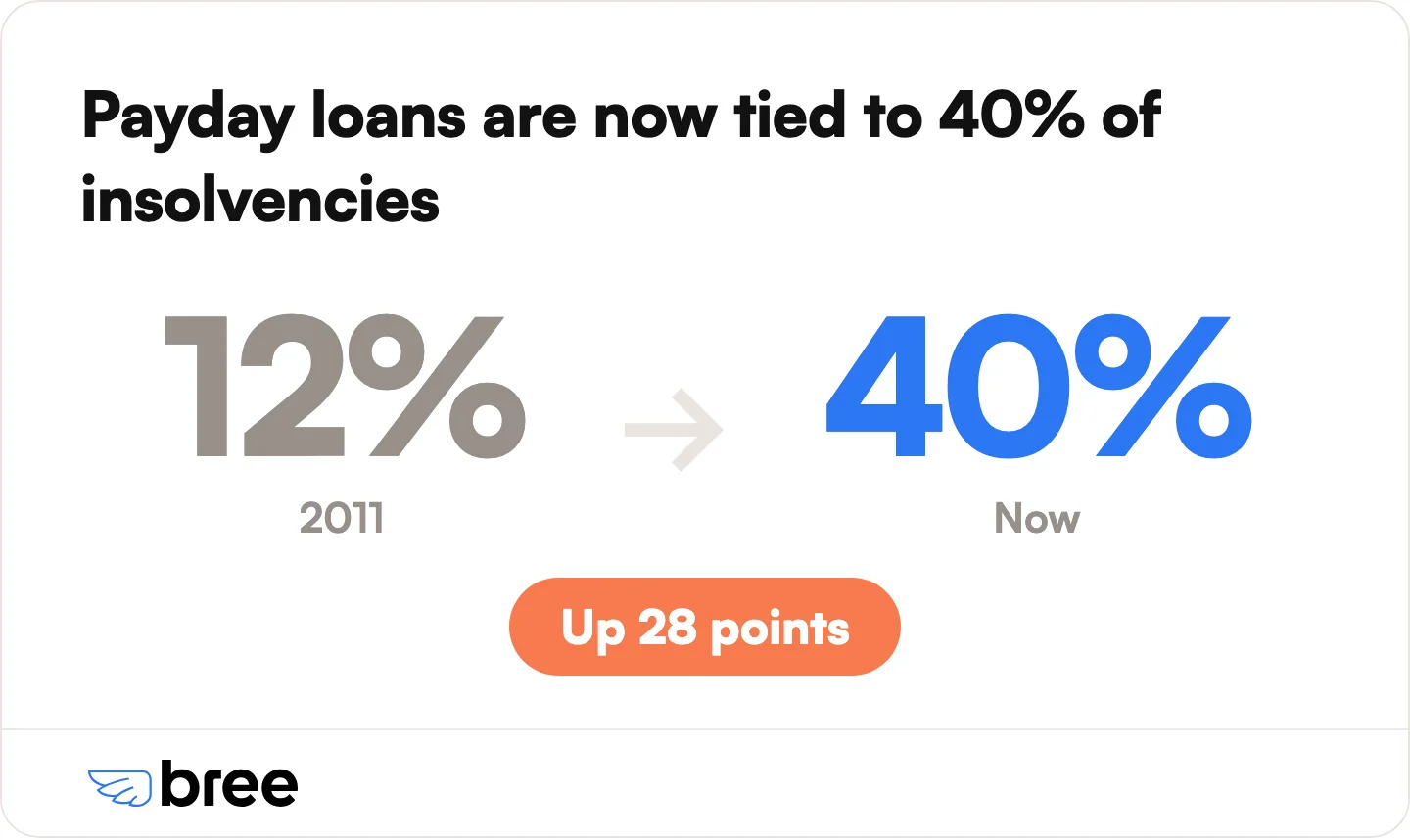
When money runs short before payday, the usual options make the problem worse. A credit card cash advance charges interest from day one with no grace period, and a payday loan can cost 365% to 391% in annual terms. Payday loans alone are now tied to 40% of consumer insolvencies in Canada, up from 12% in 2011, according to Hoyes Michalos licensed insolvency trustees.
Covering a Gap Without Adding to the Debt Pile
The data tells one clear story: covering a shortfall with high-interest credit only feeds the balances in these charts. Bree is an interest-free line of credit built for Canadians who need to bridge a gap between paycheques without turning to payday loans or overdraft. An advance of up to CA$750 arrives by direct deposit to your bank account, and Express delivery lands within minutes. It is entirely free, and Bree makes money from optional tips.
There is no credit check and no late fees, and government benefits such as ODSP, CPP, EI and the Canada Child Benefit count as qualifying income. Instead of adding a credit card balance that charges interest from the day you borrow or a payday loan at triple-digit rates, you cover the gap at 0% and repay on your own schedule. If you want to get ahead of the cycle, our guides to debt consolidation in Canada and credit counselling walk through longer-term options. You can also see how a Bree advance works.
Frequently Asked Questions
How much credit card debt does the average Canadian have?
There is no reliable single national average, but the clearest figure is the Bank of Canada's median carried balance of CA$1,150 among cardholders who revolve debt for at least two months. About 46% of cardholders carry a balance, while 67% pay in full every month, per the Canadian Bankers Association.
Is $20,000 in credit card debt normal?
No. CA$20,000 in credit card debt is far above typical levels. Even among Canadians deep enough in debt to file for insolvency, the median credit card debt was CA$13,359 in 2024, according to the Office of the Superintendent of Bankruptcy. A balance of $20,000 signals serious financial strain and usually calls for a repayment plan or professional help.
What is the debt-to-income ratio in Canada?
Canada's household debt-to-disposable-income ratio was 179.6% in Q1 2026, per Statistics Canada. That means the average household owes about $1.80 for every dollar of after-tax income. The ratio has risen for six straight quarters.
Which province has the most consumer debt?
Newfoundland and Labrador has the highest average non-mortgage debt at CA$25,062, followed by Alberta at CA$24,722, based on Equifax Canada's Q1 2026 data. Manitoba has the lowest at CA$18,568.
Does Canada have the highest household debt in the world?
Canada does not have the highest in the world, but it does carry the highest household debt among the G7 economies, per Sun Life. Its debt-to-income ratio of 179.6% is well above that of the United States and most European peers.
The Bottom Line
Canadian consumer debt set records across the board in 2026: CA$2.66 trillion owed, $1.80 of debt for every dollar of income, and consumer insolvencies at a 17-year high. With the saving rate down to 3.5%, most households have little room to absorb a surprise expense, which is how a single car repair or missed shift turns into a credit card balance or a payday loan.
Breaking that cycle starts with not borrowing at rates that make the hole deeper. An interest-free cash advance is one way Canadians can cover a short-term gap without stacking on credit card interest or triple-digit payday costs. Bree is a line of credit we built for Canadians living between paycheques, offering up to $750 at 0% with no credit check. If your budget is under steady pressure, pairing a tool like that with a longer-term plan is how you stop the balances above from growing.
Sources
- Statistics Canada: National balance sheet and financial flow accounts
- Equifax Canada: The Resilient North Market Pulse
- Office of the Superintendent of Bankruptcy: Insolvency Statistics
- Office of the Superintendent of Bankruptcy: Canadian Consumer Debtor Profile
- Bank of Canada: The reliance of Canadians on credit card debt
- Financial Consumer Agency of Canada: How credit cards work
- Sun Life: What's the average debt in Canada and how do you compare?
- Hoyes Michalos: Payday loans and consumer insolvency
- CTV News: Nearly half of Canadians are living paycheque to paycheque

Join our newsletter to get the latest updates
.png)
.png)