
Most Canadians now say living paycheque to paycheque (or "paycheck to paycheck") is just how life works. In 2025, 85% told H&R Block Canada it had become their new normal, up from 60% a year earlier. The catch is that the "real" number is hotly debated. Depending on which survey you read, the figure runs anywhere from 46% to nearly 89%, because the phrase means something different to a minimum-wage worker than it does to a six-figure earner maxing out their savings.
This page pulls together the 2025 and 2026 Canadian data in one place: how many people live this way, who gets hit hardest, what is squeezing budgets, and what it actually costs when the money runs out before payday. Every figure is dated and sourced, with U.S. numbers clearly flagged for contrast.
Key Takeaways
- 85% call it the new normal. H&R Block Canada's 2025 survey found 85% of Canadians feel living paycheque to paycheque is now standard, up from 60% in 2024.
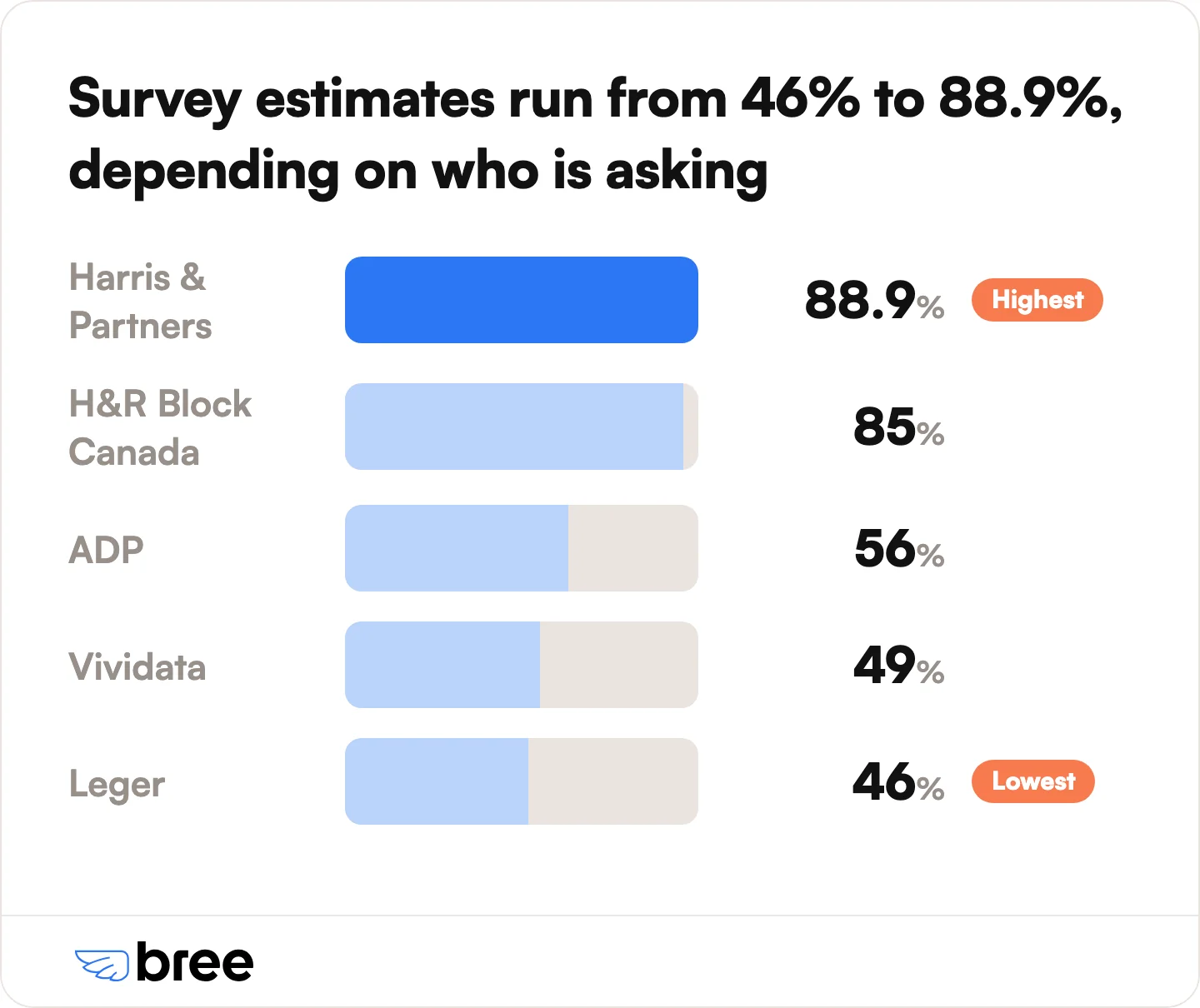
- The "true" rate is contested. Estimates run from 46% (Leger) to 88.9% (Harris & Partners) because every survey defines the term differently, which is why headline numbers disagree.
- One surprise bill breaks the budget. 77.1% of Canadians say they could not cover a $500 emergency without taking on debt (Harris & Partners), and 42% are within $200 of not being able to pay their monthly bills (MNP).
- High earners are not immune. In the U.S., 38% of households earning $100,000 or more still report living paycheque to paycheque, according to NerdWallet, a sign that lifestyle creep, not just low pay, drives the problem.
- Falling short is expensive. Overdraft and payday borrowing punish the gap: a payday loan costs $14 per $100, roughly 365% to 391% a year per the Financial Consumer Agency of Canada, while an interest-free cash advance avoids that trap entirely.
How Many Canadians Live Paycheque to Paycheque?
Most surveys now put the share of Canadians living paycheque to paycheque somewhere between the high 40s and high 80s, depending on how the question is framed. Here are the headline numbers from 2025 and 2026.

- 85% of Canadians say living paycheque to paycheque is the new normal. That is up from 60% the year before, according to a 2025 H&R Block Canada survey of 1,790 Canadians.
- 56% of Canadian workers report living paycheque to paycheque. TalentCanada reports that ADP Research's People at Work study found more than half of the country's workforce falls into this group.
- 49% of Canadians feel they are living paycheque to paycheque. That figure comes from Vividata's Study of the Canadian Consumer Winter 2026, which surveys more than 75,000 Canadians a year, as reported by CTV News.
- 46% of Canadians run out of money before their next payday. A February 2025 Leger survey of 1,550 people put the share who actively run short each cycle at nearly half.
- 88.9% of respondents say they live paycheque to paycheque in one insolvency-firm survey. A Harris & Partners survey of more than 12,000 people sits at the high end of the range, as reported by Retail Insider.
- 32% of Canadians feel stuck living paycheque to paycheque. The MNP Consumer Debt Index, conducted by Ipsos, uses a stricter "feel stuck" wording and lands far lower than the self-reported surveys.
- 99% of "extremely vulnerable" households live paycheque to paycheque. The Financial Resilience Institute found the pattern is near-universal among the most financially stressed Canadians.
- 81% of Canadians say their wages cannot keep pace with rising costs. H&R Block Canada found this held true regardless of income level, which helps explain why the paycheque-to-paycheque label now reaches so far up the income ladder.
Want the bigger picture on how Canadians handle money? See our roundup of financial literacy statistics in Canada.
Why the Estimates Range So Widely
The numbers disagree because "paycheque to paycheque" is self-reported and undefined. It captures both a renter who cannot buy groceries three days before payday and a $150,000 earner who funnels most of their salary into a TFSA and a mortgage, then feels "broke" on paper. Both tick the same box on a survey.
That gap is a running argument among Canadians themselves. In one r/PersonalFinanceCanada thread, a commenter wrote that people earning $200,000 "will say they're paycheque to paycheque because after mortgage, au pair, private school, three car payments... 'there's nothing left,'" and called most such headlines "pure clickbait for exactly this reason." A cleaner definition offered in the same thread: it should mean that if your next paycheque did not arrive, there would be serious consequences, not just that you dipped into savings.
- 25% of people who have three months of savings still say they live paycheque to paycheque. In the U.S., NerdWallet's Harris Poll survey found a quarter of those with a solid cushion describe themselves this way, proof the label is as much about feeling as finances.
The takeaway: treat any single headline figure with caution. The direction of travel, more Canadians feeling squeezed year over year, is clearer than any one percentage.
Canadians Have Almost No Cushion for an Emergency
Whatever the exact share, the deeper problem is thin savings. Most Canadian households have little or nothing set aside for a surprise expense, which is what turns a normal month into a debt spiral.

- 77.1% of Canadians could not cover a $500 emergency without taking on debt. The Harris & Partners survey found more than three in four have no buffer for a modest shock.
- 57.3% say their income did not cover basic expenses like rent, food, and bills. The same Harris & Partners data shows a majority falling short on essentials, not extras.
- 42% of Canadians are within $200 of not being able to pay their bills each month. The MNP Consumer Debt Index found two in five live that close to the edge, including 27% who already do not earn enough to cover their bills and debt.
- 36% of Canadian households have a negative or zero savings rate. The Financial Resilience Institute found more than a third save nothing at all, or spend more than they earn.
- 56% of households have drawn down savings to pay for essential expenses. The Financial Resilience Institute found most Canadians are dipping into whatever cushion they have just to cover the basics.
- The national household saving rate was 4.7% in the third quarter of 2025. Statistics Canada reported households are saving less than five cents of every dollar of disposable income.
- Only 43% of Canadians say they have enough money coming in to set some aside. The HOOPP Canadian Retirement Survey, run by Abacus Data, found fewer than half can save anything in a typical month.
For the full savings picture, see our emergency fund statistics for Canada and why an emergency fund matters even when money is tight.
Even High Earners Feel the Squeeze
A bigger paycheque does not guarantee breathing room. Lifestyle creep, where spending rises to match income, pushes even well-paid households into the same paycheque-to-paycheque cycle.
- 38% of U.S. households earning $100,000 or more say they live paycheque to paycheque. NerdWallet's survey shows the pattern reaches deep into six-figure territory south of the border.
- 51% of Canadians say it is hard to make ends meet despite a decent salary. H&R Block Canada found that even respondents who consider their pay reasonable struggle to stretch it to the end of the month.
The lesson is that income alone does not fix the problem. Fixed costs, debt payments, and rising prices can absorb a raise before it ever reaches savings.
What's Driving It: The Cost of Living
The core driver is simple. Prices have climbed faster than paycheques, so the same income buys less each year. Canadians consistently name affordability as their top financial worry.
- 82% of Canadians say the cost of living has outpaced their income growth over the past year. The Financial Resilience Institute found the squeeze is nearly universal.
- Consumer prices rose 3.2% year over year in May 2026. Statistics Canada reported inflation ticked back up from 2.8% in April.
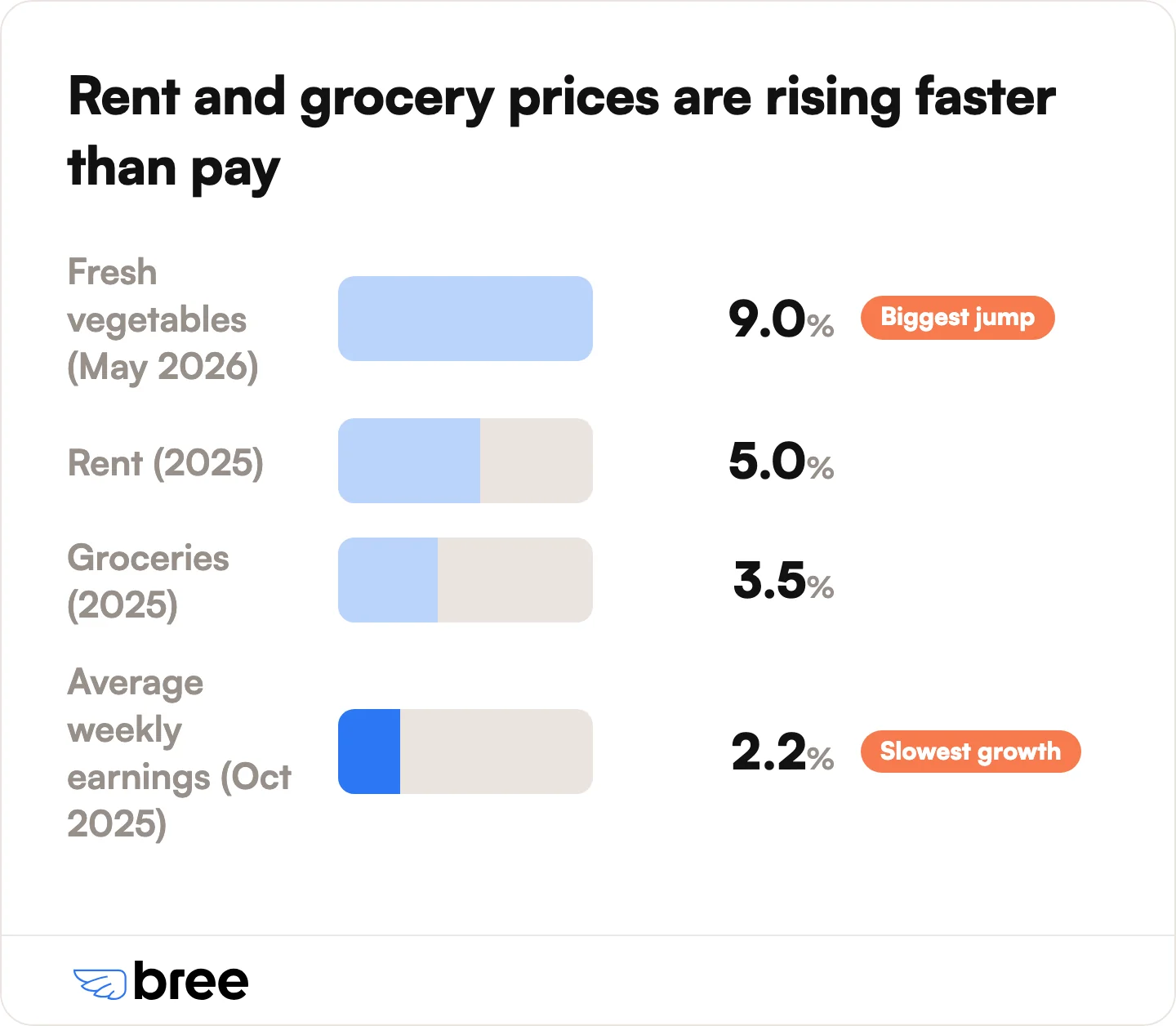
- Grocery prices climbed 3.5% in 2025. Statistics Canada found food from stores rose faster than the year before, and it has now outpaced headline inflation for 16 straight months.
- Rent rose 5.0% in 2025. Statistics Canada reported rent growth cooled from 8.2% in 2024 but still outran wages.
- Fresh vegetable prices jumped 9.0% in May 2026 alone. Statistics Canada logged the increase following a 4.1% rise the month before.
- 59% of Canadians name the cost of living as their top issue for 2026. The Angus Reid Institute found three in five rank affordability above every other concern.
- 39% of Canadians say it is hard to keep up with grocery bills. Angus Reid found this rises to a majority among households earning under $50,000 a year.
- 58% of Canadians have less disposable income than before. Vividata's Winter 2026 study, reported by CTV News, found most people have less left over after covering the essentials.
- 71% say rising costs are reducing how much they can save. The same Vividata data shows the price squeeze is eating directly into savings.
- Average weekly earnings were $1,312 in October 2025. Statistics Canada reported pay grew just 2.2% year over year, barely ahead of inflation.
Small changes add up. Our guide to saving money on groceries covers where the easiest wins are.
Canadians Are Carrying Record Debt
When income falls short, debt fills the gap. Canadian households now owe more relative to their income than almost any other G7 country, and cracks are starting to show in how they keep up.
- Canadians owe $1.77 for every dollar of disposable income. The household debt-to-income ratio hit 176.7% in the third quarter of 2025, Statistics Canada reported, as debt kept growing faster than income.
- The average Canadian carries $22,321 in non-mortgage debt. Equifax Canada found non-mortgage balances rose $511 per consumer over the year.
- Total household credit market debt is nearing $3.2 trillion. Statistics Canada reported mortgages account for almost 75% of that total.
- The 90-day non-mortgage delinquency rate reached 1.63%. Equifax Canada found missed payments climbed 14% year over year, a sign more households are falling behind.
- 1.45 million Canadians missed a credit payment in a single quarter. Equifax Canada found 84% of them, about 1.21 million people, did not even hold a mortgage.
- 1 in 20 young adults aged 18 to 35 missed a credit payment. Equifax Canada found financial stress is heaviest among younger Canadians.
- 139,335 consumer insolvencies were filed in the year ending September 2025. The Canadian Association of Insolvency and Restructuring Professionals reported filings rose 4.8% year over year to the highest level since 2009.
- 36% of Canadian credit card holders carry a balance and lean on cards when short. Vividata's Winter 2026 study, reported by CTV News, found one in three cannot pay off their card each month.
- 60% of Canadians describe their debt as a minor or major source of stress. The Angus Reid Institute found debt weighs on the majority.
The Real Cost of Falling Short: Overdraft and Payday Loans
Running out before payday is expensive, and the two most common ways Canadians bridge the gap, bank overdraft and payday loans, are also the priciest. This is where a small shortfall snowballs.
- 34% of Canadians incur an NSF fee in a given year. Federal figures published in the Canada Gazette show roughly a third of account holders get hit with a non-sufficient-funds charge annually.
- NSF fees are now capped at $10, down from as high as $50. The new $10 cap on NSF fees took effect March 12, 2026; before it, banks typically charged $45 to $48 per incident. Even at $10, repeat hits in a tight month stack up fast.
- The old NSF fee averaged $46.85 in 2023. The Canada Gazette put the pre-cap weighted average near $47 a bounce, several times the new limit.
- NSF fees generated $753 million in bank revenue in 2025. The Canada Gazette estimated 16.1 million NSF transactions for the year before the cap took hold.
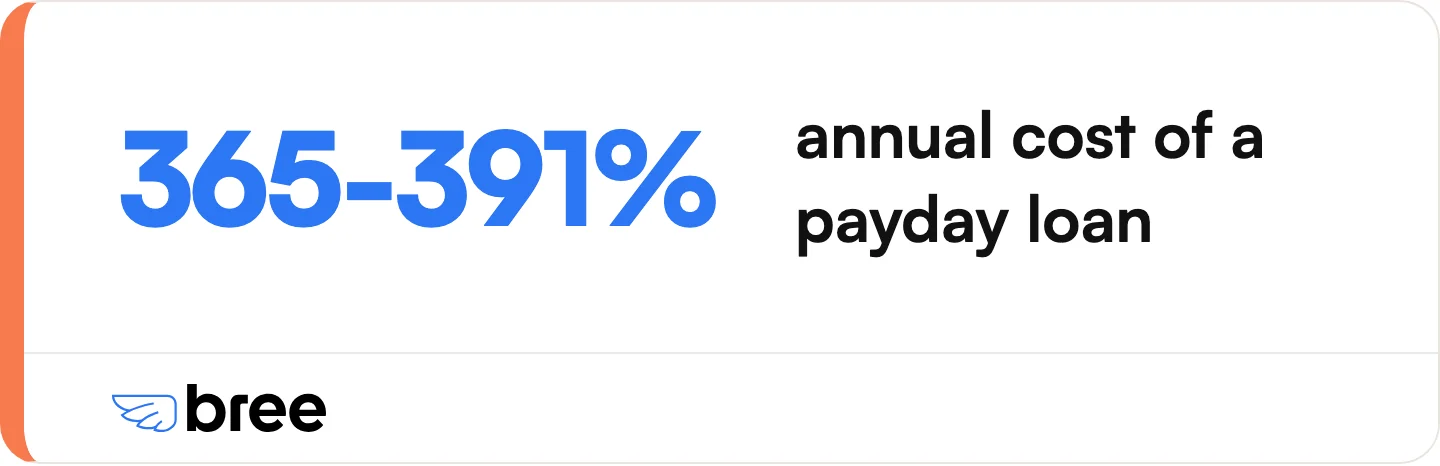
- A payday loan costs $14 for every $100 borrowed, roughly 365% to 391% a year. The Financial Consumer Agency of Canada sets the cost at $14 per $100 in most provinces. Its 14-day example annualizes to about 365%, and the commonly cited ceiling is closer to 391%, far above the 35% criminal interest rate that now applies to other loans.
- 43% of payday loan users report "struggling a lot" financially. FCAC research found 90% of those users have no emergency savings or trouble affording essentials like food.
- 23% of payday borrowers took out six or more loans in three years. FCAC research found repeat borrowing is common, the pattern that turns a one-time shortfall into a cycle.
If overdraft or payday fees are eating your paycheque, see how to escape the payday loan debt cycle, our guide to overdraft protection, and the cheaper payday loan alternatives available in Canada.
Savings and Retirement Are Slipping
The squeeze is not just about this month. When every dollar goes to bills, long-term savings and retirement are the first things to get cut, which stores up trouble for later.
- 49% of unretired Canadians set aside nothing for retirement last year. The HOOPP Canadian Retirement Survey, run by Abacus Data, found half saved zero for their future in a 12-month span.
- 74% of Canadians worry they are not saving enough. H&R Block Canada found the anxiety about savings is now the majority experience.
- 78% expect to have less to put into savings this year. H&R Block Canada found most Canadians see their savings shrinking, not growing.
- 49% of Canadian women have less than $5,000 in savings. The HOOPP survey found a stark gender gap, with 36% of women able to save in a given month versus 48% of men.
- 39% of Canadians aged 55 to 64 have less than $5,000 saved. The HOOPP survey found many near-retirees are approaching their final working years with almost no cushion.
Building a habit helps. Our financial education resources for Canada are a good starting point.
The Human Cost: Food, Housing, and Stress
Behind the percentages are real trade-offs: skipped meals, unaffordable rent, and lost sleep. The paycheque-to-paycheque squeeze now reaches people who are fully employed.
- 24% of Canadians, about 9.8 million people, lived in food-insecure households in 2024. Statistics Canada found nearly a quarter of the country struggled to afford enough food.
- Food banks logged nearly 2.2 million visits in a single month. Food Banks Canada reported that in March 2025, 19% of food bank clients had employment as their main source of income.
- 22% of households spend 30% or more of their income on housing. Statistics Canada found renters, at 33%, were more than twice as likely as owners, at 16%, to be in unaffordable housing.
- 43% of Canadians say money is their single biggest source of stress. FP Canada's Financial Stress Index found finances outrank work, health, and relationships as the top worry.
- 60.4% of Canadians go to bed worrying about money. The Harris & Partners survey found financial anxiety follows most people right to the pillow.
How to Break the Paycheque-to-Paycheque Cycle
You cannot fix wages or grocery prices overnight, but you can stop a shortfall from costing you triple. Three moves make the biggest difference.
Build even a small buffer. A cushion of $200 to $500 is enough to absorb most surprise bills and keep you clear of overdraft and payday fees. The 50/30/20 budgeting method is a simple way to carve out that first bit of savings.
Know your pay and benefit dates. A lot of shortfalls are timing problems, not income problems: rent is due on the first, but your pay or benefit lands on the third. Mapping the calendar, using guides like our CPP payment dates breakdown, helps you see the gaps before they become fees.
Avoid the high-cost bridges. When you do need to cover a gap, the source matters. A payday loan at 365% to 391% a year, or a stack of NSF fees, can turn a $100 shortfall into a debt cycle. That is exactly the trap Bree is built to replace. Bree is a Canadian cash advance app offering interest-free advances of up to $750, with 0% interest, no credit check, and government benefits like ODSP, CPP, and EI accepted as income. More than 800,000 Canadians use it, and it holds a 4.8 out of 5 rating on Trustpilot. It is a cash advance, not a loan, so there is no interest and no rollover. See how the interest-free cash advance works or read real Bree reviews from Canadians who have used it.
Frequently Asked Questions
What percentage of Canadians live paycheque to paycheque?
As of 2025, roughly 85% of Canadians say living paycheque to paycheque has become their new normal, according to H&R Block Canada, up from 60% the year before. Other 2025 and 2026 surveys land lower, from 46% (Leger) to 56% (ADP) to 49% (Vividata), because each defines the term differently. The honest answer is a range: somewhere between roughly half and the large majority of Canadians feel the squeeze.
Do high earners live paycheque to paycheque?
Yes. In the U.S., 38% of households earning $100,000 or more report living paycheque to paycheque, according to NerdWallet. The usual cause is lifestyle creep, where fixed costs, debt payments, and spending rise to match a higher income, so little is left over despite a strong salary.
Is living paycheque to paycheque the same as being poor?
No. The term is self-reported and covers very different situations. It includes people who genuinely cannot afford essentials, and also higher earners who direct most of their income into savings, investments, or a mortgage and keep little as spare cash. That overlap is why survey estimates range so widely and why the label alone does not measure hardship.
How much does it cost to fall short in Canada?
The two common ways to bridge a gap are the priciest. A payday loan costs $14 per $100 borrowed, roughly 365% to 391% a year. Bank NSF fees are now capped at $10 as of March 2026, down from $45 to $48 before, but repeat hits still add up. An interest-free cash advance avoids both, charging 0% interest instead of high fees.
The Bottom Line
The headline figure gets the attention, 85% of Canadians calling paycheque to paycheque their new normal, but the number matters less than the cushion behind it. Most households have almost nothing set aside: 77.1% could not cover a $500 surprise without debt, and 42% sit within $200 of missing a bill. Whether the "true" rate is 46% or 88.9%, the direction is clear, and it points at thin savings meeting rising prices.
The stats are a snapshot. The fix is making the shortfall cheaper. For Canadians caught between paycheques, an interest-free cash advance is a transparent alternative to the overdraft charges and payday loans that punish a short month. Bree offers advances of up to $750 with 0% interest, no credit check, and no late fees, so a timing gap does not turn into a debt spiral. If you are one of the 85%, you can get up to $750, interest-free, and keep a bad week from becoming a bad year.
Sources
- H&R Block Canada: Are Emaciated Canadian Piggybanks Today's Reality
- TalentCanada: More Than Half of Canadian Workers Living Paycheck to Paycheck
- CTV News: Nearly Half of Canadians Are Living Paycheque to Paycheque
- Leger: State of the Economy
- Retail Insider: Survey Reveals Canadians Have Reached Breaking Point (Harris & Partners)
- MNP Consumer Debt Index
- Financial Resilience Institute: Financial Health and Resilience Index
- NerdWallet: Living Paycheck to Paycheck Study
- Angus Reid Institute: Canadians Feeling Financial Pressure
- HOOPP: Canadian Retirement Survey
- Statistics Canada: National Balance Sheet and Household Debt
- Statistics Canada: Consumer Price Index, May
- Statistics Canada: Consumer Price Index, Annual Review
- Statistics Canada: Average Weekly Earnings
- Statistics Canada: Food Insecurity
- Statistics Canada: Housing Affordability
- Equifax Canada: Consumer Credit Trends Report
- Canadian Association of Insolvency and Restructuring Professionals: Consumer Insolvencies
- Food Banks Canada: HungerCount
- FP Canada: Financial Stress Index
- Department of Finance Canada: New $10 Cap on NSF Fees
- Canada Gazette: NSF Fee Regulations
- Financial Consumer Agency of Canada: Payday Loans
- Financial Consumer Agency of Canada: Understanding Payday Loan Users
- Financial Consumer Agency of Canada: Payday Loans Market Trends

Join our newsletter to get the latest updates
.png)

