You can get a payday loan while on EI. Licensed Canadian lenders accept Employment Insurance as income because it lands by direct deposit on a predictable schedule, and many skip the credit check entirely. The problem is the price. A payday loan costs up to about 365% APR, and the full balance is pulled straight from your next EI deposit, so the shortfall you were trying to cover comes right back.
If you are on EI and rent is due before your next payment, that math matters. This guide breaks down what an EI payday loan actually costs on a weekly benefit cheque, the cash-flow gap that pushes people toward payday lenders in the first place, and the cheaper options that also accept EI. Bree is one of them: an interest-free line of credit up to $750 that counts EI as qualifying income, used by more than 600,000 Canadians.
Key Takeaways
- Yes, you can get a payday loan on EI. Licensed lenders treat Employment Insurance as recurring income, though some approve only returning borrowers who have repaid before.
- It costs up to about 365% APR. That is $14 for every $100 borrowed, and the full balance is automatically withdrawn from your next EI deposit.
- The EI cash-flow gap is the real problem. A one-week waiting period and a first payment about 28 days after you apply, on a benefit capped at $729 a week, leaves no cushion for a surprise bill.
- A $500 payday loan costs about $70 in fees. The same $500 from a 0%-interest line of credit costs nothing to borrow.
- Cheaper options accept EI too. An interest-free line of credit like Bree, a Service Canada EI advance, provincial assistance, and credit union loans all cost far less than 365%.
Can You Get a Payday Loan While on EI?
Yes. Licensed Canadian payday lenders accept Employment Insurance as qualifying income. EI is recurring, arrives by direct deposit, and follows a set schedule, so lenders treat it much like a paycheque. Most look at your recent bank deposits rather than your credit score, which is why a payday loan on EI often involves no credit check or only a soft one.
What you can borrow follows the standard rules. The most you can get is $1,500, with up to 62 days to repay, and lenders fund it in minutes, usually by Interac e-Transfer. Approval is fast because the bar is low. That speed is also the trap, which the cost section below breaks down.
The catch most lenders don't advertise
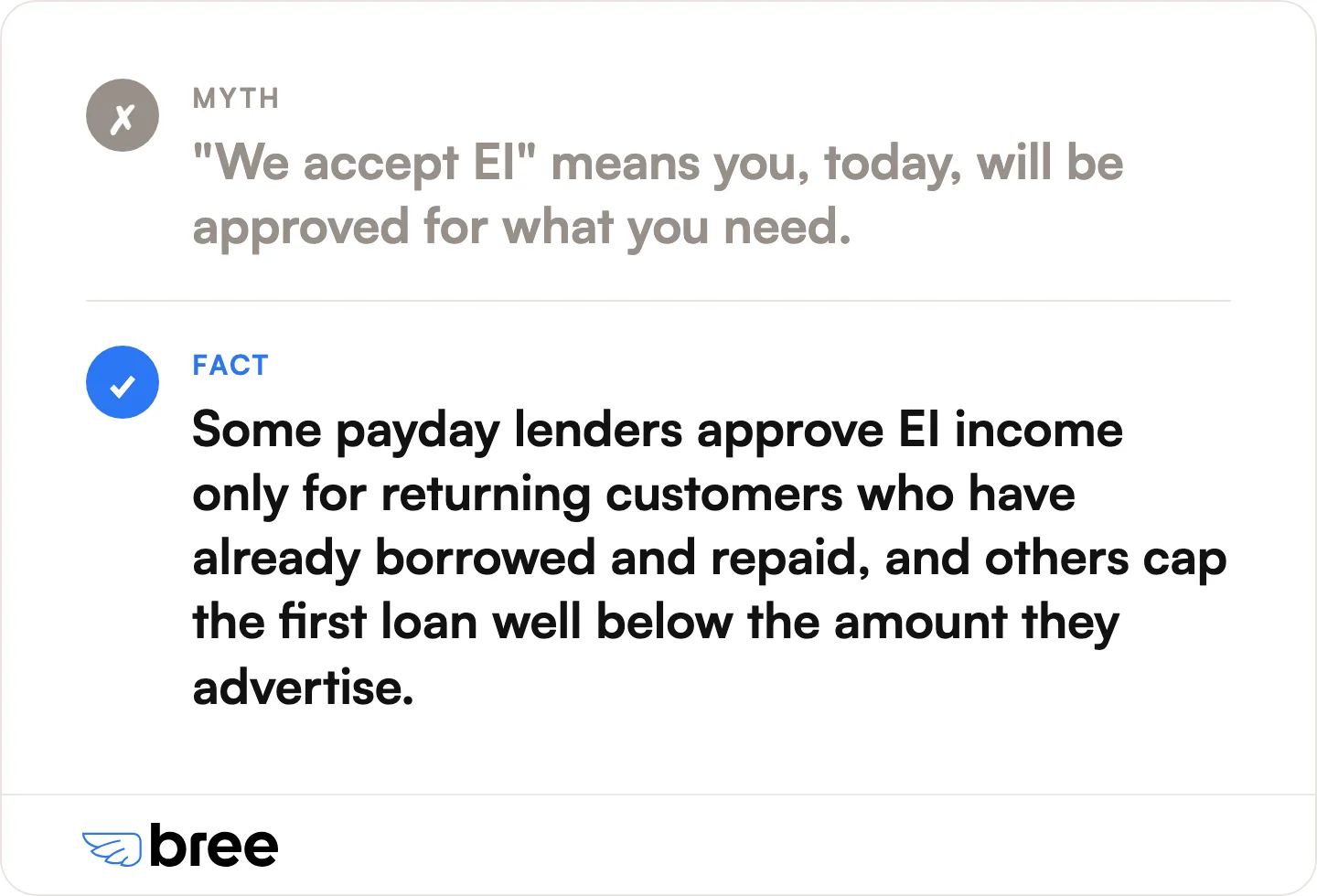
Many payday lenders quietly restrict first-time EI borrowers. Some approve EI income only for returning customers who have already borrowed and repaid, and others cap the first loan well below the amount they advertise. So "we accept EI" does not always mean you, today, will be approved for what you need. If your credit is stressed and you have no history with the lender, expect a smaller first offer or a decline, no matter what the landing page promises.
How Much an EI Payday Loan Really Costs
A payday loan costs $14 for every $100 you borrow. On a typical 14-day term that works out to roughly 365% APR, the maximum most provinces allow, according to the Financial Consumer Agency of Canada. On EI, the full balance plus that fee is automatically withdrawn on your next deposit date.
Here is what that looks like on a real EI cheque. Say you receive the maximum $729 a week and borrow $500 to cover a car repair. You repay $570: the $500 plus $70 in fees. That $570 comes out of your next EI deposit, which leaves you short again, so many borrowers take a second loan to get through the following week. That is how the cycle starts.
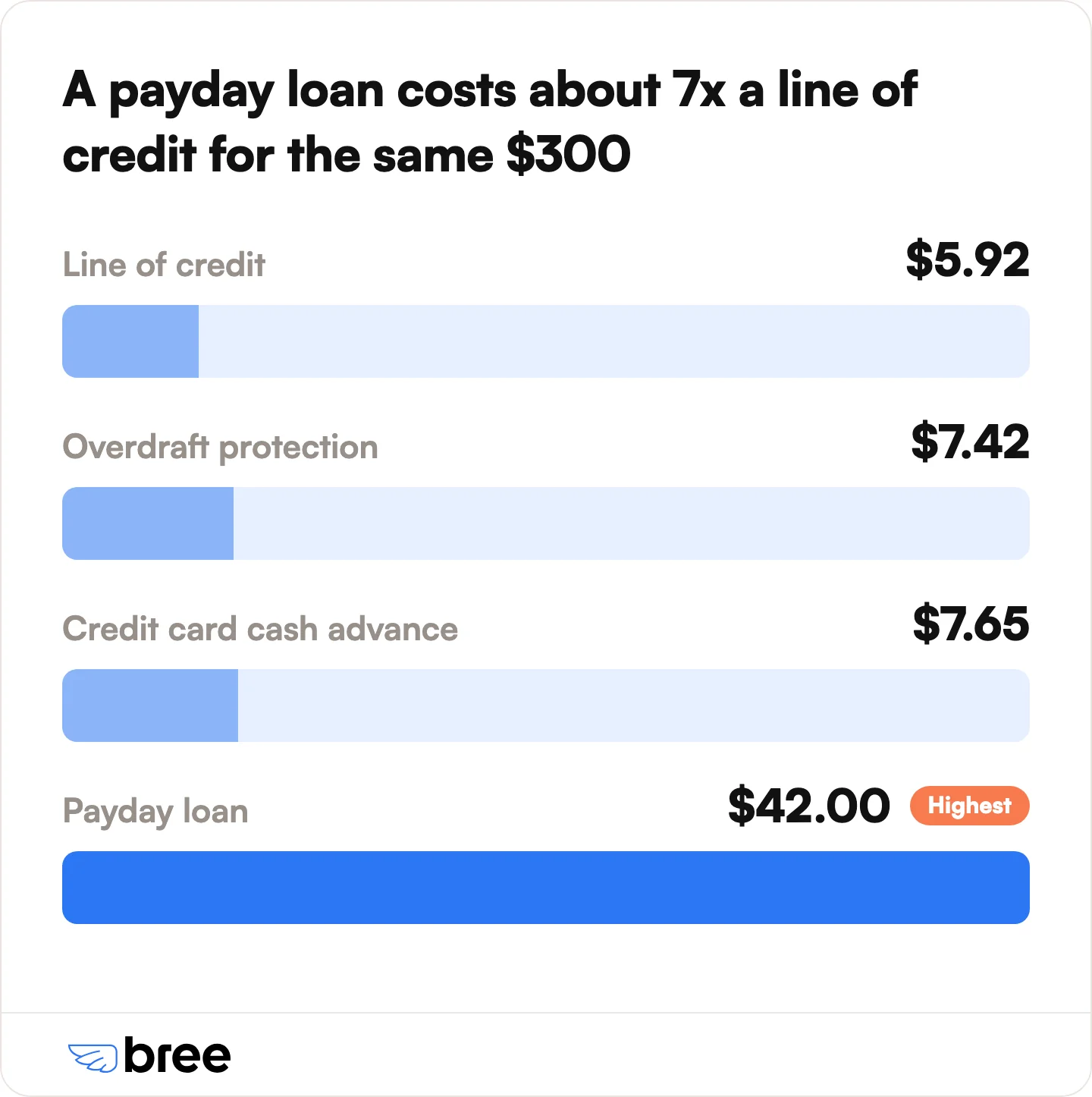
The gap between a payday loan and cheaper credit is stark. The FCAC compares the cost of borrowing $300 for 14 days across products:
Source: FCAC research on the cost of payday loans.
A payday loan costs about seven times what a line of credit costs for the same $300. Stretched over a year of repeat borrowing, the difference is life-changing money. Payday debt is also a major driver of insolvency in Canada. Licensed insolvency trustee Hoyes Michalos found that 40% of consumer insolvencies involved payday loans, compared with 12% in 2011. For people on a fixed benefit, the repayment auto-withdrawal is exactly what turns one short-term loan into a stack of them. If you are already caught in that loop, our guide on escaping the payday loan debt cycle walks through the way out.
The EI Cash-Flow Gap That Sends People to Payday Lenders
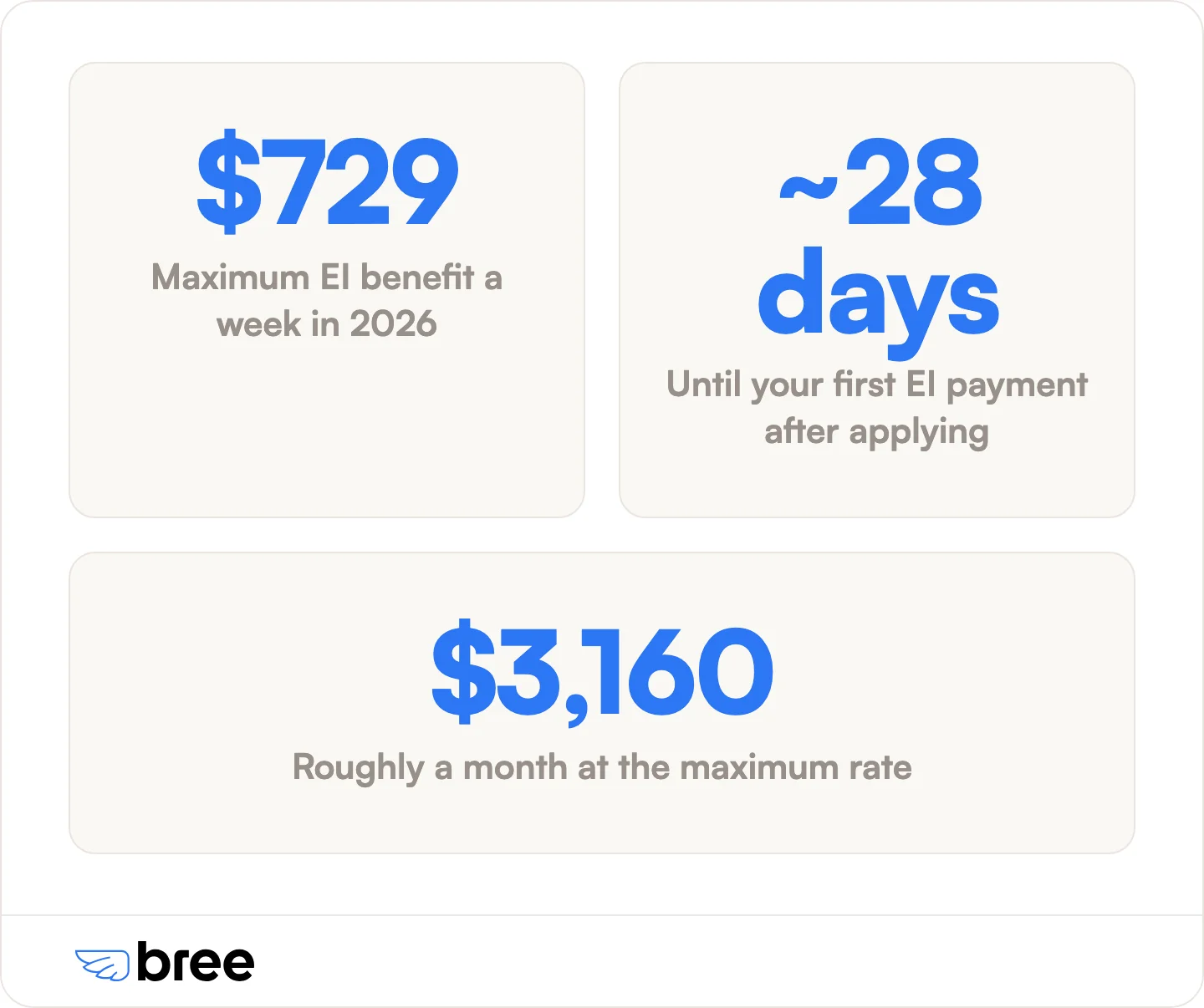
The reason EI recipients reach for payday loans is timing, not recklessness. EI pays 55% of your average insurable weekly earnings, up to a maximum of $729 a week in 2026, but the money does not arrive right away.
When you file a claim there is a one-week unpaid waiting period, and your first payment lands about 28 days after you apply, according to Service Canada. A rent payment or a broken furnace inside that four-week window has no cushion behind it. Even once payments start, a benefit capped at $729 a week, roughly $3,160 a month at the maximum, rarely stretches to cover a surprise expense on top of rent, food, and bills.
There is one piece of timely relief. Service Canada has temporarily waived the one-week waiting period for new EI claims, so recent claimants get paid a week sooner. It is a temporary measure set to end, and it does not close the roughly 28-day gap before your first payment. Knowing your exact deposit dates helps you plan around the gap. Our EI payment dates guide lays out the schedule so you can see the shortfall coming instead of being surprised by it.
Does Getting a Loan Affect Your EI?
No. EI regular benefits are not reduced because you borrow money. Borrowed funds are not earnings, so a payday loan or a line of credit does not lower your EI cheque or affect your eligibility. You can bridge a gap without touching your benefit amount.
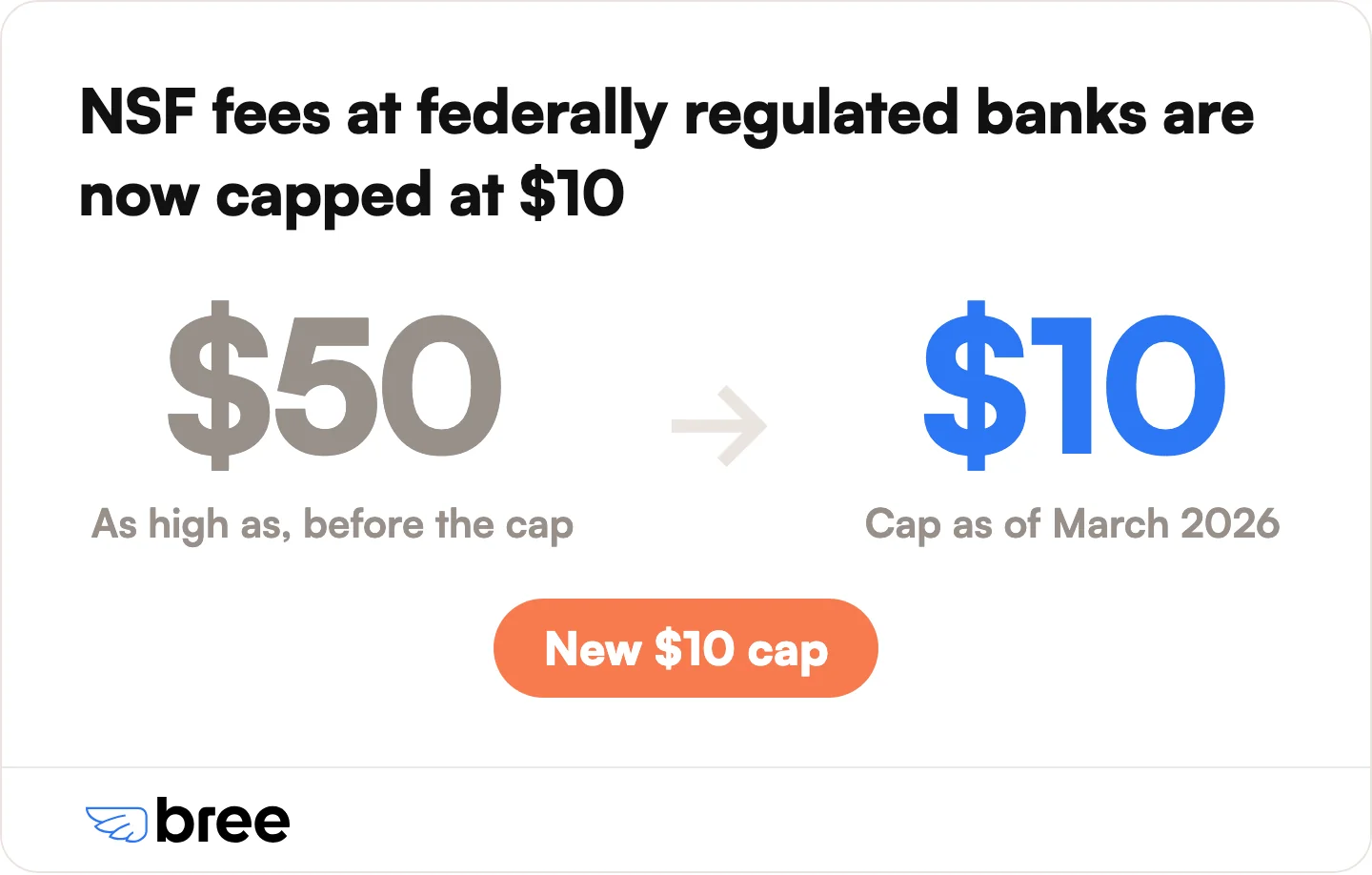
What can drain your EI is the repayment. When a payday lender auto-withdraws $570 and your account is short, you get hit with a returned-payment fee from the lender and a non-sufficient funds fee from your bank. There is some good news on that second fee: as of March 2026, NSF fees at federally regulated banks are capped at $10, down from as high as $50. Still, a missed payday repayment on EI can stack fees on top of an already tight week, which is the opposite of what you needed the money for.
Better Options Than an EI Payday Loan
On EI, a payday loan is usually the most expensive way to borrow. The good news is that the cheaper options accept EI too. Here is how the main routes compare.
A 0%-interest line of credit that accepts EI
The cheapest way to bridge an EI gap is a line of credit that charges no interest. Bree is an interest-free line of credit of up to $750 that accepts EI as qualifying income, with no credit check, no late fees, and no hidden or mandatory fees. Approval is based on your recent bank deposits, not your credit score. Funds arrive by direct deposit to your bank account, standard delivery is free over one to three business days, and Express delivery is an optional fee to get cash in minutes. You repay on your own schedule, so there is no lump sum yanked from your next deposit the way a payday loan works.
Bree is the interest-free line of credit we built for Canadians who get squeezed between payments, including the roughly 11 million living paycheque to paycheque and people on EI, ODSP, CPP, and other benefits. More than 600,000 Canadians use it, and it holds a 4.8 out of 5 rating on Trustpilot across 8,007+ reviews. It is free to use; Bree makes money from optional tips, like a waiter, so the person who can afford to tip helps cover the person who cannot. You can see how the $750 line of credit works and check whether EI clears the income bar, covered in the next section.
Cash advance apps
Cash advance apps are a cheaper alternative to payday loans, but most were not built for EI. Apps like KOHO and Nyble charge no interest, yet they cap advances at around $250, which often is not enough for a real emergency. Earned-wage-advance apps are worse for EI recipients: they advance money against hours you have already worked, so if your only income is EI there are no earned wages to advance and you are excluded outright. Read the fine print before you rely on one, because "accepts government benefits" is not universal in this category.
Service Canada advance and provincial help
Some of the best options on EI are not loans at all. If you are waiting on a claim, contact Service Canada about an advance or emergency payment on benefits you are owed. Provincial social assistance and community relief programs can cover food, utilities, or rent in a crisis, which preserves your EI for the essentials instead of sending it to a lender. Credit unions also offer small-dollar loans at a fraction of payday rates and will often work with members on a fixed income. If you receive other benefits alongside or instead of EI, our guides on borrowing options for social assistance, disability, and pensioners go deeper on each.
What You Need to Qualify for a Line of Credit on EI
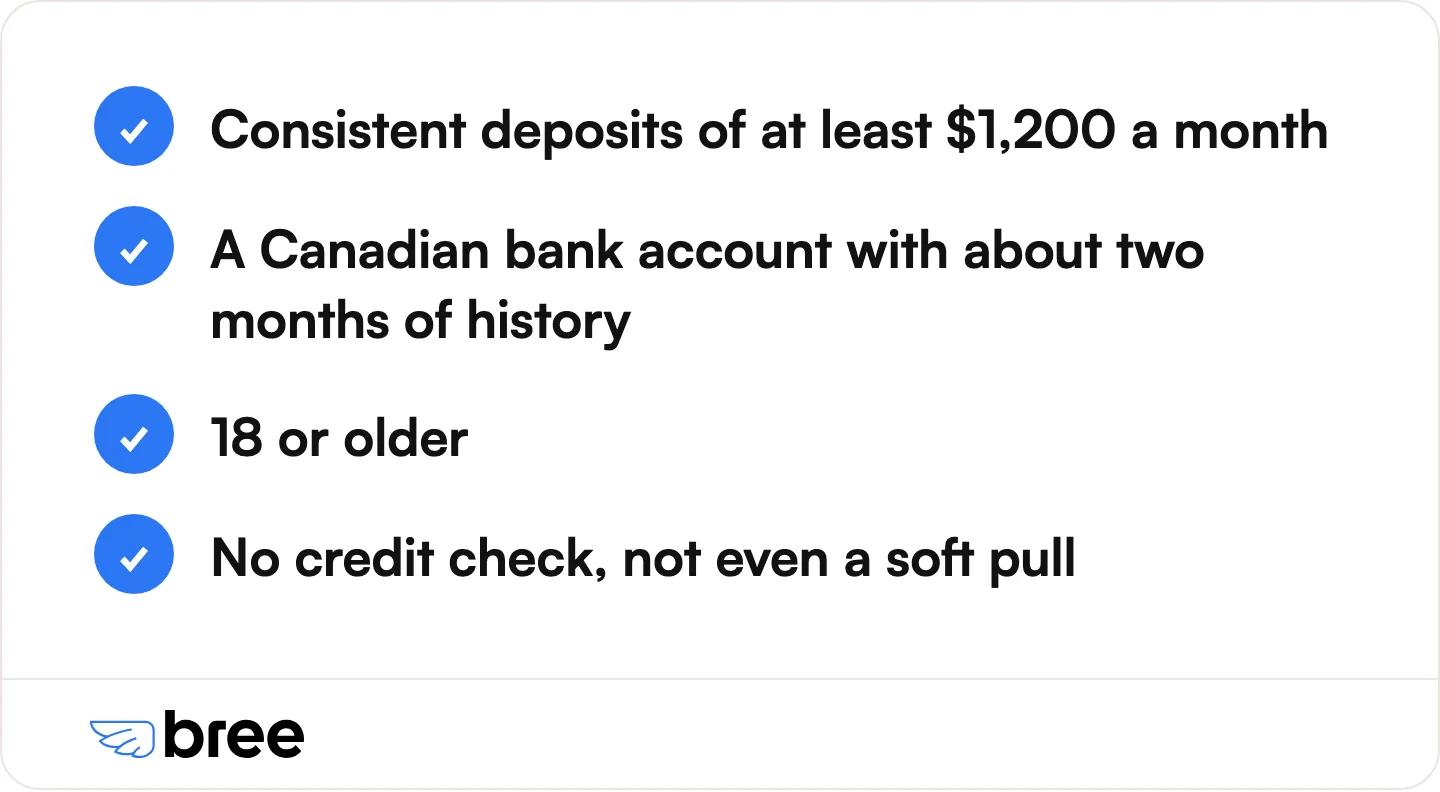
To qualify for an interest-free line of credit like Bree while on EI, you need consistent deposits of at least $1,200 a month, a Canadian bank account with about two months of history, and to be 18 or older. There is no credit check, not even a soft pull, so a low or damaged score does not block you.
Whether EI clears that bar depends on your rate. At the maximum $729 a week, EI works out to roughly $3,160 a month, which sits comfortably above the $1,200 floor. If you receive a lower weekly rate, because EI pays 55% of lower earnings, you may fall short of the income requirement on EI alone. We would rather tell you that up front than promise guaranteed approval, because no honest lender can guarantee it. Approval always comes down to what your bank history actually shows.
Frequently Asked Questions
Can I get a payday loan while on EI?
Yes. Licensed Canadian lenders accept EI as recurring income and can fund a loan in minutes. Expect a cost of around 365% APR ($14 per $100), and know that some lenders approve only returning borrowers who have repaid a loan before.
What's the easiest loan to get on EI with bad credit?
No-credit-check options are the easiest to qualify for, because they approve based on your recurring bank deposits rather than your credit score. A 0%-interest line of credit that accepts EI, like Bree, is both easier to qualify for than a bank loan and far cheaper than a payday loan. No lender can guarantee approval, so be cautious of any that claims to.
Where can I borrow money if I'm unemployed?
EI counts as income for several borrowing options, including payday loans, cash advance apps, and interest-free lines of credit. Non-loan routes are often better: ask Service Canada about an EI advance, and check provincial social assistance and community relief programs, which do not have to be repaid.
Do EI payday loans require a credit check?
Usually not. Most payday lenders check your recent bank deposits instead of running a full credit check. Bree does no credit check at all and approves based on two months of bank transaction history, which matters when EI has already stretched your budget thin.
Can I borrow $200 or $500 instantly on EI?
Yes. An interest-free line of credit of up to $750 covers a $200 or $500 need, and with Express delivery the funds arrive in minutes by direct deposit to your bank account. It costs nothing in interest, unlike a payday loan where $500 comes with about $70 in fees.
The Bottom Line
EI payday loans are real and easy to get, but they are the most expensive way to bridge a gap on a benefit cheque. At $14 per $100, roughly 365% APR, the full balance is clawed back from your next EI deposit, and that is how one loan becomes a cycle. The timing gap that sends people to payday lenders, a one-week wait and a roughly 28-day delay before the first payment, is real, but a 365% loan is not the only way to cover it.
Bree is the interest-free line of credit up to $750 that accepts EI as income, built for Canadians bridging the gap between payments without a credit check and without predatory interest. If EI is your income and a bill cannot wait, it is a cheaper, calmer way to get through the week. You can get started and see if you qualify in a few minutes.
Sources
- Financial Consumer Agency of Canada: Payday loans
- Financial Consumer Agency of Canada: Understanding payday loans
- Service Canada: EI regular benefits, how much you could receive
- Service Canada: EI regular benefits, after you apply
- Service Canada: EI waiting period
- Department of Finance Canada: New $10 cap on NSF fees
- Hoyes Michalos: Payday loans and insolvency
- Trustpilot: Bree reviews

Join our newsletter to get the latest updates