Close to 2 million Canadians turn to payday loans in a typical year, by the lending industry's own count, and it costs them more than almost any other way to borrow. Since January 1, 2025, a payday loan in Canada is capped at $14 for every $100 borrowed. That works out to an annual percentage rate of about 365%. The payday loan statistics below pull together the most current Canadian data on who borrows, what it really costs, how often people get stuck repeat-borrowing, and how the rules differ by province.
Where the freshest government data exists, this page leads with it. The Financial Consumer Agency of Canada's 2019 to 2023 research is used as the current baseline, and its older 2016 national survey is flagged as the historical picture. Bree is a Canadian financial app, and we built it as a 0% interest alternative to payday lending for the more than 600,000 people who have used it to bridge a gap before payday.
Key Takeaways
- The payday industry serves an estimated 2 million Canadians a year, while recent government survey data puts annual use at 1.7% of Canadians over any 12-month period.
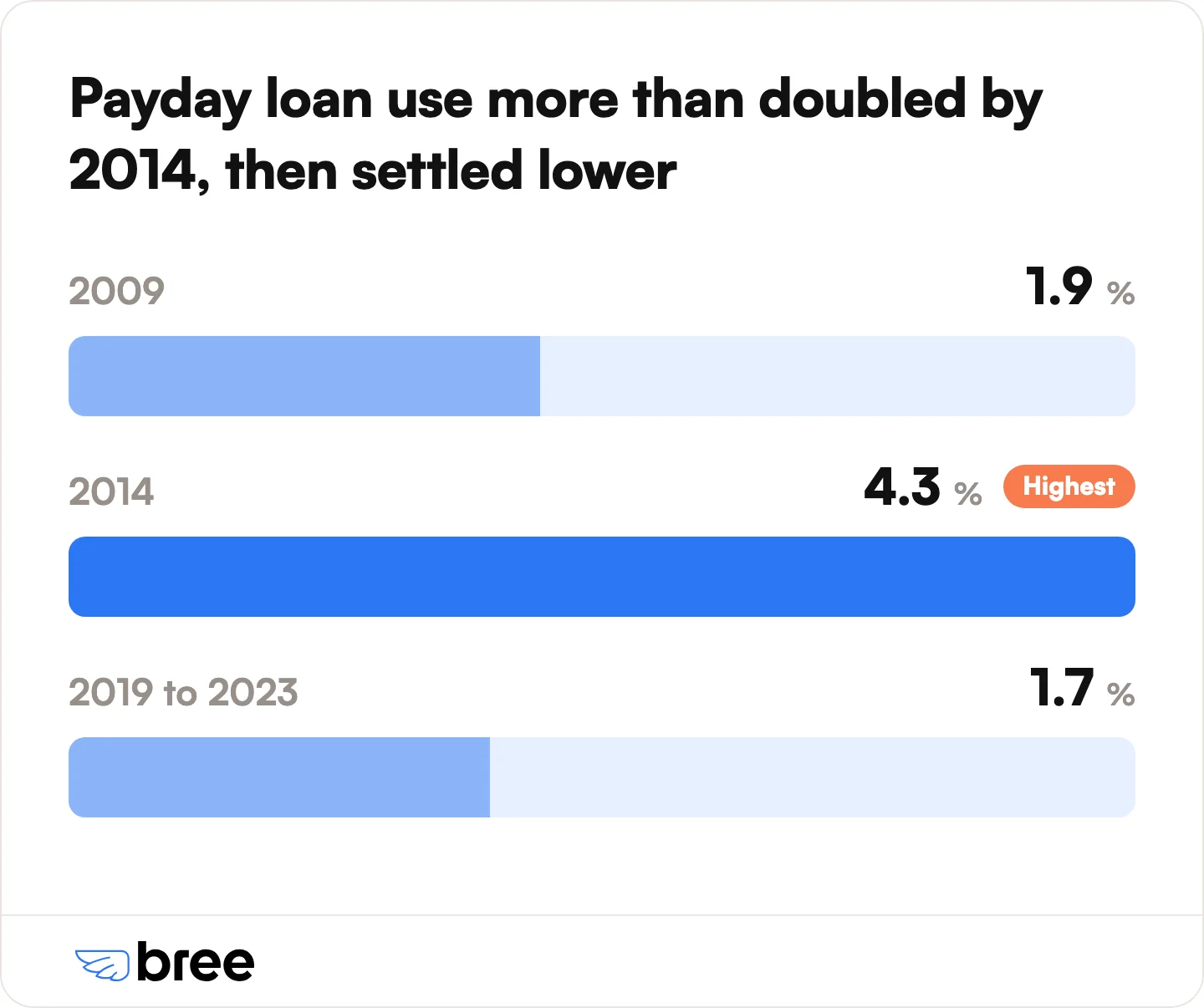
- Payday loans cost $14 per $100, roughly a 365% APR. The same $300 borrowed for two weeks costs about $6 to $8 through a line of credit, overdraft, or credit-card cash advance.
- Half of borrowers take out more than one payday loan, and 23% took six or more within three years. Repeat borrowing is the trap, not the single loan.
- 88% of payday loan users have no emergency savings, compared to 50% of non-users. Payday loans now show up in 40% of consumer insolvencies, up from 12% in 2011.
- Payday borrowing is concentrated among lone parents (6.2%), Indigenous Peoples (5.5%), and renters (3.1%), all well above the 1.7% national baseline.
How Common Are Payday Loans in Canada?
Payday loans reach a small but significant share of Canadian households, and usage climbed over the last 15 years before the newest data showed it settling.
- About 2 million Canadians use payday loans each year. FCAC's payday loan market research attributes this estimate to the Canadian Payday Loan Association.
- 4% of Canadian households used a payday loan in the prior year (2014), up from 2% in 2009. FCAC's market research recorded the share of households roughly doubling over that period.
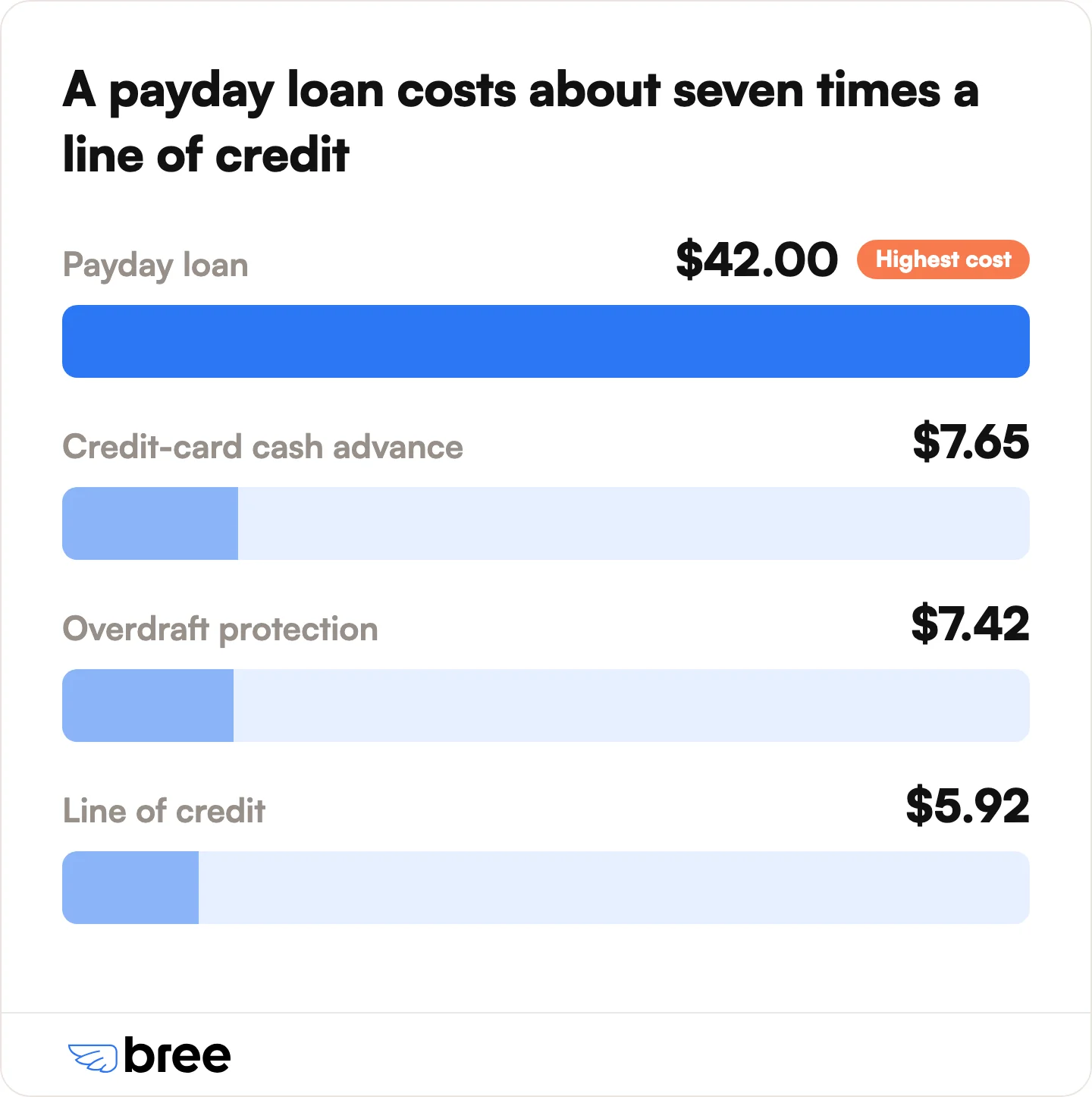
- Measured per person, use rose from 1.9% in 2009 to 4.3% in 2014. That is more than a doubling of payday loan use in five years, per FCAC.
- The current baseline is lower, at 1.7% of Canadians in a 12-month period. FCAC's study on understanding payday loan use, based on 2019 to 2023 data from more than 20,000 respondents, puts recent prevalence at 1.7%.
- 3.6% of Canadians used an online lender or payday company in 2023. Insolvency firm Hoyes Michalos tracked the shift toward digital lending in its payday loan analysis.
- Payday loans ranked sixth among credit products Canadians favour, at 4%. A 2025 Finder Canada consumer survey placed payday loans well behind credit cards (12%) and lines of credit (11%).
How many Canadians use payday loans depends on who is counting. The payday lending industry estimates close to 2 million users a year, the broadest figure. Government household surveys land lower: FCAC recorded 4% of households in 2014 and, in its more recent 2019 to 2023 data, 1.7% of individual Canadians over a 12-month period. Read together, they show payday loans reaching a meaningful share of the country, with the industry's own count sitting well above the survey rates.
What a Payday Loan Costs in Canada
The headline number is small until you turn it into an interest rate. Then it becomes one of the most expensive ways to borrow money in the country.
- A payday loan costs $14 per $100 borrowed. This is the federal maximum in force across payday-regulated provinces, per FCAC.
- That $14 per $100 equals an annual interest rate of about 365%. FCAC states the cost this way to make the true price clear.
- The old rates were higher. When Ontario allowed $15 per $100, the APR was about 391%, and an illustrative historical rate of $21 per $100 worked out to roughly 546%, as FCAC's market research noted.
- The criminal interest rate dropped from 48% APR to 35% APR on January 1, 2025. Licensed payday lenders are exempt from this cap under provincial rules, but the change reset the ceiling for other lending, per FCAC.
- A lender can charge a one-time fee of up to $20 for a dishonoured or returned payment. This is the capped penalty when a payment bounces.
- In Ontario, default interest is capped at 2.5% per month, non-compounding. Ontario's payday loan rules limit what a lender can add once a loan is in default.
The cleanest way to see the cost is to compare the same short-term loan across borrowing methods. FCAC published this breakdown for $300 borrowed over 14 days.
Quoted as "$14 per $100," a payday loan sounds cheap. Expressed as an APR near 365%, it costs about seven times what the same amount would cost on a line of credit, and five to six times what an overdraft or credit-card cash advance would run. That gap is the whole story.
Payday Loan Rules by Province
Payday lending is regulated province by province, so the cost cap, loan limit, and borrower protections depend on where you live. Most provinces now sit at the $14 per $100 cap, while Quebec's rules effectively keep payday lenders out.
- The maximum payday loan is $1,500, repayable within 62 days. This limit applies across payday-regulated provinces.
- In Ontario and British Columbia, a lender cannot advance more than 50% of your net income or paycheque per loan. Both provinces cap the loan against your income.
- British Columbia's rate fell from $15 to $14 per $100 on January 1, 2025. Consumer Protection BC confirms the current cap and the $1,500 / 62-day limit.
- Alberta capped costs at $15 per $100 in 2016, down from $23, and Ontario cut its cap from $21 to $15 per $100 in 2018. These provincial reductions preceded the federal alignment, per Hoyes Michalos.
- Quebec effectively has no payday loan industry. The province restricts lending permits above a 35% APR, which keeps payday-style products out of the market, per FCAC.
- Ontario borrowers gain access to an extended payment plan after taking three loans within 63 days. This protection kicks in for repeat borrowers under Ontario's rules.
Cost caps are current as of 2026. Because each province sets its own rules, check your provincial regulator for the latest figures before borrowing. For a deeper look at one market, see our guide to payday loans in Ontario.
How Big Is the Average Payday Loan?
Most payday loans are small. The data shows people borrowing a few hundred dollars to cover a shortfall, not large sums.
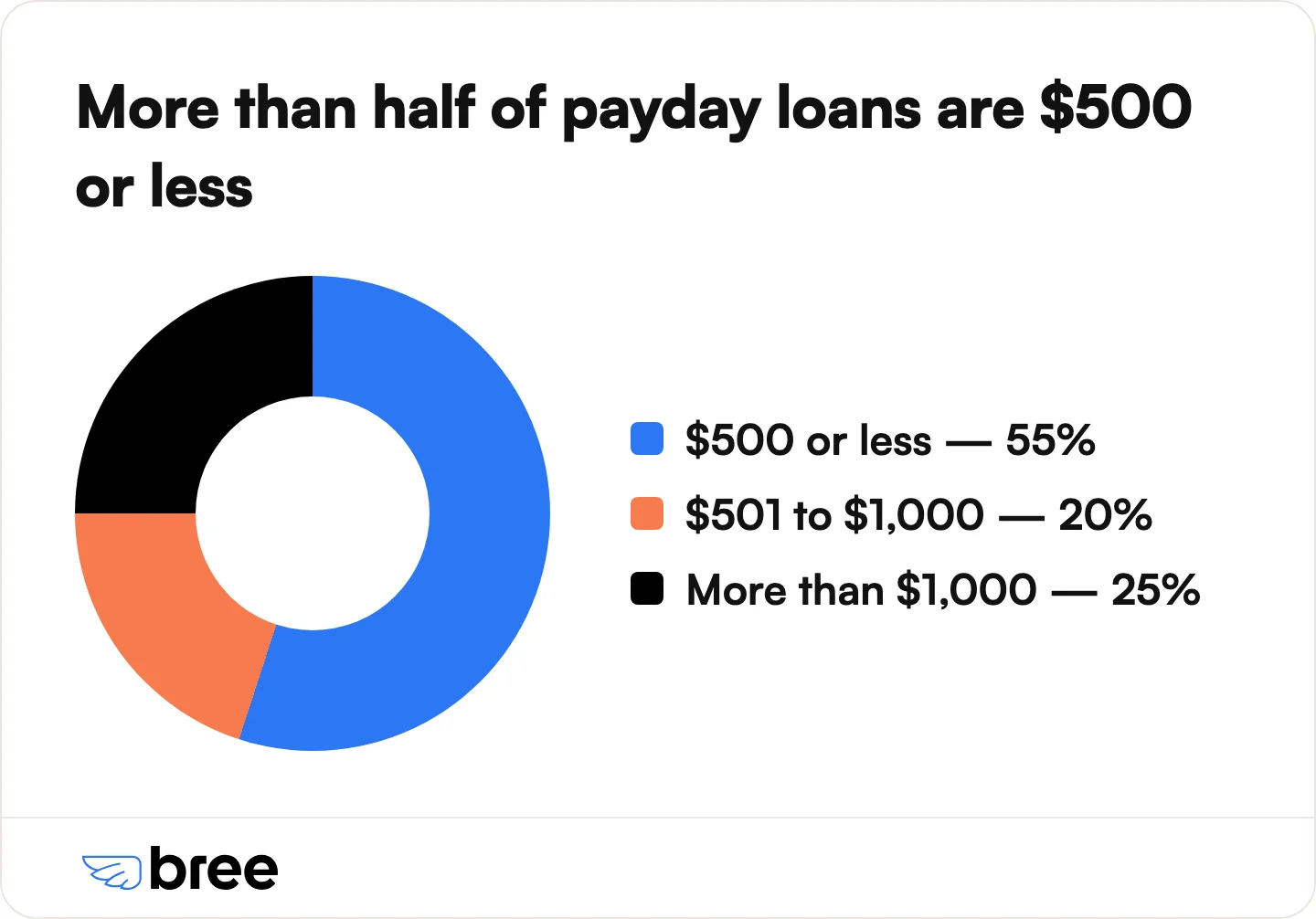
- 75% of payday loans were $1,000 or less. FCAC's market research found the large majority of loans stayed under four figures.
- 55% of payday loans were $500 or less. More than half of all loans fell at or below $500, per FCAC.
- Beyond the 55% at $500 or less, about 20% of loans landed between $500 and $1,000, leaving roughly a quarter above $1,000. Few topped the $1,500 legal maximum, per FCAC's market research.
- Among insolvent borrowers, homeowners owed more in payday debt than renters, at $1,830 versus $1,379 on average. Hoyes Michalos recorded this split in its insolvency study.
Repeat Borrowing and the Payday Debt Cycle
A single payday loan is rarely the problem. The harm shows up when people borrow again and again to stay afloat, and the data makes the pattern hard to miss.
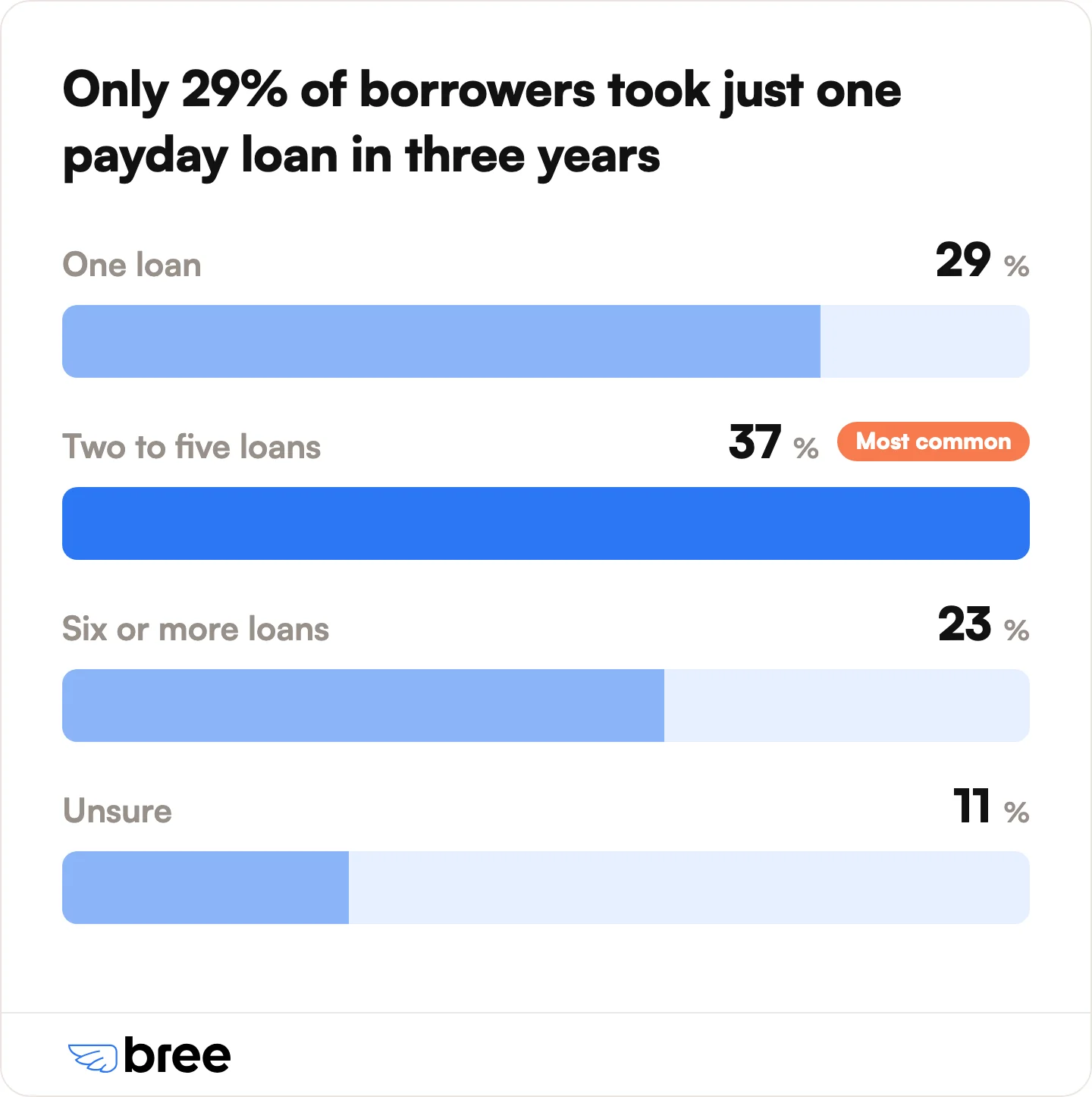
- 29% of borrowers took just one payday loan in three years, 37% took two to five, and 23% took six or more. FCAC's market research documented this spread, with 11% unsure.
- 50% of payday loan users took out a loan more than once during the survey period, versus 36% who borrowed only once and 14% who were unsure. FCAC's study on understanding payday loan use confirmed repeat borrowing is the majority experience.
- 7% of users took out a new payday loan specifically to repay an existing one. This direct rollover, per FCAC, is the clearest sign of a cycle.
- Roughly 45% of borrowers take multiple loans a year, averaging two to three loans annually. Hoyes Michalos found repeat use to be the norm rather than the exception.
- 15% of borrowers took out 10 or more payday loans in three years. A small group borrows constantly, per Hoyes Michalos.
- Renters are more likely to be repeat borrowers, with 25% taking six or more loans a year versus 18% of homeowners. Hoyes Michalos recorded the housing split.
- About 20% of payday loan users fail to repay on time. Roughly one in five borrowers misses the due date, per Hoyes Michalos.
- 30% of payday loan users report difficulty repaying their loans on time. That self-reported repayment struggle, per FCAC's study on understanding payday loan use, is what pushes many borrowers toward another loan.
The lived experience behind these numbers is grim. Borrowers describe juggling several lenders at once, taking a new loan from one to pay off another, until the biweekly payments swallow the paycheque. If that sounds familiar, our guide on how to escape the payday loan debt cycle walks through the way out.
Why Canadians Take Out Payday Loans
People do not use payday loans for luxuries. The data points overwhelmingly to necessary bills and to the speed of getting approved when other doors are closed.
- 45% of borrowers used a payday loan for an unexpected necessary expense, such as a car repair. FCAC's market research identified this as the top reason.
- 41% borrowed for an expected necessary expense, such as rent or a utility bill. Recurring essentials drive nearly as many loans, per FCAC.
- 89% of users borrowed for necessary living expenses overall. The current FCAC research on understanding payday loan use confirms the near-universal focus on essentials.
- 90% of borrowers said a payday loan was the fastest or most convenient option. Speed is the leading draw, per FCAC.
- 74% said it was the best option available to them, and 55% cited the best customer service. Many borrowers see few alternatives, per FCAC's market research.
- 27% said a bank or credit union would not lend to them. For more than a quarter of users, traditional credit was off the table, per FCAC.
- In early 2023, borrowers most often cited groceries (13%), electricity (11%), and gas (8%). A Finder Canada survey tracked the specific bills behind recent loans.
Who Uses Payday Loans in Canada
Payday borrowers span a wider range of ages and incomes than the stereotype suggests, but renters and lower-income households are clearly overrepresented.
Age, housing, and income
- 48% of borrowers are aged 35 to 54, and 72% are aged 25 to 54. Prime working-age adults make up the bulk of users, per FCAC and Hoyes Michalos.
- Seniors 65 and older make up about 6% of borrowers, and their use has been growing. Older Canadians are a rising share, per Hoyes Michalos.
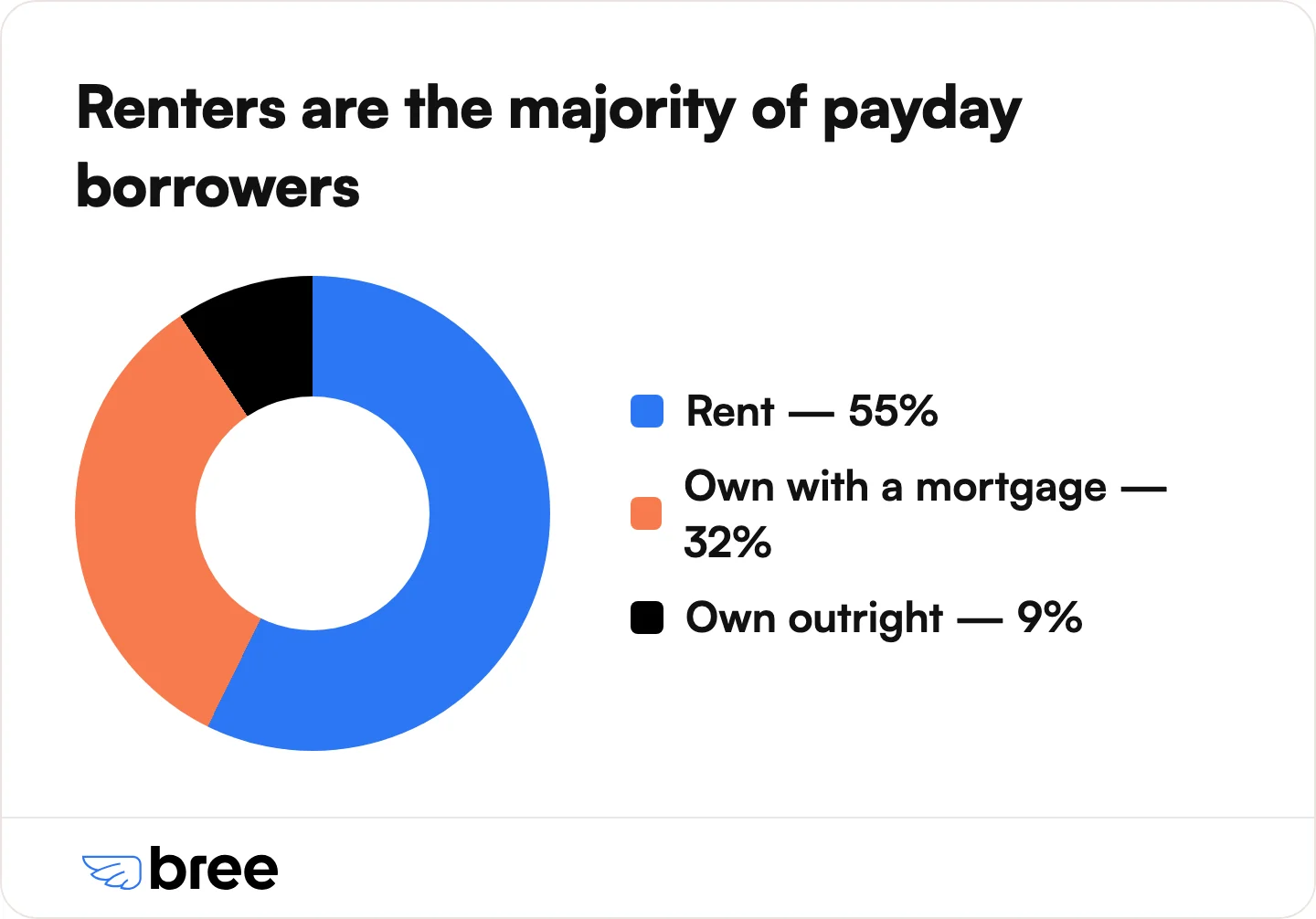
- 55% of borrowers rent, 32% own with a mortgage, and 9% own outright. Renters are the majority, per FCAC's market research.
- More than half of borrowers live in households earning under $55,000, and more than 70% earn under $80,000. Payday use concentrates in lower-income households, per FCAC.
- 20% of borrowers reported household incomes above $80,000, and 7% above $120,000. Payday borrowing is not limited to the lowest earners, per FCAC.
- 47% of borrowers have moderate or higher incomes, and 20% earn above the Canadian median household income. Hoyes Michalos found payday use reaching well into the middle class.
Who is overrepresented
Against a national baseline of 1.7%, the current FCAC research shows some groups using payday loans well above the national rate, up to nearly four times higher.
Payday loan use by group against the 1.7% national baseline. Source: FCAC.
- Lone parents (6.2%) and Indigenous Peoples (5.5%) use payday loans at the highest rates. Both sit well above the 1.7% baseline, per FCAC's study on understanding payday loan use.
- Renters (3.1%), people with a disability (3.5%), unemployed Canadians (3.7%), and low-income households under $40,000 (2.9%) are also overrepresented. These gaps show who leans on payday credit most, per FCAC.
Payday Loans and Financial Distress
Payday borrowing is both a symptom of financial strain and something that can deepen it. The gap between users and non-users on basic financial health is stark.
- 88% of payday loan users report a lack of emergency savings, compared to 50% of non-users. FCAC's research on understanding payday loan use records the divide.
- 86% of users are often short on money for essentials like food, versus 31% of non-users. Payday borrowers face far more frequent shortfalls, per FCAC.
- 43% of payday users describe themselves as struggling a lot financially, compared to 13% of non-users. The self-reported strain is more than triple, per FCAC.
- Only 25% of users recognized that a payday loan costs more than a credit-card cash advance, and 26% thought it cost the same as a bank loan. Cost misperception is widespread, per FCAC.
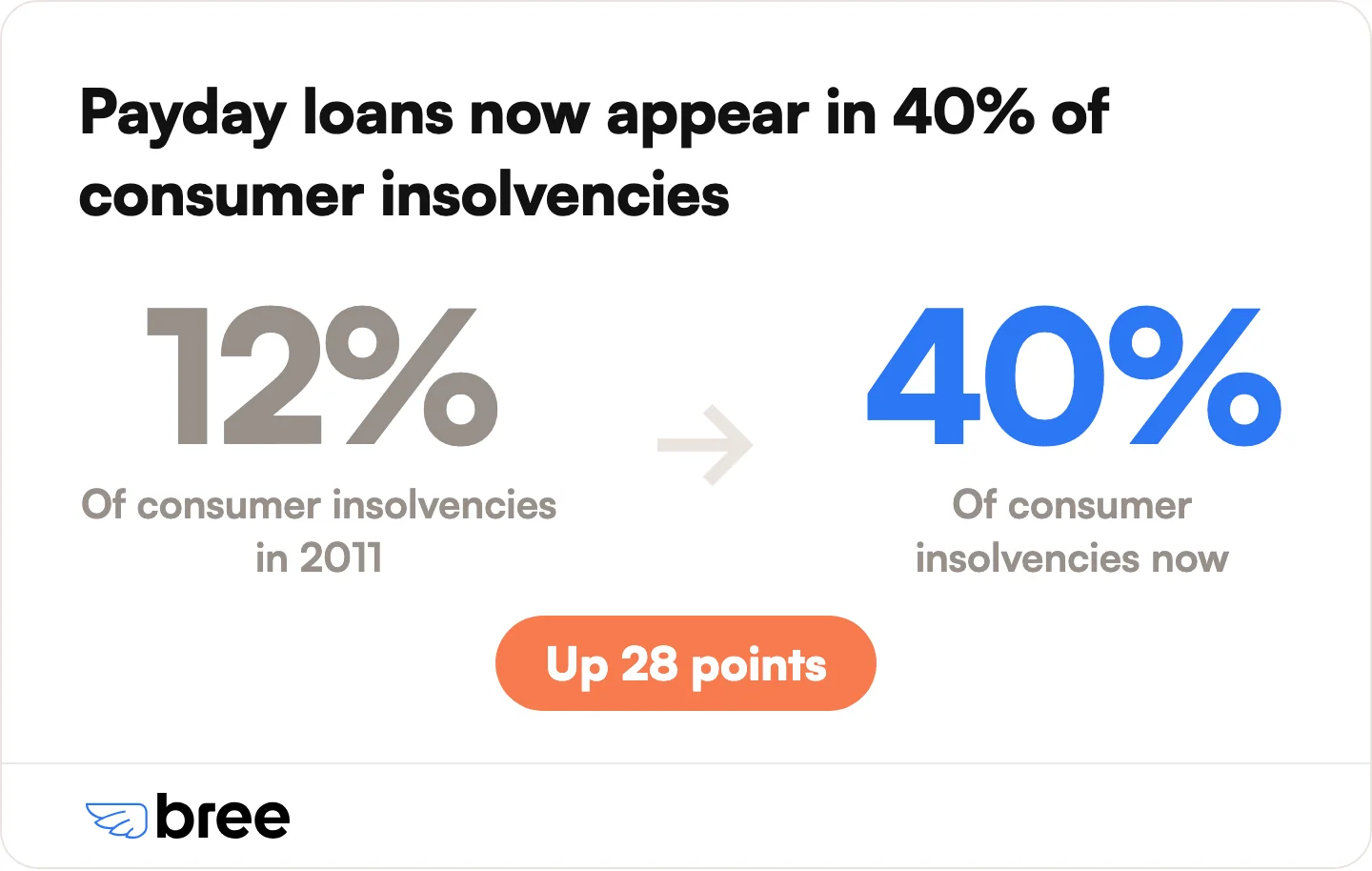
- Payday loans appear in 40% of consumer insolvencies, up from just 12% in 2011. Hoyes Michalos found payday debt increasingly tied to insolvency filings.
- The average insolvent payday borrower owed $8,157 in payday loans, rising to $12,352 including instant-cash installment loans. Hoyes Michalos recorded the debt loads at insolvency.
- Among insolvent payday borrowers, 73% had two or more loans at once, and 9% owed at least 10 different lenders. Multiple simultaneous loans are common at the point of insolvency, per Hoyes Michalos.
- In 2023, 28% of insolvent debtors aged 60 and older had a payday loan, owing $9,606 on average. Older insolvent debtors carry heavy payday balances, per Hoyes Michalos.
This strain sits inside a wider debt picture.
- Canadian household debt reached 179.6% of disposable income in the first quarter of 2026, its sixth straight quarterly increase, with a debt-service ratio of 14.75%. Statistics Canada reports Canadians owed roughly $1.80 in credit market debt for every dollar of disposable income.
- Insolvency filings totalled 150,505 over the 12 months ending June 2026, consumers and businesses combined, up 5.3% year over year. The Office of the Superintendent of Bankruptcy recorded 37,523 consumer insolvencies in the second quarter of 2026, up from 37,121 in the first quarter.
Roughly half of Canadians feel they are living paycheque to paycheque, which is the pressure that sends people to payday lenders in the first place. Our paycheque-to-paycheque statistics page digs into that data.
The Payday Loan Market Is Changing
The payday industry is still large, but it is moving online as storefronts close and lower-cost alternatives grow.
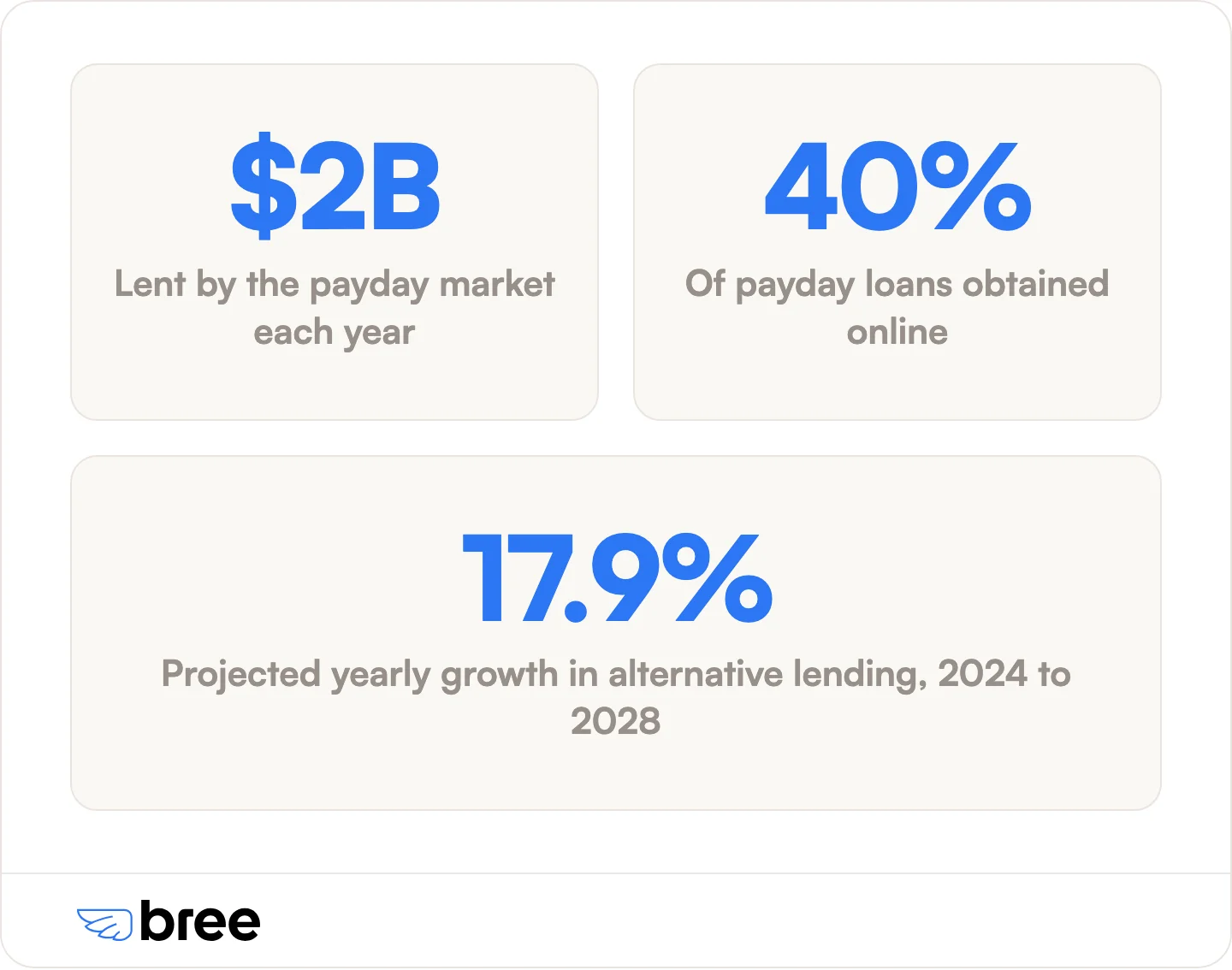
- The Canadian payday market lends an estimated $2 billion each year. Hoyes Michalos sized the market in its payday loan analysis.
- About 40% of payday loans are now obtained online. Digital lending has taken a large share of the market, per Hoyes Michalos.
- Alberta's storefronts fell from 230 in 2015 to 165 in 2018, an almost 30% drop. Tighter rate caps thinned the storefront network, per Hoyes Michalos.
- Alternative lending in Canada is projected to grow at a compound annual rate of 17.9% from 2024 to 2028. A Research and Markets forecast points to fast growth in non-bank credit.
- Only 3% of Canadians would turn to a payday loan first to cover a $1,000 emergency. A Finder Canada survey found most people would reach for savings or other credit before a payday lender.
Alternatives to Payday Loans
Cheaper options exist, and the fastest-growing one is the interest-free cash advance app. These apps launched in Canada around 2021 and are already among the credit products Canadians say they would use, according to Finder Canada survey data.
The contrast with payday lending is direct. A payday loan charges $14 per $100, an APR near 365%. An interest-free cash advance charges 0%. Bree is a Canadian line of credit, and we offer up to $750 in funds with no credit check and no interest. Funds arrive by direct deposit to your bank account, and government benefits like ODSP, OW, CPP, CCB, and EI count as qualifying income. There are no mandatory fees. The only costs are an optional tip and an optional express fee to get your money faster.
For more ways to cover a shortfall without the 365% price tag, see our roundup of payday loan alternatives, or learn how a $750 interest-free cash advance works.
Frequently Asked Questions
What percentage of Canadians use payday loans?
About 4% of Canadian households used a payday loan in the year measured by FCAC's market research. The payday lending industry separately estimates close to 2 million users a year, while FCAC's more recent 2019 to 2023 data puts use at 1.7% of individual Canadians over a 12-month period.
What is the interest rate on a payday loan in Canada?
A payday loan costs $14 for every $100 borrowed, which equals an annual percentage rate of about 365%. This federal cap took effect on January 1, 2025. Before that, provinces allowed higher rates, such as $15 per $100 in Ontario, which worked out to roughly 391%.
Are payday loans illegal in Canada?
No. Payday loans are legal and regulated province by province. Licensed payday lenders are exempt from the 35% criminal interest rate cap, provided they follow their provincial rules on maximum cost, loan size, and borrower protections. An unlicensed lender charging above the legal cap is operating illegally.
How long can a payday lender take you to court in Canada?
A payday lender can pursue an unpaid debt through collections and, if needed, civil court, generally within the provincial limitation period, which is commonly around two years from the last payment or acknowledgment of the debt. You cannot be jailed for an unpaid payday loan. It is a civil debt, not a criminal matter. In Ontario, a lender in this situation can add default interest of no more than 2.5% per month, non-compounding.
How can you spot an illegal lender or loan shark?
Warning signs include no provincial licence, rates above the legal $14 per $100 cap, demands for upfront fees before you receive money, and no written loan agreement. Every legitimate payday lender must be licensed in the province where it operates, so check with your provincial consumer protection office before borrowing.
The Bottom Line
Payday loans in Canada are common, expensive, and concentrated among the people with the least financial slack. Around 2 million Canadians use them each year, half borrow more than once, and the $14-per-$100 cost translates to an APR near 365%. The rules have tightened, but the debt cycle the data describes is still very real.
The good news is that cheaper options keep growing. Bree is the interest-free line of credit we built for exactly this situation: up to $750 in funds, no credit check, and a 4.8 out of 5 rating across more than 8,007 Trustpilot reviews. If you are weighing your options, see how an interest-free line of credit works.

Sources
- Financial Consumer Agency of Canada: Understanding Payday Loan Use and Perspectives
- Financial Consumer Agency of Canada: Payday Loans Market Trends
- Government of Ontario: Payday Loan, Your Rights
- Consumer Protection BC: Payday Loans
- Statistics Canada: National Balance Sheet and Financial Flow Accounts
- Office of the Superintendent of Bankruptcy: Insolvency Statistics
- Hoyes Michalos: Payday Loan Crisis

Join our newsletter to get the latest updates
.png)