.png)
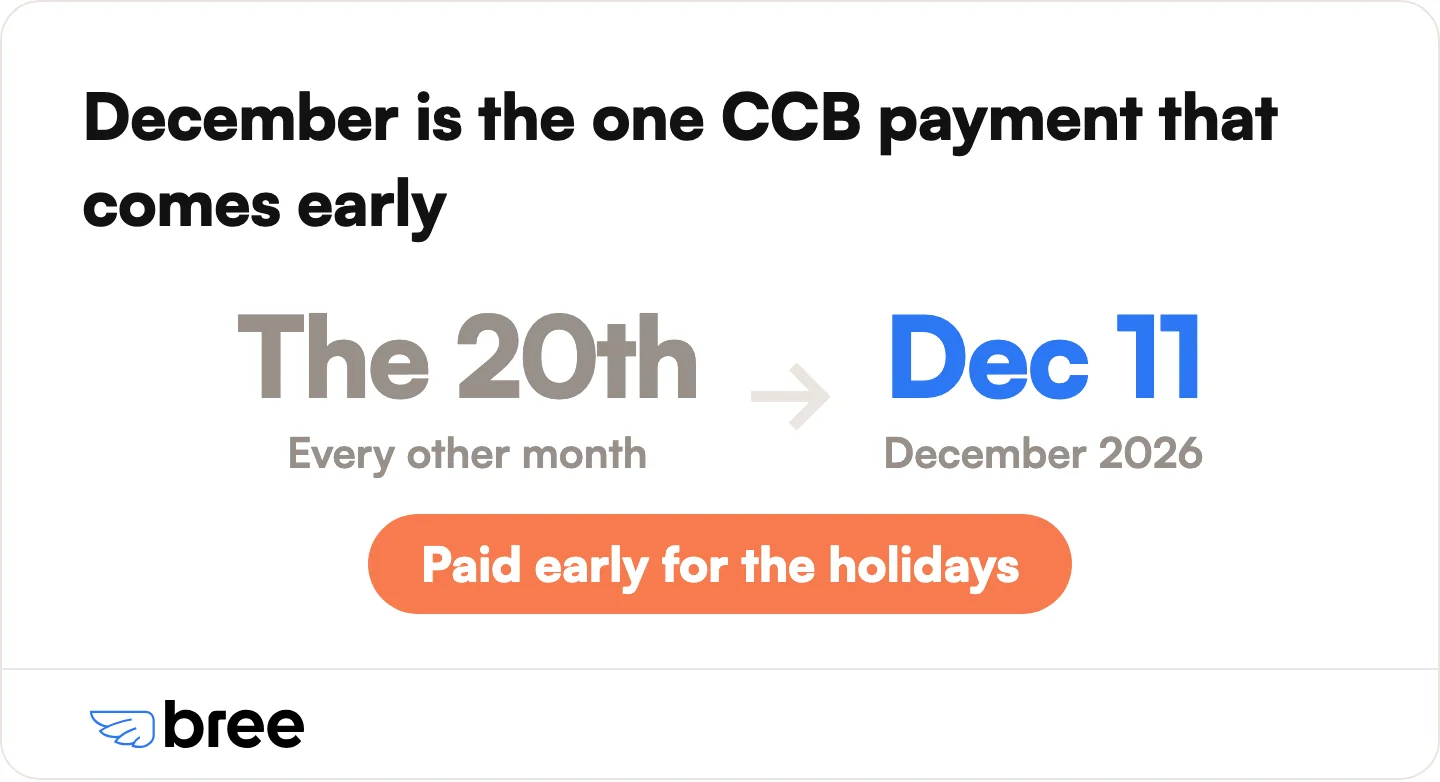
The next Canada Child Benefit (CCB) payment is September 18, 2026. The Canada Revenue Agency (CRA) pays the CCB on the 20th of each month. When the 20th lands on a weekend, the payment arrives on the last business day before it, and in December it comes earlier so families have the money before the holidays. The final 2026 payment is December 11.
The CCB is a tax-free monthly payment that helps eligible families with the cost of raising children under 18. Below you will find every 2026 payment date, the maximum amounts for the July 2026 to June 2027 benefit year, who qualifies, and what to do if a payment is late.
Key Takeaways
- The next CCB payment is September 18, 2026, and payments land on the 20th of each month unless that date falls on a weekend or the December holiday period.
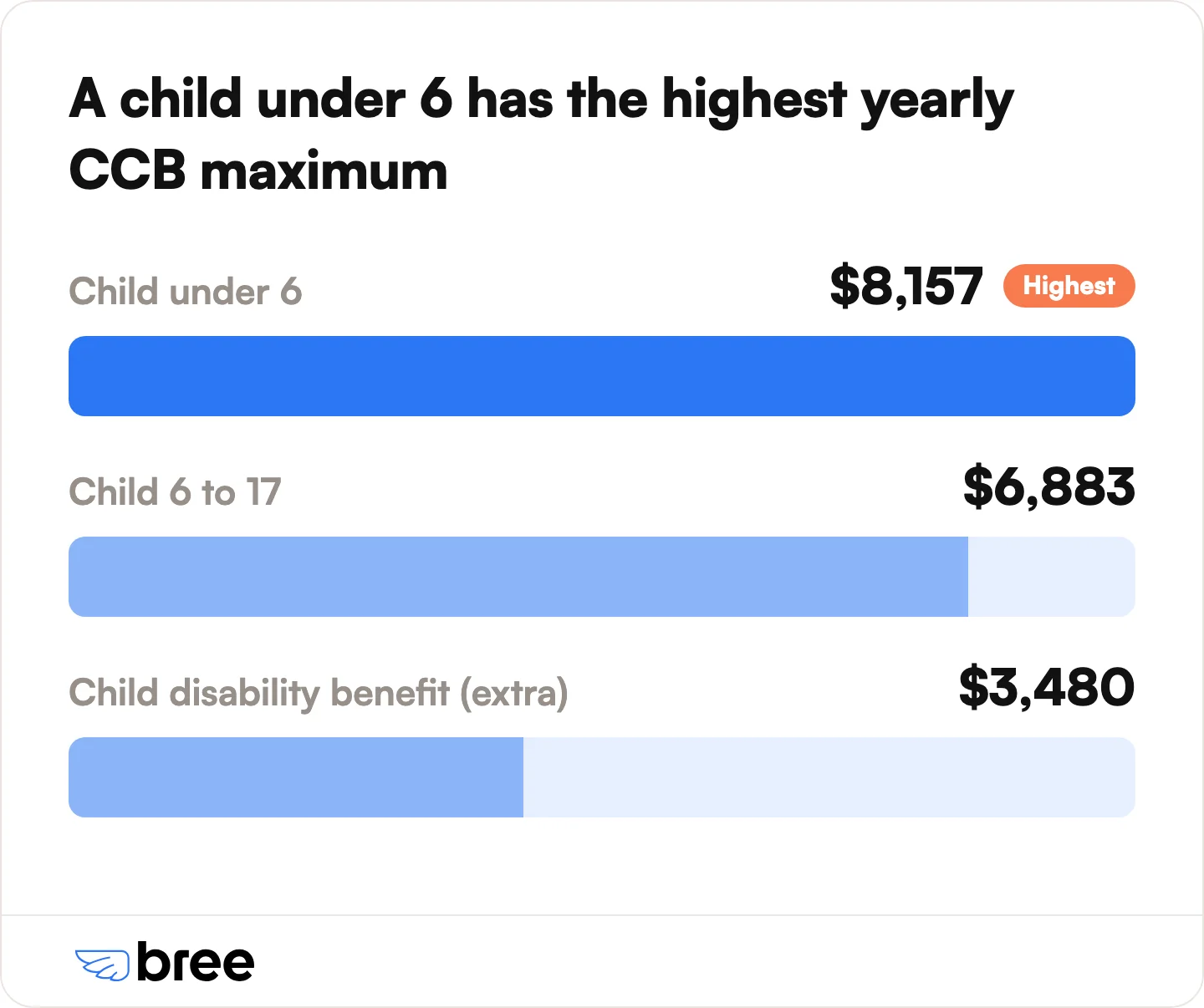
- The maximum CCB for July 2026 to June 2027 is $8,157 per year ($679.75 per month) for each child under 6, and $6,883 per year ($573.58 per month) for each child aged 6 to 17.
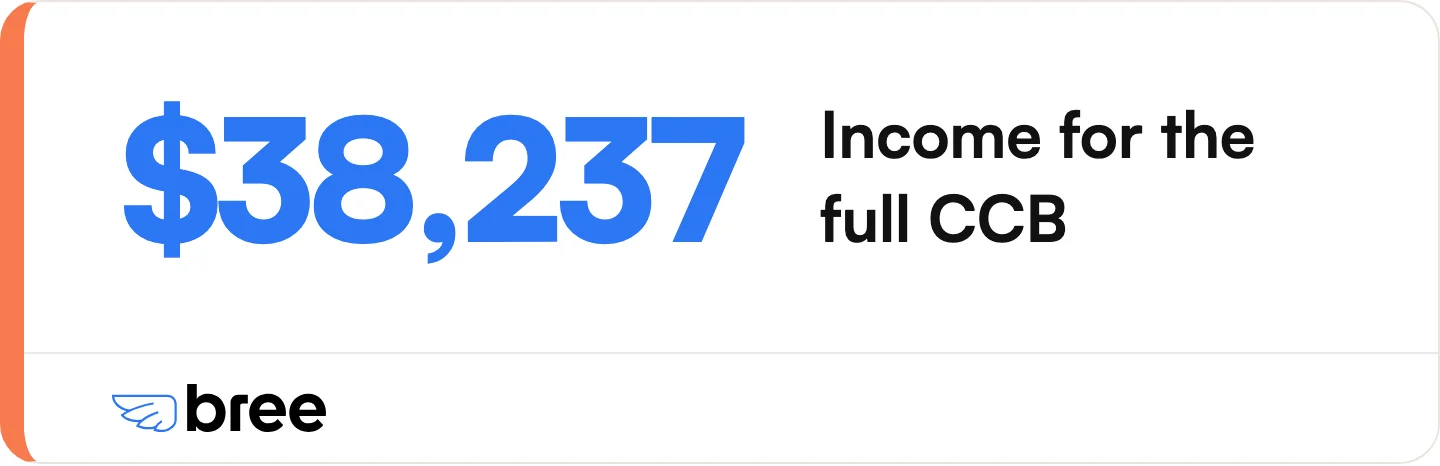
- Families with an adjusted family net income under $38,237 receive the full maximum benefit. The amount is reduced above that threshold.
- The Child Disability Benefit adds up to $3,480 per year ($290 per month) for each child who qualifies for the disability tax credit.
- File your taxes every year to keep your payments coming. The CRA recalculates your benefit each July from your previous year's return.

CCB Payment Dates 2026
The CRA issues Canada Child Benefit payments once a month, on the 20th. When the 20th falls on a weekend, the payment is moved to the last business day before it. The December payment is issued earlier than the 20th so families receive it ahead of the holidays.
Here are the Canada Child Benefit payment dates for 2026:
- January 20, 2026
- February 20, 2026
- March 20, 2026
- April 20, 2026
- May 20, 2026
- June 19, 2026 (the 20th is a Saturday)
- July 20, 2026
- August 20, 2026
- September 18, 2026 (the 20th is a Sunday)
- October 20, 2026
- November 20, 2026
- December 11, 2026 (early holiday payment)
If your total annual benefit is less than $240, the CRA does not send monthly payments. Instead, you receive one lump-sum payment with your July payment. You can confirm your own dates and amounts in your CRA My Account.
2027 payment dates are not published yet. The CRA typically releases the new calendar late in the year. The monthly schedule follows the same pattern: the 20th of each month, moved earlier for weekends and the December holidays. We will update this page with the exact 2027 dates once the CRA publishes them.
Looking for other benefit schedules? See our guides to CPP payment dates and GST/HST credit payment dates.
How Much Is the CCB in 2026 to 2027?
For the benefit year running July 2026 to June 2027, the maximum Canada Child Benefit is $8,157 per year for each child under 6 and $6,883 per year for each child aged 6 to 17. These amounts are based on your adjusted family net income (AFNI) from your 2025 tax return.
You receive the full maximum when your adjusted family net income is under $38,237. Above that, the benefit is reduced on a sliding scale, and the reduction increases again once your income passes $82,847. The exact reduction depends on how many children you have.
Worked example: A family with one child under 6 and an adjusted family net income of $50,000 is $11,763 over the $38,237 threshold, so their benefit is reduced below the $8,157 maximum. Because the reduction rate changes with the number of children, the simplest way to get your exact figure is the CRA child and family benefits calculator.
If your child qualifies for the disability tax credit, you may also receive the Child Disability Benefit, worth up to $3,480 per year ($290 per month) for each eligible child for the July 2026 to June 2027 period.
Provincial and Territorial Child Benefits
Many provinces and territories run their own child benefit programs on top of the federal CCB. Examples include the BC Family Benefit, the Ontario Child Benefit, the Alberta Child and Family Benefit, and similar programs in other regions. You do not apply separately for most of them. When you apply for the CCB, the CRA checks whether you qualify for your province's or territory's program too.
In most cases the CRA combines these amounts with your federal CCB and pays them together in one monthly deposit on the same payment date. That is why your total deposit may be higher than the federal maximums listed above. Your province's own income thresholds and amounts determine the extra.
What Is the Canada Child Benefit?
The Canada Child Benefit is a tax-free monthly payment from the Canada Revenue Agency that helps eligible families with the cost of raising children under 18. It replaced the Universal Child Care Benefit and the Canada Child Tax Benefit in 2016.
Each benefit year runs from July to June of the following year. The amount you receive depends on four things:
- The number of children in your care
- The ages of your children
- Your marital status
- Your adjusted family net income
Because the benefit is tax-free, you do not report it as income and it does not reduce other benefits you receive.
Who Is Eligible for the CCB?
To receive the Canada Child Benefit, you must live with a child under 18, be primarily responsible for that child's care, and be a resident of Canada for tax purposes. You or your spouse or common-law partner also needs to meet one of the CRA's status requirements. Here is what each condition means.
1. Primary caregiver status
You must be the person primarily responsible for the child's daily care and upbringing. That means you supervise the child's daily activities, make sure their medical needs are met, and arrange child care when it is needed. Only one person per household should apply, even if two parents live together.
If you share custody, the rules depend on how much time the child spends with you. When a child lives with you between 40% and 60% of the time, the CRA treats it as shared custody, and each parent receives 50% of the payment they would get with full custody. When a child is with you more than 60% of the time, you are considered to have full custody and should apply. If a child lives with you less than 40% of the time, you are not eligible.
2. Canadian residency status
You must be a resident of Canada for tax purposes. You and your spouse or common-law partner may qualify if you are a:
- Canadian citizen
- Permanent resident
- Protected person
- Temporary resident who has lived in Canada for the previous 18 months and holds a valid permit
- Person registered, or entitled to be registered, under the Indian Act
3. The age of the child
Your child must be under 18. Payments stop the month after your child turns 18.
4. Income qualifications
Your payment amount depends partly on your income. Families with an adjusted family net income under $38,237 receive the maximum CCB for each child. As your income rises above that amount, your benefit is gradually reduced. You can estimate your benefit with the CRA child and family benefits calculator.
How to Apply for the CCB
You can apply for the Canada Child Benefit in three ways: at birth, online, or by mail. Only one parent per household should apply.
- At birth. When you register your newborn with your province or territory, you can consent to share the birth registration information with the CRA and apply for the CCB at the same time.
- Online. Sign in to CRA My Account and use "Apply for child benefits."
- By mail. Complete and sign Form RC66, Canada Child Benefits Application, and mail it to your tax centre.
Processing times vary depending on when and how you apply. You can track the status of your application in CRA My Account. If your spouse or common-law partner is a non-resident of Canada for part of the year, you also need to complete Form CTB9, Income of Non-Resident Spouse or Common-Law Partner.
Why Did My CCB Amount Change?
The CRA recalculates your Canada Child Benefit every July using your adjusted family net income from the previous year's tax return. If your July 2026 payment changed, the most common reason is that your 2025 income was different from the year before.
Your amount can also change during the year if:
- Your marital status changed
- The number of children in your care changed
- A child turned 6, which moves them to the lower age band
- A child turned 18, which ends their payments
- Your custody arrangement changed
The maximum amounts also rise most years because the CRA indexes them to inflation. That is why the 2026 to 2027 maximums ($8,157 and $6,883) are higher than the previous year's.
What to Do If Your CCB Payment Is Late or Missing
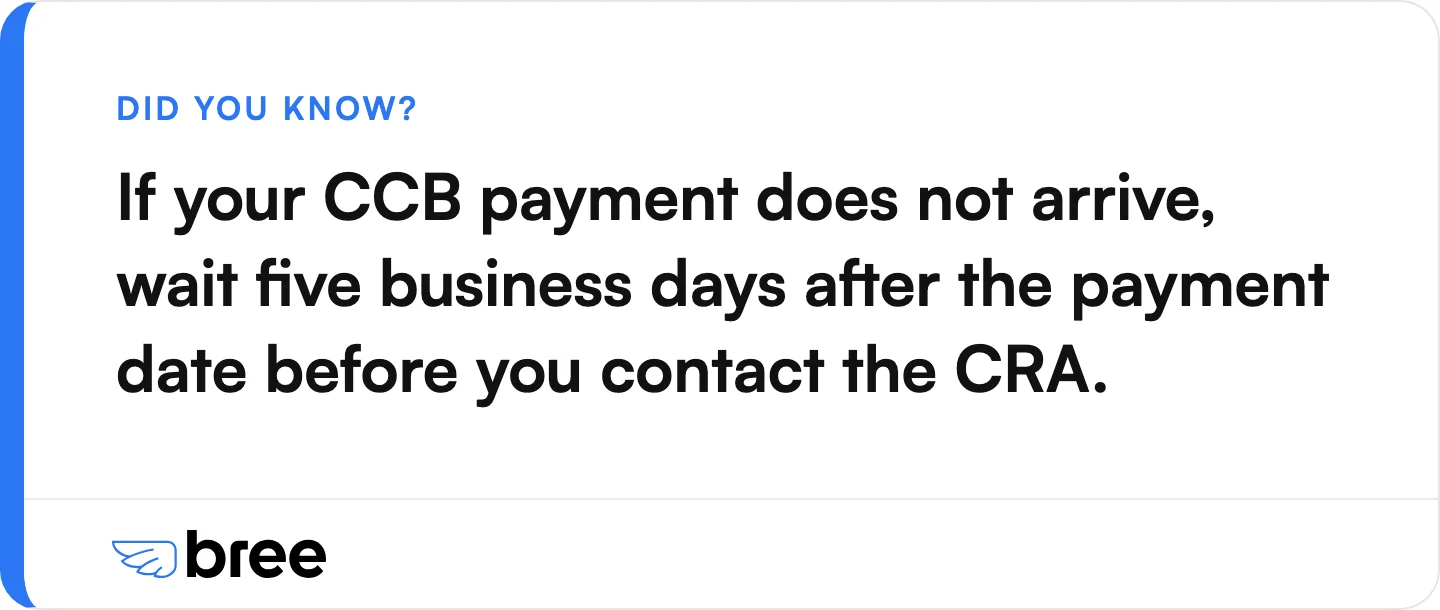
If your Canada Child Benefit payment does not arrive, wait five business days after the payment date before contacting the CRA. Payments can be delayed by weekends, holidays, or a change to your banking information.
Your payments may stop or change for reasons such as:
- You did not file your tax return, or your spouse or common-law partner did not file theirs
- You did not respond to a letter or request from the CRA
- Your address or direct deposit details changed and the CRA was not notified
- Your income rose after the July recalculation
- Your child turned 18, or you no longer have a child in your care
After five business days, you can check your payment details in CRA My Account or call the CRA at 1-800-387-1193. If you live in Yukon, the Northwest Territories, or Nunavut, call 1-866-426-1527.
Waiting on a delayed payment can leave a real gap when rent or groceries are due. If that happens, an interest-free line of credit can bridge the days until your CCB lands, and our guide to payday loans that accept child tax benefits explains how it works.
Bridge the Gap Between CCB Payments
Bree is an instant line of credit built for Canadians, and we help families cover the gap between government payments with an up to $750 in interest-free funds. CCB, CPP, EI, ODSP, and other government benefits all count as qualifying income, which matters because many lenders reject benefit recipients.
Here is what makes Bree different from a payday loan:
- 0% interest, no mandatory fees. Bree is free to use. The only costs are an optional tip and an optional express fee if you want your money faster.
- Up to $750, deposited straight to your bank account. Standard delivery is free and lands in 1 to 3 business days. Express delivery arrives in minutes.
- No credit check. Approval is based on your bank account history, not your credit score.
More than 600,000 Canadians use Bree, and it holds a 4.8 out of 5 rating on Trustpilot from over 8,000 reviews. If your CCB payment is days away and the bills are due now, you can get up to $750 with Bree or read real customer reviews first. For more on borrowing against child benefits, see our guide to child tax loans in Canada.
Frequently Asked Questions
Is the CCB going up in 2026?
Yes. For the July 2026 to June 2027 benefit year, the maximum rose to $8,157 per year for each child under 6 and $6,883 per year for each child aged 6 to 17. The CRA indexes these maximums to inflation each July.
How much CCB will I get for two children?
Your amount depends on your income and the ages of your children, not a flat per-family figure. A family under the $38,237 income threshold with two children under 6 would receive the full maximum for each, which is $8,157 per child per year for the 2026 to 2027 period. Use the CRA calculator for your exact amount.
Is the CCB taxable?
No. The Canada Child Benefit is tax-free. You do not report it as income on your tax return, and it does not reduce other benefits.
Can I get the CCB if I share custody?
Yes. When a child lives with you between 40% and 60% of the time, the CRA treats it as shared custody, and each parent receives 50% of the amount they would get with full custody. Each parent's share is based on their own adjusted family net income.
What happens to the CCB when my child turns 18?
Your CCB payments for that child end. The last payment is issued for the month of the child's 18th birthday, calculated at the 6 to 17 rate.
How long until my first CCB payment?
Processing time depends on how and when you applied. Applications made when you register your child's birth are usually the fastest. You can see an estimated processing time and track your application in CRA My Account, and you can expect your first payment on the next scheduled CCB date once your application is approved.
What if I was overpaid?
If you received more CCB than you were entitled to, the CRA recovers the difference. It usually does this by lowering your future CCB payments or other tax benefits and credits until the balance is repaid. Keeping your marital status, income, and custody details current with the CRA is the best way to avoid an overpayment.
The Bottom Line
The Canada Child Benefit is paid on the 20th of each month, with the next payment on September 18, 2026 and the final 2026 payment arriving early on December 11. For the July 2026 to June 2027 benefit year, the maximum is $8,157 per year for each child under 6 and $6,883 per year for each child aged 6 to 17, with full benefits going to families under the $38,237 income threshold. File your taxes on time every year, keep your details current with the CRA, and use My Account to track your payments.
When a payment is late or the month runs long, our interest-free line of credit gives Canadian families a way to bridge the gap, with up to $750 in funds with government benefits accepted as income. You can sign up in a few minutes and only pay a tip if you choose to.
Sources

Join our newsletter to get the latest updates