.png)
The Canada Pension Plan disability benefit (CPP-D) is a monthly payment from the Canada Pension Plan for people who paid into CPP and now have a severe, long-term disability that stops them from working. To apply, you complete two forms, the application (ISP-1151) and a medical report your doctor fills out (ISP-2519), then submit them online through your My Service Canada Account or by mail. Service Canada aims to decide within 120 days.
The single thing that decides most claims is the medical report. It has to show what your condition stops you from doing day to day, not just name a diagnosis. Get that part right and you avoid the most common reason applications get denied.
Bree is a Canadian financial app we built for the millions of Canadians who live between paycheques and benefit payments, and unlike most lenders we accept CPP and other government income as qualified income. This guide walks through the whole application, from checking if you qualify to what to do if you are denied.
Key Takeaways
- CPP disability is contributory, not means-tested. You qualify on your CPP contribution history plus a severe and prolonged disability, not on your income, savings, or assets.
- The medical report (ISP-2519) is the deciding document. Adjudicators want your functional limitations spelled out, not just a diagnosis label.
- Expect about four months for a decision. Standard applications are targeted for 120 calendar days. Terminal and grave conditions are fast-tracked.
- The 2026 maximum is $1,741.20 per month. The average new beneficiary receives $1,234.68 per month.
- A first denial is not the end. You can ask for a reconsideration and then appeal to the Social Security Tribunal, and many denied applicants succeed on appeal.

What Is the CPP Disability Benefit?
The CPP disability benefit is a monthly federal payment for CPP contributors under 65 who cannot work regularly because of a severe and prolonged disability. You must have paid into the Canada Pension Plan through past work, and your disability has to meet a strict medical test. It is paid by Service Canada, not by your province.
CPP-D is easy to confuse with three other programs. Getting the right one saves you from applying to the wrong place.
- It is not the Canada Disability Benefit. The Canada Disability Benefit is a newer, income-tested federal payment tied to the Disability Tax Credit, with its own separate application. If that is what you are looking for, see our guide to Canada Disability Benefit payments.
- It is not provincial disability assistance. Programs like Ontario's ODSP or BC's Persons With Disabilities (PWD) benefit are run by your province and are based on income and assets, not CPP contributions. You can read our guides to ODSP payment dates and BC disability payment dates for those.
- It is not for Quebec residents. If you worked in Quebec and paid into the Quebec Pension Plan, you apply for the QPP disability pension through Retraite Québec instead.
You can also receive CPP-D at the same time as some provincial disability payments, but each program is applied for separately and each has its own rules.
Who Qualifies for CPP Disability?
To qualify for CPP disability you have to meet three requirements at once: an age requirement, a contribution requirement, and a medical requirement. Missing any one of them means the application is denied, so it is worth checking all three before you apply. All three are set out on the Service Canada CPP disability eligibility page.
You must be over 18 and under 65. CPP-D is for working-age contributors. At 65 it automatically converts to the CPP retirement pension, so you cannot start a new disability claim after that.
You must meet the contribution requirement. You need valid CPP contributions in at least four of the last six years, or at least 25 years of contributions with contributions in three of the last six years. Your contributions come from money you paid into CPP while working. If a gap in your work history is caused by raising young children or by a divorce, the child-rearing provision and credit splitting can sometimes help you meet this rule.
Your disability must be both severe and prolonged. This is the medical test, and it uses two specific words with legal meanings:
- Severe means a mental or physical disability that regularly stops you from doing any type of substantially gainful work, not just your old job.
- Prolonged means the disability is long-term and of indefinite duration, or is likely to result in death.
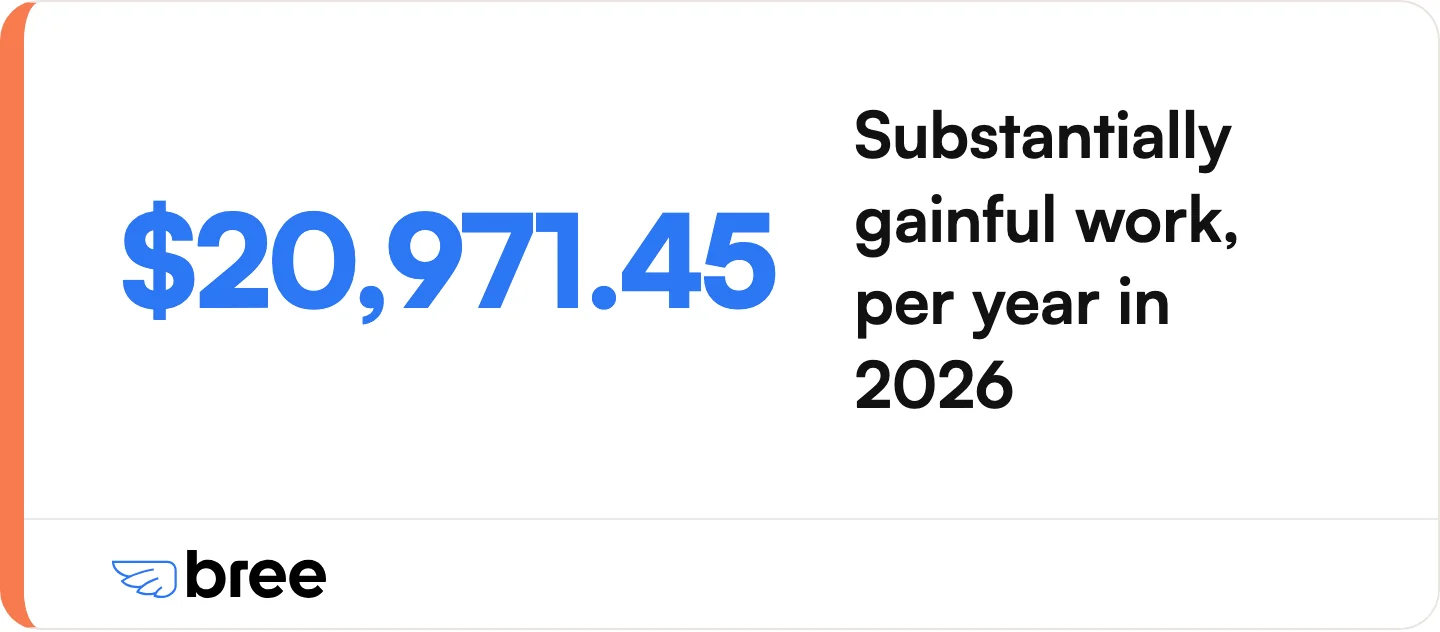
"Substantially gainful" has a dollar figure attached. As of 2026 it is $20,971.45 per year before tax, according to the Service Canada CPP disability benefits overview. If you are working and earning around this amount or more, your application is likely to be refused because you are considered able to do substantially gainful work.
What Medical Conditions Qualify for CPP Disability?
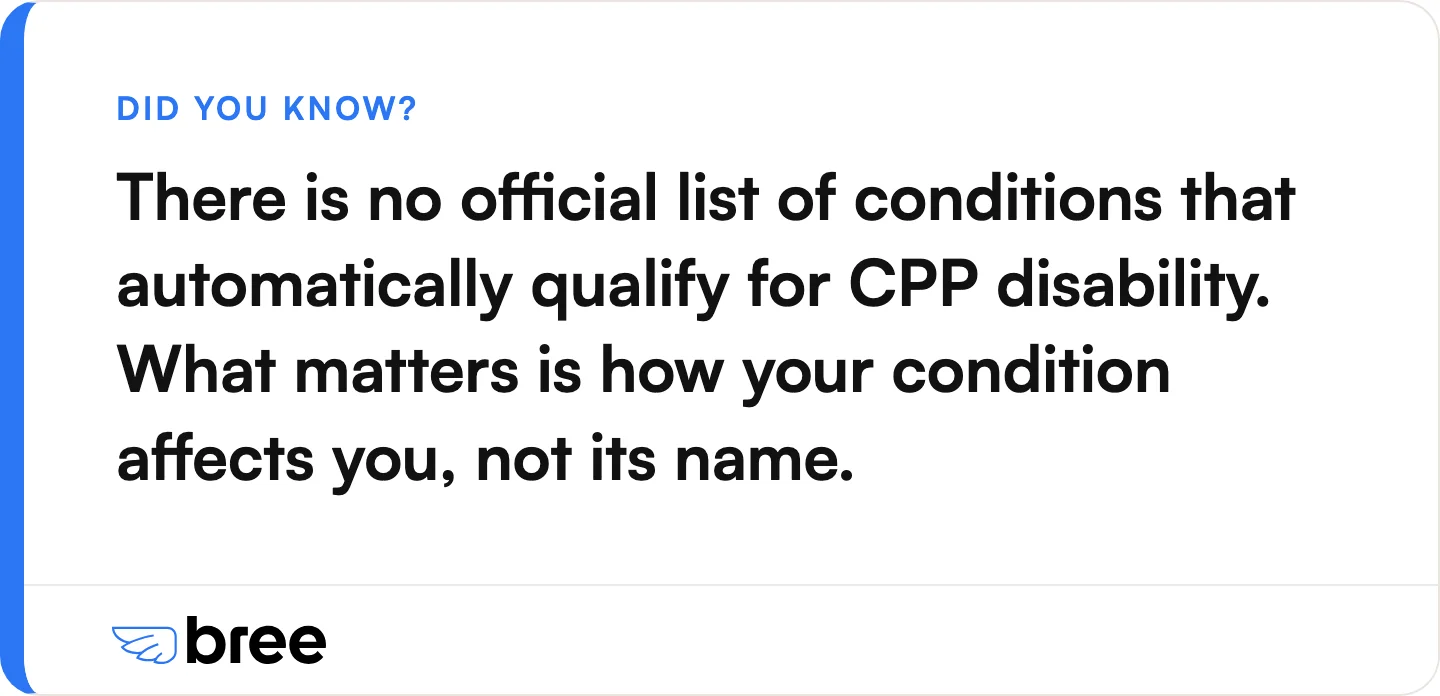
There is no official list of conditions that automatically qualify for CPP disability. What matters is how your condition affects you, not its name. The same diagnosis can qualify one person and not another, depending on how severe the limitations are and how long they are expected to last.
This is the part people misunderstand most. A condition like arthritis, depression, cancer, chronic pain, or a back injury can qualify if it regularly stops you from doing any substantially gainful work and is long-term or likely fatal. The same condition will not qualify if you can still work regularly or if it is expected to improve. Service Canada looks at your capacity to work, not the label on your chart.
Is it hard to qualify? Honestly, the test is strict, and many first-time applications are denied. But a large share of those denials come from thin or incomplete medical evidence, not from people who were never going to qualify. A complete application with a medical report that documents your functional limitations gives you the best shot at approval the first time.
What You Need Before You Apply for CPP Disability
Before you start, gather your forms, your personal details, and your medical information. Having everything ready in one place is what keeps an application complete, and complete applications avoid the delays and denials that come from missing information.
You will need three main forms, all available from Service Canada:
- Application for CPP Disability Benefits (ISP-1151). This is the main form you fill out about yourself, your work history, and your condition.
- Medical Report (ISP-2519). Your doctor or nurse practitioner completes this. It is the most important document in your application.
- Consent form (ISP-2502). This lets Service Canada share information about your claim with someone you name, such as a family member or representative.
If you have a terminal illness, there are separate fast-track forms (ISP-2530A and ISP-2530B) that your doctor completes to request priority processing.
You should also have these details on hand:
- Your Social Insurance Number and, if applicable, your spouse's or common-law partner's.
- Banking information for direct deposit.
- Your work and education history.
- The names and contact details of the doctors and specialists who treat you.
- Details about your dependent children, if you have any, since they may qualify for their own benefit.
The most common mistakes are leaving sections blank, giving vague answers about what you can and cannot do, and submitting a medical report that lists a diagnosis without describing your day-to-day limitations. Take your time with the parts that describe how your condition affects your daily life.
How to Apply for CPP Disability: Step by Step
You can apply for CPP disability two ways: online through My Service Canada Account, or by mail. The online route is usually faster and lets you track your application. Both use the same forms and the same medical report. The full process is laid out on the Service Canada CPP disability apply page.
- Register for or sign in to your My Service Canada Account (MSCA). This is the secure online portal where you start and submit your application.
- Complete the application form (ISP-1151). Fill in your personal details, work history, and a description of your condition and how it limits you. Be specific and consistent.
- Have your doctor complete the medical report (ISP-2519). Give this to your doctor or nurse practitioner early, since they may need time to complete it. There may be a fee to fill it out.
- Gather your supporting documents and consent form. Include any medical records, test results, or specialist notes that back up your claim.
- Submit your application. Send it online through MSCA, or mail the completed forms to the Service Canada office listed on the form.
- Keep a copy and note your confirmation. Save copies of everything you send, and keep any confirmation number in case you need to follow up.
If your condition is terminal or grave, apply the same way but ask about priority processing and use the terminal-illness forms so your application is flagged for a faster decision.
The Medical Report: The Most Important Part of Your Application
The medical report (ISP-2519) is the document that decides most CPP disability claims. Service Canada uses it to judge whether your disability is severe and prolonged, so a weak or vague report is the single biggest reason applications are denied. Everything else on the form matters less than this.
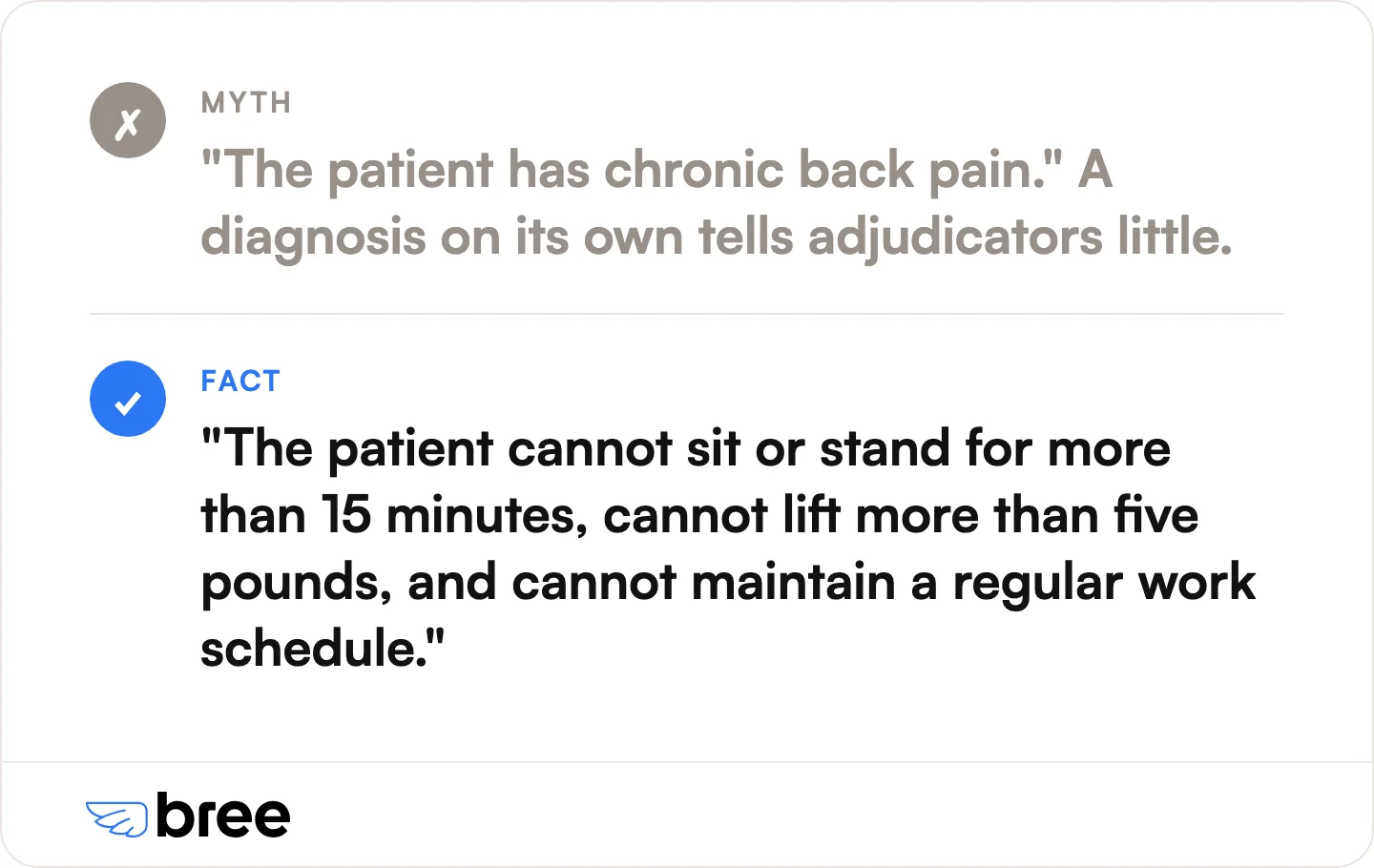
The mistake that sinks applications is assuming your doctor knows exactly what Service Canada is looking for. Many doctors write a diagnosis and a short note. What adjudicators actually need are your functional limitations: what you can and cannot do, how long you can do it for, and how often. "The patient has chronic back pain" tells them little. "The patient cannot sit or stand for more than 15 minutes, cannot lift more than five pounds, and cannot maintain a regular work schedule" tells them what they need to decide.
To give your report the best chance:
- Talk to your doctor about your day-to-day limitations before they fill it out, not just your diagnosis.
- Ask them to be specific about frequency, duration, and severity.
- Make sure your report matches what you wrote on your own form. Inconsistencies raise questions.
- Include supporting records from specialists if your condition involves more than one provider.
How Long Does CPP Disability Take to Get Approved?
Service Canada aims to make a decision on a standard CPP disability application within 120 calendar days, which is about four months. That is a target, not a guarantee, and complicated files can take longer. The clock effectively starts once they have your complete application, including the medical report.
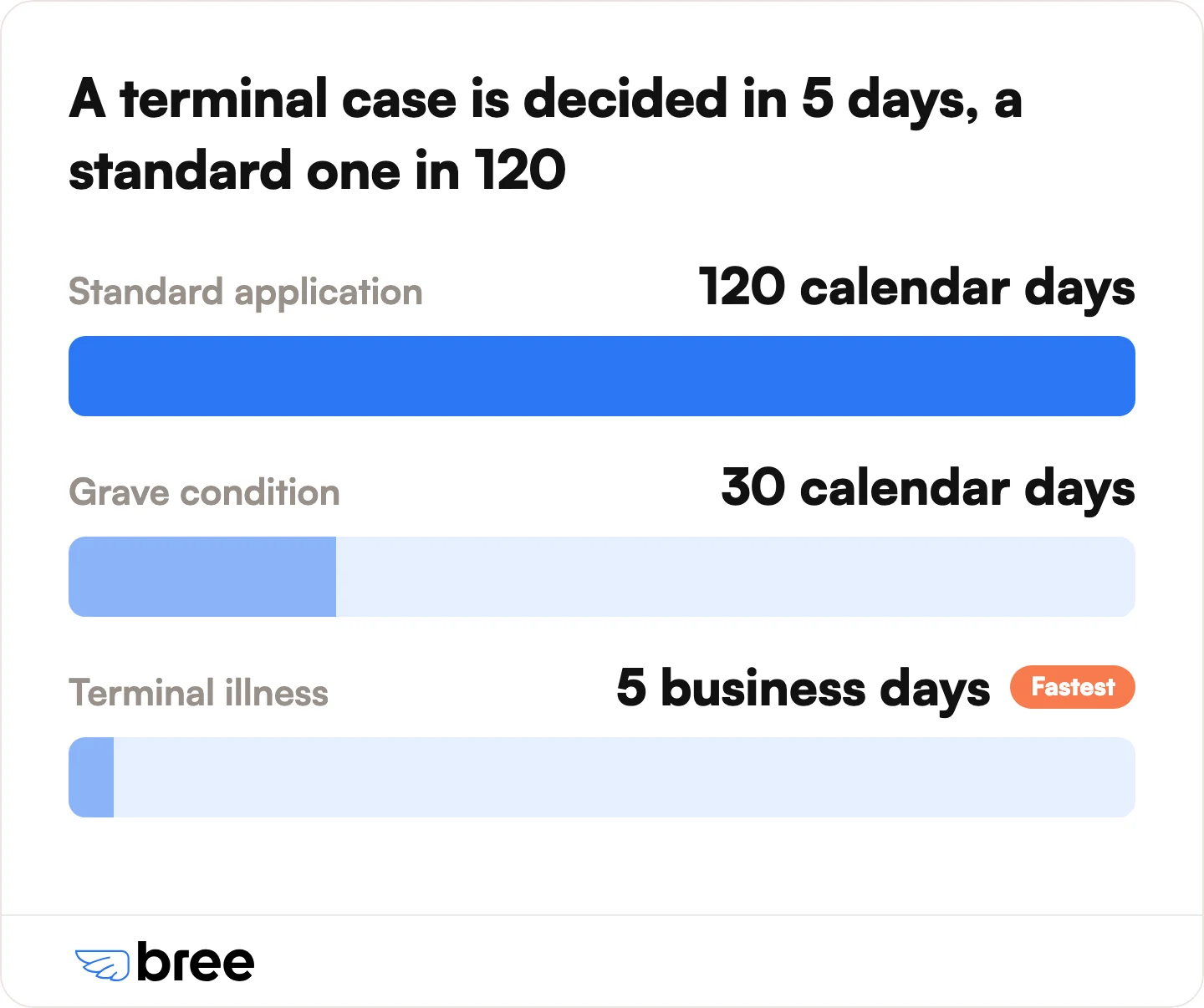
Some situations are processed much faster:
- Terminal illness: within 5 business days. A terminal illness is defined as a disease that cannot be cured or adequately treated and is likely to result in death within six months.
- Grave condition: within 30 calendar days. This covers severe conditions that are not terminal but are clearly disabling.
If your application is denied and you appeal, expect the total timeline to stretch well beyond four months. That long wait is real, and it is one of the hardest parts of the process for people who already cannot work.
How Much Does CPP Disability Pay in 2026?
As of 2026, the maximum CPP disability payment is $1,741.20 per month, and the average amount for a new beneficiary is $1,234.68 per month, according to the Service Canada benefit amount page. Your exact amount depends on how much and how long you contributed to CPP.
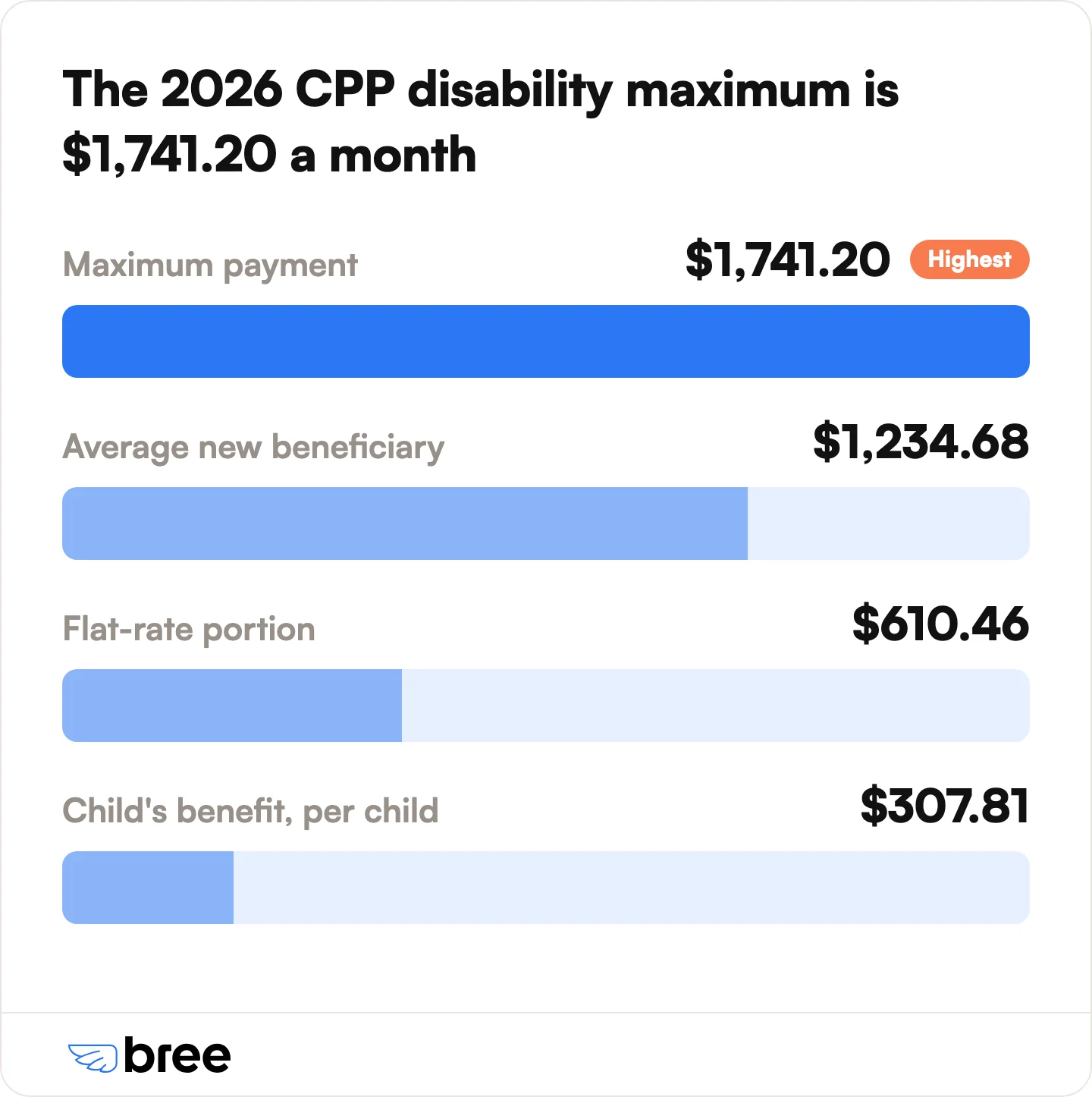
Every CPP-D payment is built from two parts:
- A flat-rate portion that everyone who qualifies receives. In 2026 this is $610.46 per month.
- An earnings-based portion tied to how much you paid into CPP during your working years.
Because the earnings-based portion varies, two people with the same condition can receive different amounts. CPP disability amounts are indexed each January to keep up with the cost of living, so the figures rise over time.
Extra payments for your children
If you have dependent children, they may qualify for the disabled contributor's child's benefit. As of 2026 this is a flat $307.81 per month for each child under 18, or 18 to 25 and in full-time study. Children aged 18 to 25 in part-time study receive $153.91 per month. These figures come from the Service Canada payment amounts page, and the flat-rate structure is explained on the CPP children's benefit page.
The Post-Retirement Disability Benefit
If you are between 60 and 65 and already receiving the CPP retirement pension when you become disabled, you cannot switch to full CPP-D. Instead you may qualify for the Post-Retirement Disability Benefit, a flat $610.46 per month as of 2026, paid on top of your retirement pension until you turn 65.
Retroactive (back) payments
CPP disability can pay retroactively for up to 12 months from the date your application is received, according to Service Canada. The program also has a built-in four-month waiting period before monthly payments begin. If you were disabled well before you applied, any back payment can arrive as a lump sum. One caution: if you also receive private long-term disability insurance, your insurer may claw back part of that retroactive amount, so check your policy before you spend it.
Can you get CPP retirement and CPP disability at the same time?
No. You cannot receive the CPP retirement pension and CPP disability benefit at the same time. CPP-D is generally the higher of the two while you qualify, and at 65 it automatically converts into the retirement pension. You can, however, receive CPP-D alongside a CPP survivor's pension, up to a combined maximum of $1,756.14 per month in 2026.
What Happens After You Apply: Approvals, Denials, and Appeals
After you apply, Service Canada reviews your file and sends a written decision. If you are approved, your payments begin and any retroactive amount is calculated. If you are denied, you have the right to challenge the decision, and there is a clear path for doing so.
If you are approved, you will receive a letter confirming your monthly amount and start date, including any back payment. CPP-D recipients are reviewed periodically to confirm they still qualify, and you are expected to tell Service Canada if your condition improves or you return to work.
If you are denied, the denial letter explains why and how to respond. The appeal path has clear stages, set out by the Social Security Tribunal of Canada:
- Reconsideration. You ask Service Canada to review its decision. You must make this request in writing within 90 days of receiving your decision letter, and this is where you can add stronger medical evidence.
- Social Security Tribunal, General Division. If reconsideration is refused, you can appeal to the Tribunal, an independent body that reviews the decision fresh.
- Social Security Tribunal, Appeal Division. If the General Division does not rule in your favour, you can ask for a further appeal on specific grounds.
Many people who are denied at first are later approved at reconsideration or the Tribunal, often because they add the functional-limitation detail that was missing the first time. If you missed a deadline because you were incapacitated, the late-applicant provision may still let you qualify, so it is worth asking rather than assuming you are out of time.
How to Bridge the Gap While You Wait for CPP Disability
The hardest part of a CPP disability claim is often the money you are missing while you wait. A decision can take four months, longer if you are denied and appeal, and even once payments start they are fixed amounts that can fall short between due dates. That gap is real, and it hits people who already cannot work.
Bree offers a line of credit we built for exactly this situation, and we accept CPP and CPP disability income as a qualified income source, which most cash advance apps and lenders reject. You can request up to $750 in interest-free funds, no credit check, and no mandatory fees. It is entirely free to use. We make money from optional tips and an optional express fee, not from interest.
When you request an advance, the money is sent by direct deposit to your bank account. Standard delivery is free and lands in one to three business days. If you need it sooner, Express delivery gets cash to your bank account within minutes for an optional fee. More than 600,000 Canadians use Bree, and it holds a Trustpilot rating of 4.8 out of 5 across more than 8,007 reviews.
If your CPP disability payment is delayed or does not stretch to the end of the month, you can get up to $750 with Bree to bridge the gap between payments. It is not a payday loan and it will never trap you in interest. For tracking when your other CPP payments land, our guide to CPP payment dates lays out the schedule.
Frequently Asked Questions
What medical conditions qualify for CPP disability?
There is no fixed list of qualifying conditions. Any physical or mental condition can qualify if it is severe and prolonged, meaning it regularly stops you from doing any substantially gainful work and is long-term or likely to result in death. Service Canada judges the impact on your ability to work, not the diagnosis itself.
How long does it take to get approved for CPP disability?
Service Canada targets a decision on a standard application within 120 calendar days, about four months. Terminal illnesses are processed within 5 business days and grave conditions within 30 calendar days. If you are denied and appeal, the total timeline is longer.
How much does CPP disability pay per month?
As of 2026, the maximum is $1,741.20 per month and the average for a new beneficiary is $1,234.68 per month. Every payment includes a flat-rate portion of $610.46 plus an earnings-based amount tied to your past CPP contributions.
Can I get CPP retirement and CPP disability at the same time?
No. You cannot receive the CPP retirement pension and CPP disability benefit together. CPP-D generally pays more while you qualify, and it converts to the retirement pension automatically at age 65. You can receive CPP-D alongside a CPP survivor's pension, up to a combined cap.
How far back will CPP disability pay?
CPP disability can pay retroactively for up to 12 months from the date your application is received, and the program has a separate four-month waiting period before monthly payments begin. If you receive private long-term disability insurance, your insurer may recover part of that lump sum, so review your policy first.
Is it hard to qualify for CPP disability?
The medical test is strict, and many first-time applications are denied. But a large share of denials come from incomplete or vague medical evidence rather than people who never qualified. A complete application with a medical report that describes your functional limitations improves your odds.
Where do I get the CPP disability application form?
The application (ISP-1151) and medical report (ISP-2519) are available from Service Canada. The fastest way to apply is online through your My Service Canada Account, where you can complete and submit the application and track its status.
The Bottom Line
Applying for CPP disability comes down to a clear path: confirm you meet the age, contribution, and medical requirements, complete the application (ISP-1151) with a strong medical report (ISP-2519) that spells out your functional limitations, submit it through My Service Canada Account or by mail, and expect a decision in about four months. If you are denied, reconsideration and the Social Security Tribunal give you a real second chance, so do not treat a first "no" as final.
While you wait, the missing income is the part no form solves. Bree is a Canadian line of credit for people bridging the gap between paycheques and benefit payments, and because we accept CPP income at 0% interest with no credit check, we can help when a payment is late or short. If that is where you are right now, you can get an interest-free advance up to $750 to tide you over until your benefit arrives.
Sources
- Canada Pension Plan disability benefits: Overview
- CPP disability benefits: Do you qualify
- CPP disability benefits: Apply
- CPP disability benefits: How much you could receive
- Canada Pension Plan: Payment amounts
- Canada Pension Plan children's benefit
- CPP disability benefits: Receiving your benefit
- Canada Pension Plan: Request a reconsideration
- Social Security Tribunal of Canada: CPP disability appeals process

Join our newsletter to get the latest updates