Canadians spent an estimated $140 billion at retail across November and December 2025, by our tally of Statistics Canada's two monthly totals, yet most households planned to spend less per person than they did the year before. Statistics Canada put December 2025 retail sales at $70.0 billion, on top of $70.4 billion in November. At the same time, the average Canadian planned to spend $1,675 on gifts, travel, and entertainment, down 10% from 2024.
That gap between a growing national total and a shrinking personal budget is the story of the last Canadian holiday season, and the starting point for the next one. Spending held up in dollar terms, but tariffs, high credit-card balances, and cost-of-living pressure pushed shoppers toward tighter budgets, buy-Canadian choices, and more borrowing to bridge the gap.
This page pulls together holiday shopping statistics for Canada from primary sources: Statistics Canada, PwC Canada, the Retail Council of Canada, Moneris, Interac, Equifax Canada, BMO, CPA Canada, and Payments Canada. Every figure covers November–December 2025, the most recent season with complete data. United States and global figures appear only as clearly labelled context. It is published by Bree, a Canadian financial app, as a free reference for anyone researching how Canadians shop and pay for the holidays.
Citation Policy: These holiday shopping statistics are free to cite, share, and reuse, including for commercial and editorial work. If a figure here helps your article, report, or research, please credit Bree with a link back to this page so other people can find the original data.
Key Takeaways
- Canadian retail sales hit $70.0 billion in December 2025 and $70.4 billion in November, according to Statistics Canada.
- Canadians spent roughly $140.4 billion at retail across November and December 2025 (our calculation, summing Statistics Canada's seasonally adjusted November and December totals).
- The average Canadian planned to spend $1,675 on gifts, travel, and entertainment in 2025, down 10% from 2024, per PwC Canada.
- The average Canadian gift budget was $975 in 2025, essentially flat year over year, according to the Retail Council of Canada and Leger.
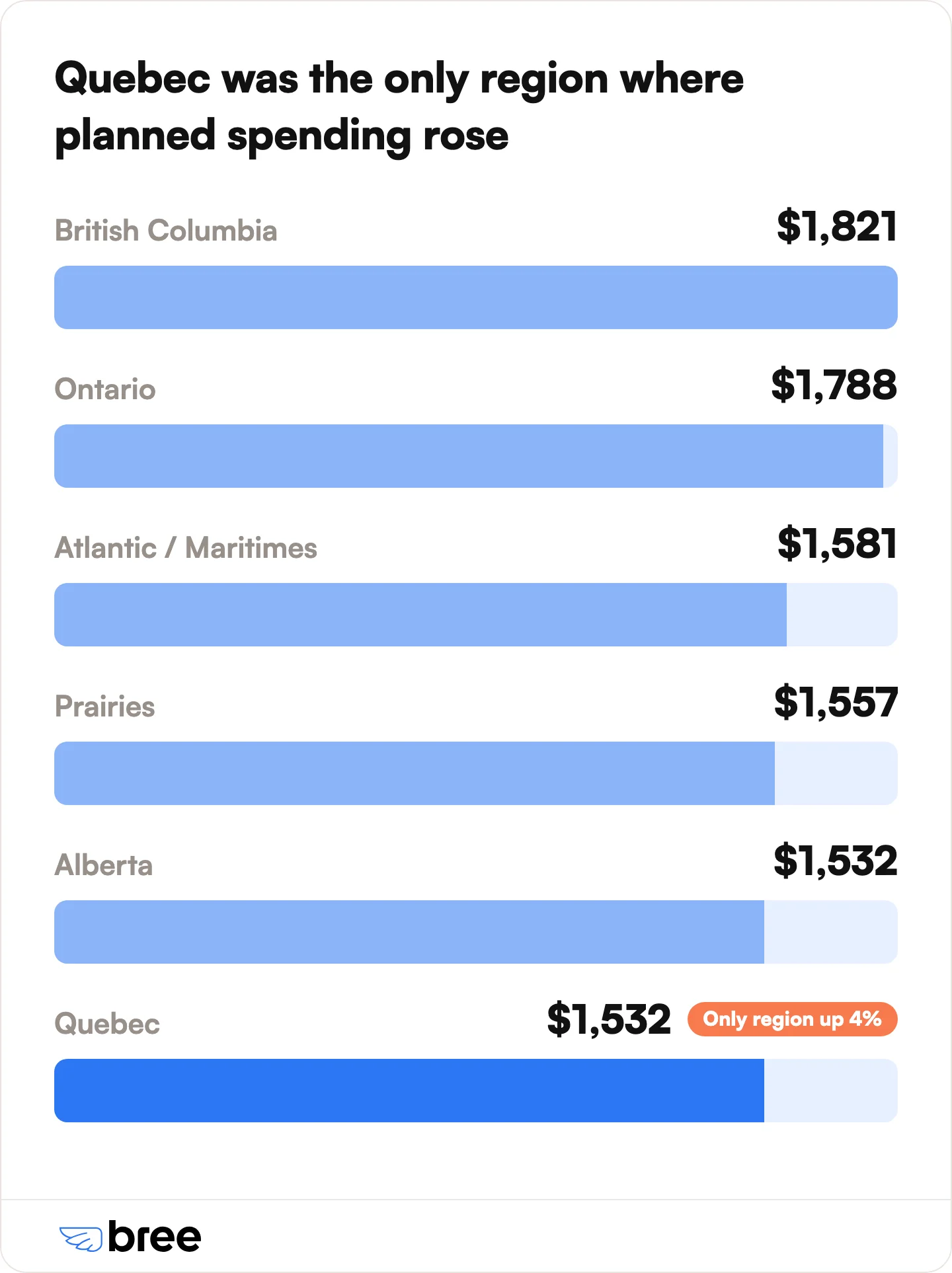
- Quebec was the only province where planned spending rose in 2025 (up 4%), while every other region fell, per PwC Canada.
- 49% of Canadians planned to use credit to pay for the holidays in 2025, rising to 58% among those aged 18 to 34, according to CPA Canada.
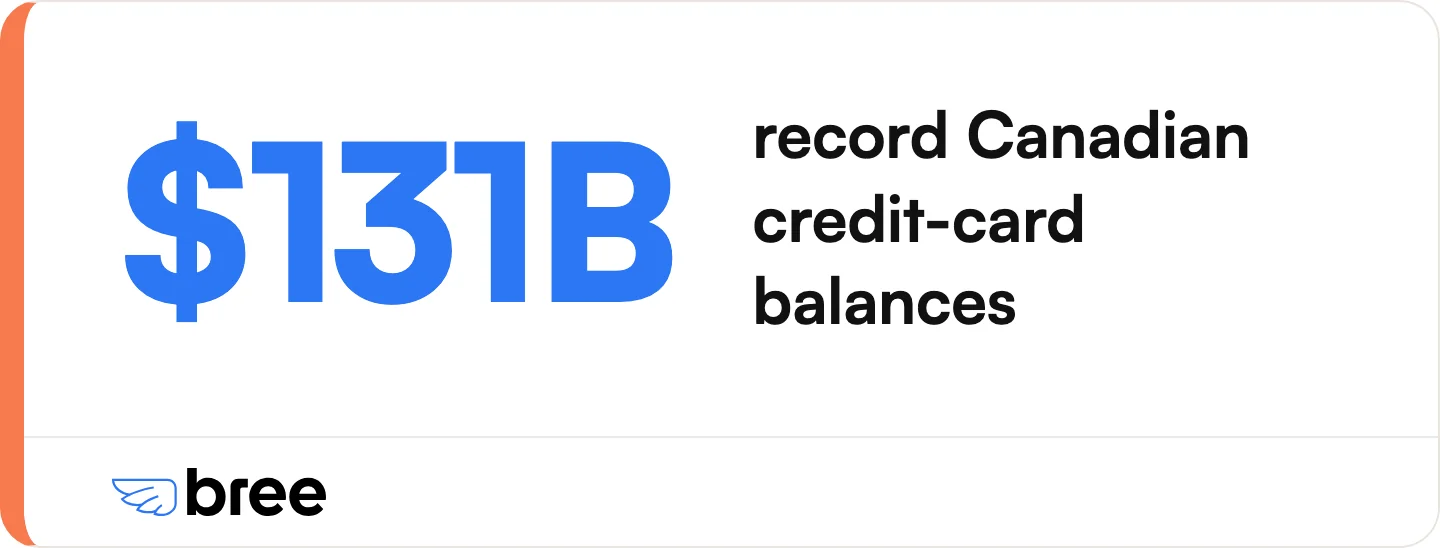
- Canadian credit-card balances reached a record $131 billion in late 2025, up 4.04% year over year, per Equifax Canada.
- Boxing Day has fallen to under half of Black Friday's transaction volume in Canada, according to Moneris.
- Canadian holiday spending rose 4.4% in 2025 even as per-person budgets fell, according to Visa.
How Much Canadians Spend on Holiday Shopping
Canadian retail sales reached $70.0 billion in December 2025 and $70.4 billion in November 2025, both seasonally adjusted, according to Statistics Canada. Summed together, that is about $140.4 billion in holiday-season retail spending across November and December 2025 (our calculation, adding the two seasonally adjusted monthly totals; Statistics Canada does not publish a single combined holiday figure).
For the full year, Statistics Canada reported Canadian retail sales of $837.2 billion in 2025, up 4.0% from 2024. Visa's spending monitor reported that Canadian holiday spending rose 4.4% year over year across all payment types, faster than the pace of per-person budgets, which points to more shoppers and higher prices rather than bigger individual baskets.
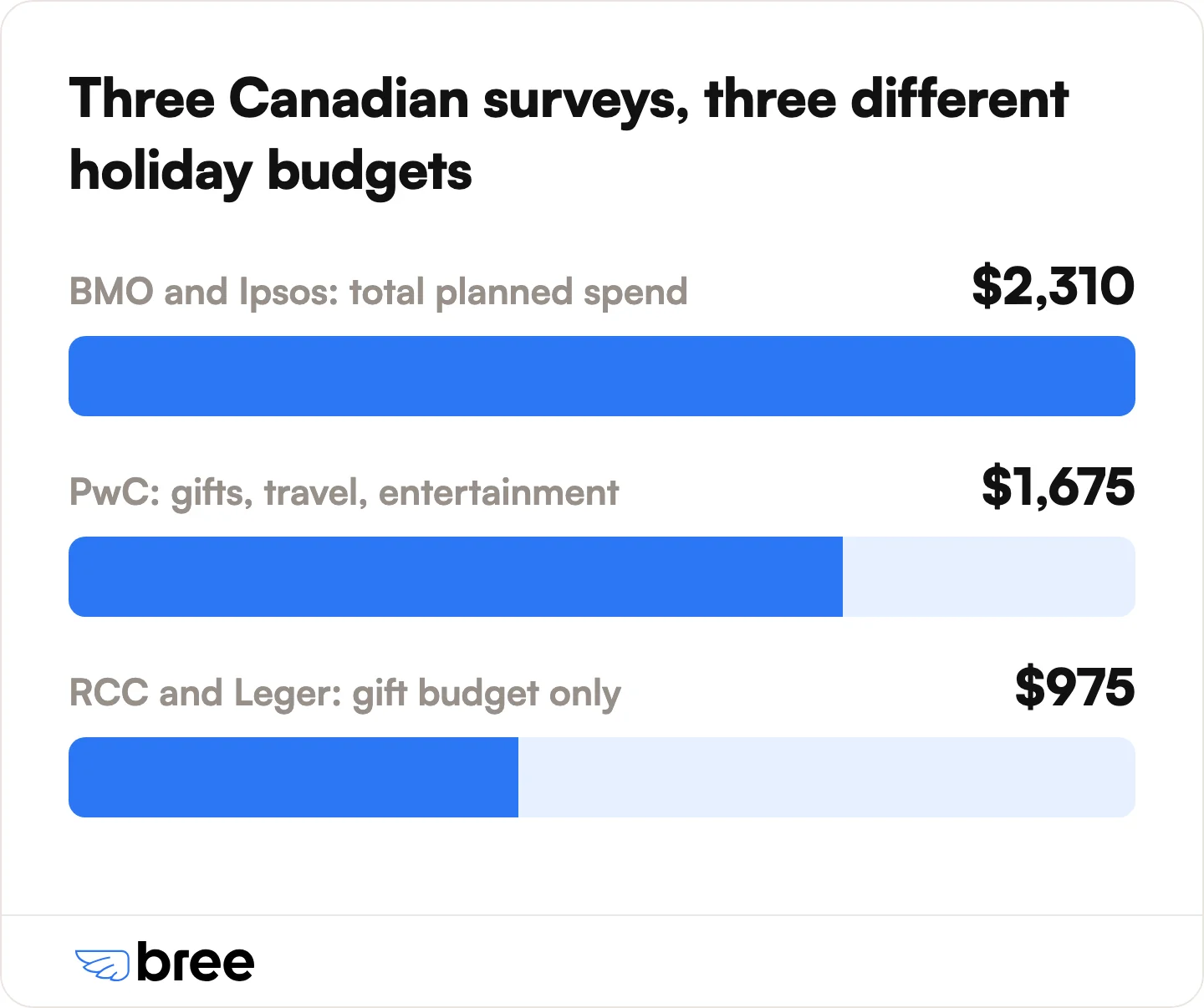
There is no single "average Canadian holiday spend" number, and treating one survey's figure as the total is the most common mistake in holiday coverage. The three most-cited Canadian surveys each measure something different:
Source: PwC Canada, Retail Council of Canada and Leger, BMO and Ipsos.
These numbers are not interchangeable, and they sometimes move in different directions. PwC counts travel and entertainment; the Retail Council counts gifts alone; BMO's total is broader still. Always cite the survey and what it covers, not just the dollar figure.
Canada also lacks a dedicated government holiday-spending study. Statistics Canada last published a standalone analysis of Christmas shopping patterns in the mid-2000s and discontinued the dedicated study after 2007. That report found that November and December together accounted for about 18% of annual retail sales. That gap in official data is exactly why the survey figures above carry so much weight.
Canadian Holiday Spending by Year (2019 to 2025)
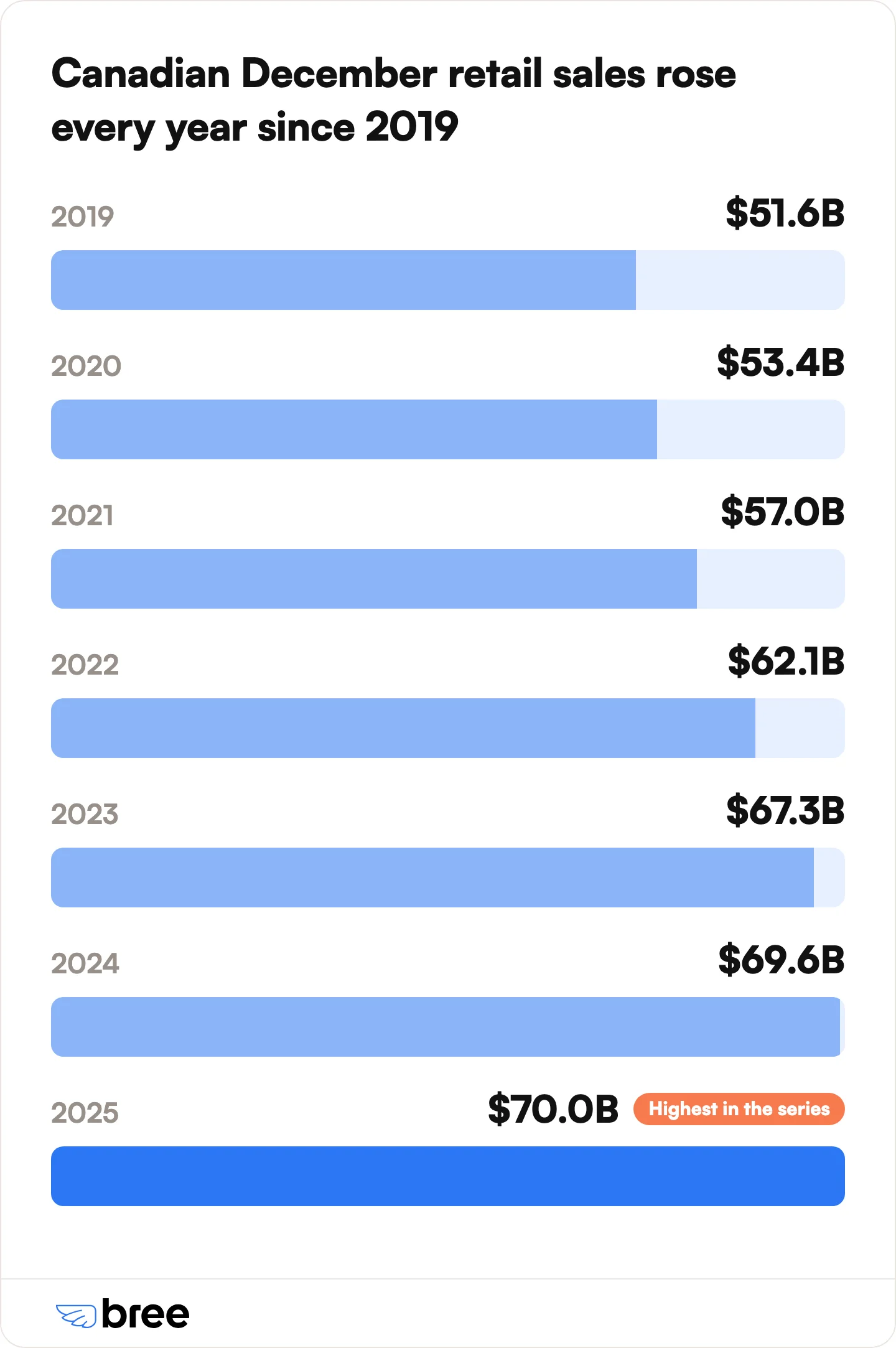
Canadian December retail sales have climbed every year since 2019, from $51.6 billion to $70.0 billion, according to Statistics Canada monthly retail trade releases. Even through 2020, when the pandemic reshaped how and when Canadians shopped, December sales rose as spending shifted online.
How we built this: each row is Statistics Canada's seasonally adjusted total retail-sales figure for December of that year, taken from the corresponding Monthly Retail Trade release. Same source, same basis, compiled into one series.
Per-person planned spending tells a different story. PwC Canada's yearly holiday outlook shows budgets falling in 2020, rebuilding through 2024, then pulling back in 2025.
Source: PwC Canada Holiday Outlook. How we built this: each row is PwC Canada's average planned per-person spend reported in its Holiday Outlook for that year, compiled into one series.
The average gift budget tracked by the Retail Council of Canada and Leger follows a similar arc but sits lower, because it counts gifts only. Compiled from the Retail Council's annual holiday surveys, the same survey one edition per season, it fell from $792 in 2019 to $693 in 2020, recovered to $898 by 2023 and $972 in 2024, then held essentially flat at $975 in 2025.
The lesson across all three series is that "holiday spending" moved in opposite directions in 2025 depending on the measure: national retail dollars rose, while per-person gift-and-travel budgets fell. For a companion look at what a healthy gift budget looks like, see our guide on how much to spend on Christmas gifts.
Holiday Spending by Province
Holiday budgets vary widely across Canada, and in 2025 Quebec was the only province where planned spending rose. According to PwC Canada, British Columbia led planned per-person spending at $1,821, while Quebec, at $1,532, was the single region moving up year over year.
The Retail Council of Canada and Leger measured a different figure, the average gift budget, and it ranked the provinces differently again: Alberta highest at $1,193 and Quebec lowest at $620.
Source: PwC Canada, Retail Council of Canada and Leger. The two columns measure different things (total planned spend versus gift budget) and should not be added together.
Card data pointed the same way. Moneris, which processes a large share of Canadian in-store and online transactions, reported that Alberta saw the biggest pullback in transaction volume in 2025, down about 8% year over year, while Ontario held up best and Manitoba was the clearest grower. A survey Moneris ran with Angus Reid found 53% of Albertans planned to cut their holiday budgets.
What Canadians Buy: Holiday Spending by Category
Travel and gifts are the two biggest holiday spending buckets for Canadians, and both shrank in 2025. PwC Canada found planned gift spending down 6% and travel down 14% year over year, the categories taking the hardest cuts as budgets tightened.
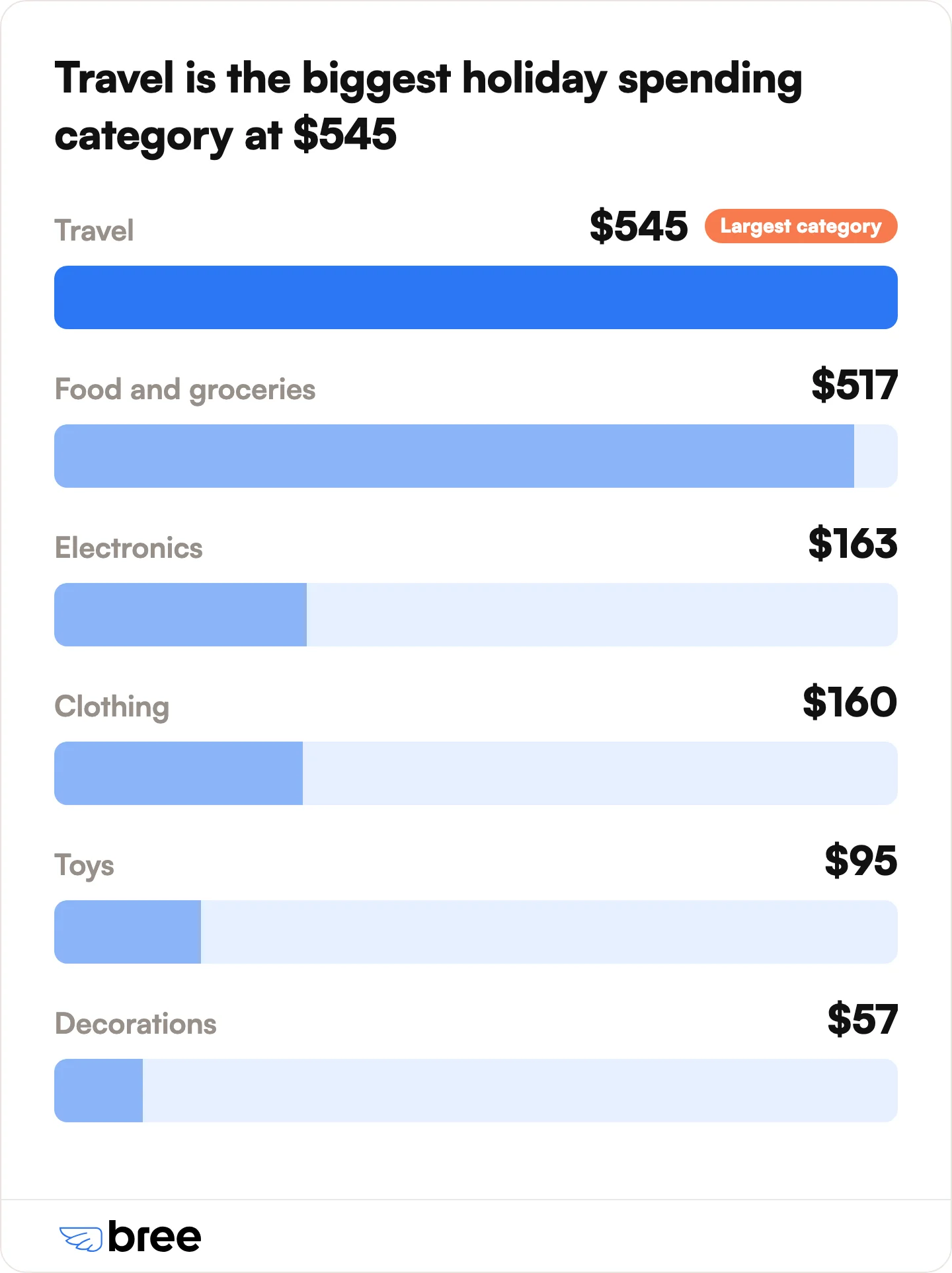
BMO and Ipsos broke total planned holiday spending into categories, with travel the single largest at $545 per person.
Source: BMO and Ipsos.
In the Retail Council of Canada and Leger survey, clothing was the single largest share of the gift budget, at 17%.
Online vs In-Store Holiday Shopping
Most Canadian holiday spending still happens in physical stores. Deloitte Canada measured an in-store share of 55% against 42% online, and PwC Canada found 64% of Canadians expected to buy in person, 46% through marketplaces, and 33% direct from brand sites.
The online share of holiday spending has climbed steadily, with one enormous pandemic spike. PwC Canada tracked the online share rising from 41% in 2019 to 52% in 2021. Statistics Canada recorded December e-commerce jumping 31.5% year over year in 2019, then surging to $4.7 billion and up 69.3% in December 2020 as stores closed. By late 2025, e-commerce had settled at about 6.1% of total December retail sales in the official figures, which count only retailers whose primary business is online.
Holiday Spending by Generation
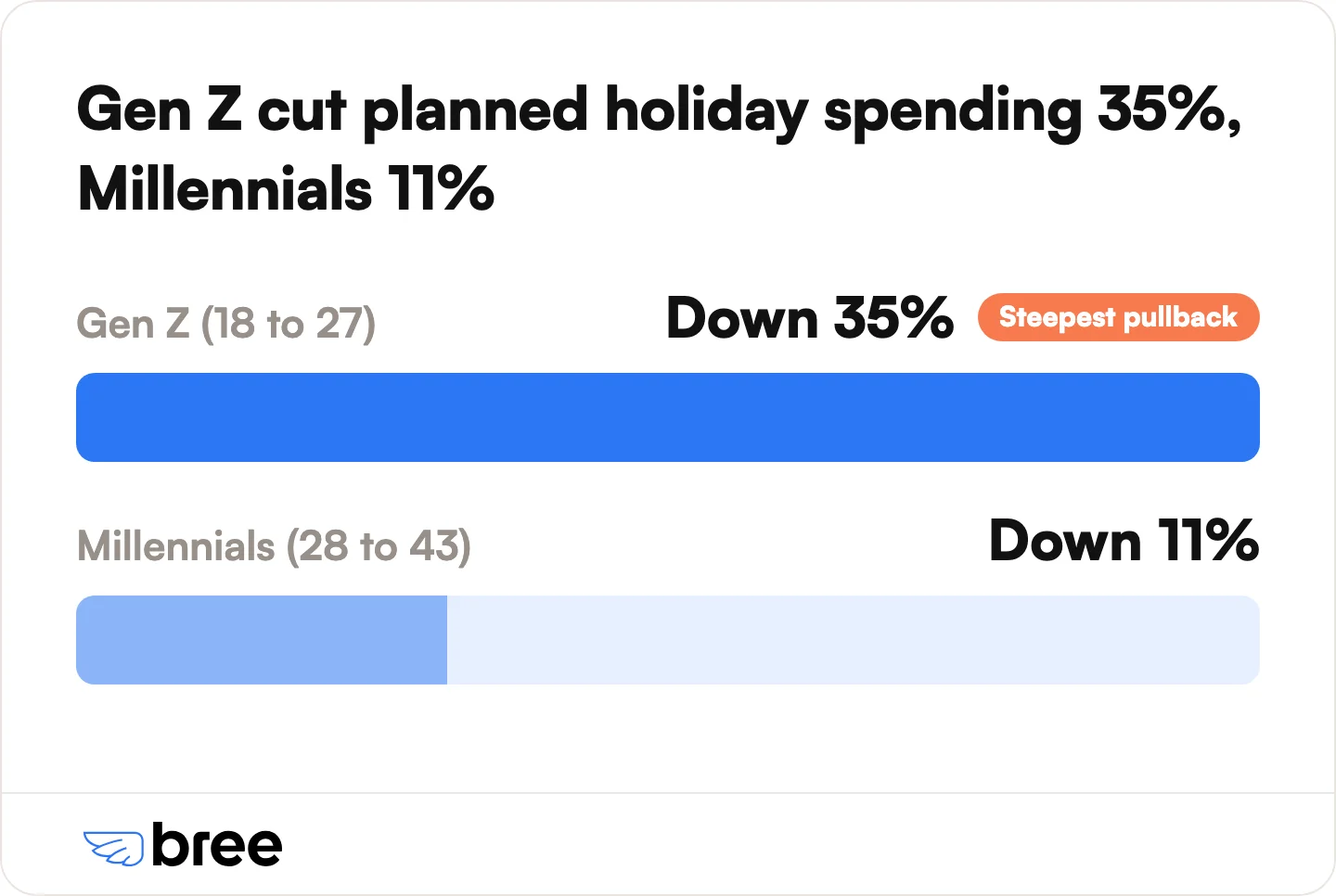
Younger Canadians cut their holiday budgets the most in 2025, yet they also lean on credit the hardest. PwC Canada found Gen Z planned spending down 35% year over year and Millennials down 11%, the steepest pullbacks of any age group. At the same time, CPA Canada reported that among Canadians aged 18 to 34, 58% expected to rely on credit for holiday purchases and 40% still planned to spend more than the year before.
Older Canadians behaved differently. CPA Canada found that among those 55 and older, 68% planned to spend about the same as last year and 70% intended to pay with savings rather than credit. BMO and Ipsos reported that 55% of Gen Z and 46% of Millennials took on extra work to fund the holidays.
The credit strain shows up in the data. Equifax Canada found the 26-to-35 age group carried the highest credit-card delinquency rate heading into the 2025 holidays, at 2.55%, and was the only age band cutting December card spending, down about 2%, while shoppers 46 and older increased theirs.
Source: PwC Canada, CPA Canada and Leger, BMO and Ipsos.
Deloitte Canada also found the season starting earlier, with 20% of Canadians beginning their holiday shopping in October in 2025, up from 15%.
Holiday Debt: How Canadians Pay for the Season
Nearly half of Canadians planned to use credit to cover the 2025 holidays, and many expected the bill to follow them well into the new year. CPA Canada found 49% of Canadians planned to use credit, and BMO and Ipsos reported that many expected to need more than two months to pay off their holiday spending, with 9% unsure when they would clear it at all.
Canadians carried more card debt into the 2025 season than ever before. Equifax Canada reported total credit-card balances swelled to a historic $131 billion, up 4.04% year over year, with the average cardholder balance around $4,652. Equifax also found December card spending slipped 0.7% to $2,297 per cardholder on an inflation-adjusted basis, a sign shoppers were pulling back even as balances stayed high.
The trade-offs were explicit. BMO and Ipsos found 36% of Canadians knowingly sacrificed long-term savings to pay for the holidays. That combination of high balances, credit reliance, and multi-month payoff windows is what turns holiday spending into holiday debt.
For readers weighing the cost of borrowing, the Financial Consumer Agency of Canada notes that payday loans in Canada can cost up to about 365% APR, based on a maximum of $14 per $100 borrowed. Credit cards typically charge around 20% or more and start accruing interest immediately on cash advances. If holiday debt is already piling up, our guides on debt consolidation in Canada and how to escape the payday loan debt cycle walk through the options.
How Canadians Pay: Cards, Debit, and Buy Now, Pay Later
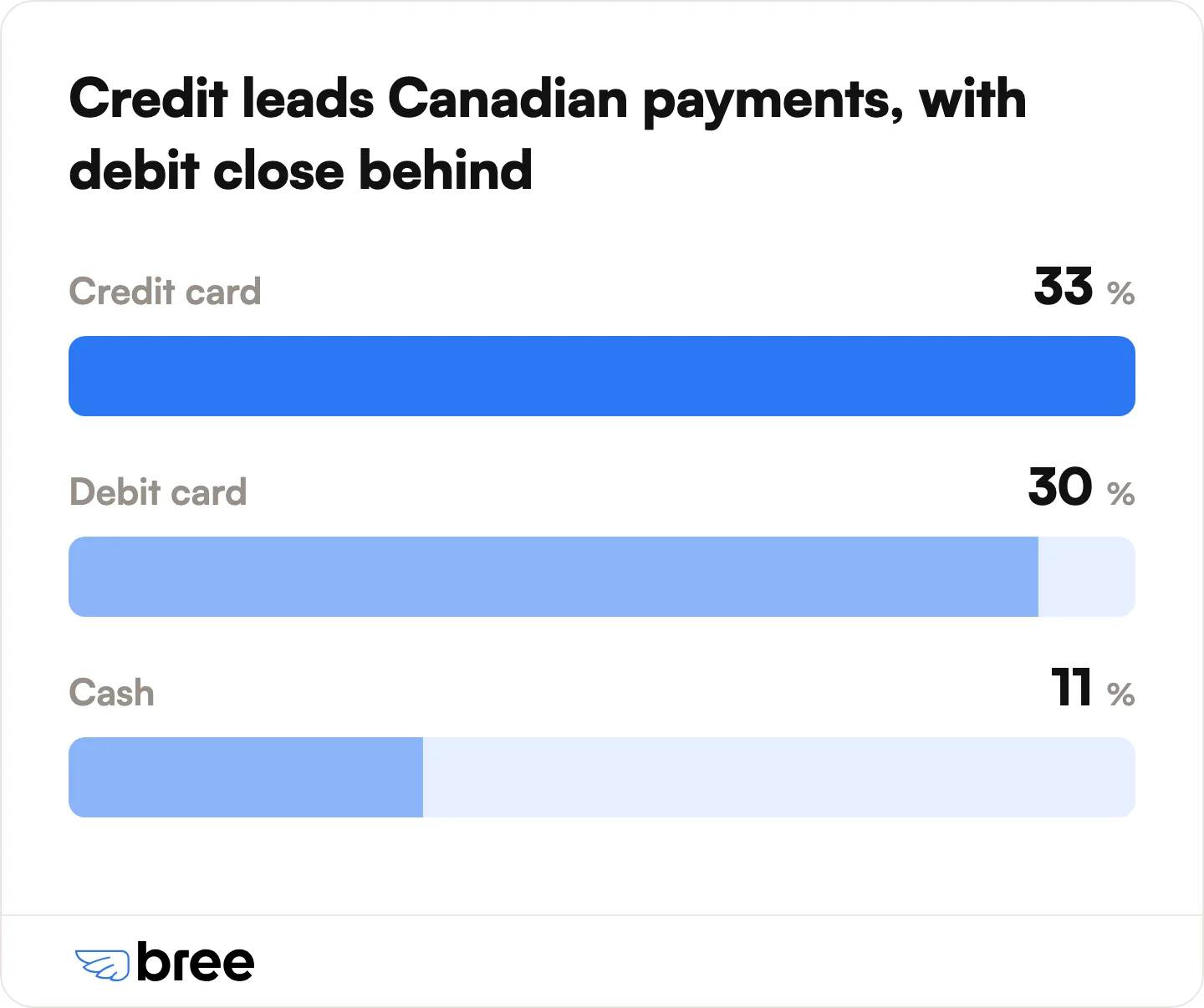
Credit is the most common way Canadians pay overall, but debit and Interac hold a large share of holiday transactions. Payments Canada found that across all channels, credit cards accounted for 33% of payments, debit 30%, and cash 11%. Online, credit stretched to 57%, with PayPal and debit each near 18%.
Interac forecast 24.8 million Interac Debit purchases on the busiest debit day of the 2025 season. Its survey also found 11% of Canadians used Interac Debit specifically to keep spending under control, and 19% used Interac e-Transfer to split holiday costs with others.
Buy now, pay later is the biggest data gap in Canadian holiday payments. The most recent government study, a Financial Consumer Agency of Canada pilot with fieldwork from 2019 to 2021, found 8% of Canadians had used BNPL, that 74% of those users spent more than $200 on their last BNPL purchase, and that 20% spent more than they otherwise would have. No comparable government survey of Canadian BNPL use has been published since 2021, which leaves a real hole in the national picture.
For context, buy now, pay later spending in the United States reached US$20 billion, up 9.8%, with one day becoming the first ever to top US$1 billion in that channel, per Adobe Analytics.
The Biggest Shopping Days: Black Friday, Cyber Monday, and Boxing Day
Black Friday is now the biggest shopping day of the Canadian holiday season by transaction volume, and Boxing Day has faded to a fraction of its former pull. Moneris reported that Black Friday topped all holiday shopping days in 2025, with transaction volume up about 25% week over week and average ticket size up 14%.
Cyber Monday ran second but well behind Black Friday, and Boxing Day has slipped below half of Black Friday's volume and continues to decline. The old Boxing Day rush has effectively moved a month earlier to the Black Friday and Cyber Monday window.
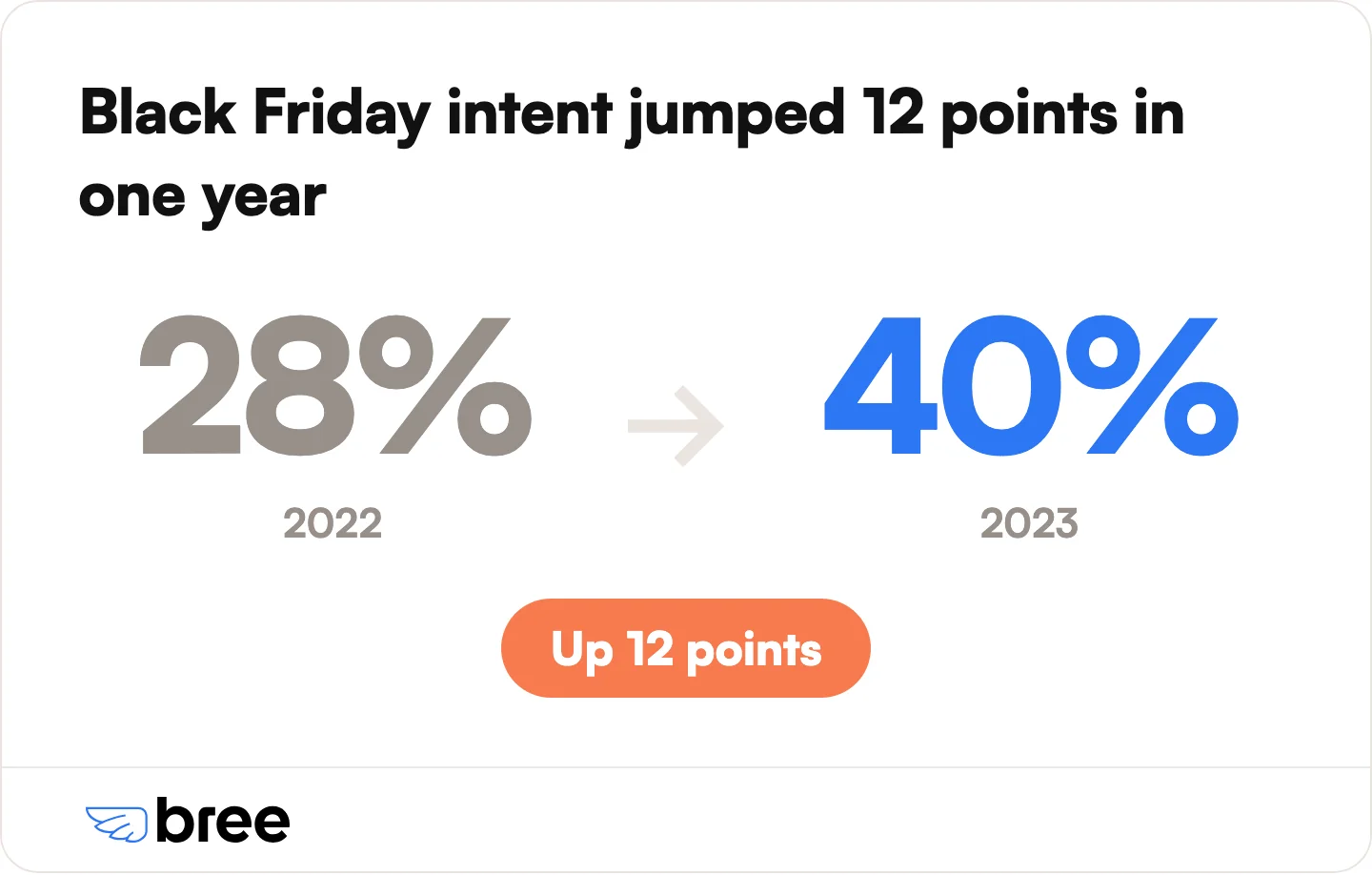
Shoppers agree on where the season peaks. The Retail Council of Canada and Leger found 84% of Canadians said Black Friday was their most important shopping day in 2025, and day-intent has grown from 28% in 2022 to 40% in 2023. Deloitte Canada estimated about a quarter of holiday budgets get spent around Black Friday. Interac predicted December 19 would be the busiest day of the season for Interac Debit purchases.
For context, figures from Adobe Analytics showed Cyber Monday setting a record at US$14.25 billion and Black Friday at US$11.8 billion, while the NRF reported a record 202.9 million United States shoppers over the Thanksgiving weekend.
Holiday Financial Stress and Overspending Regret
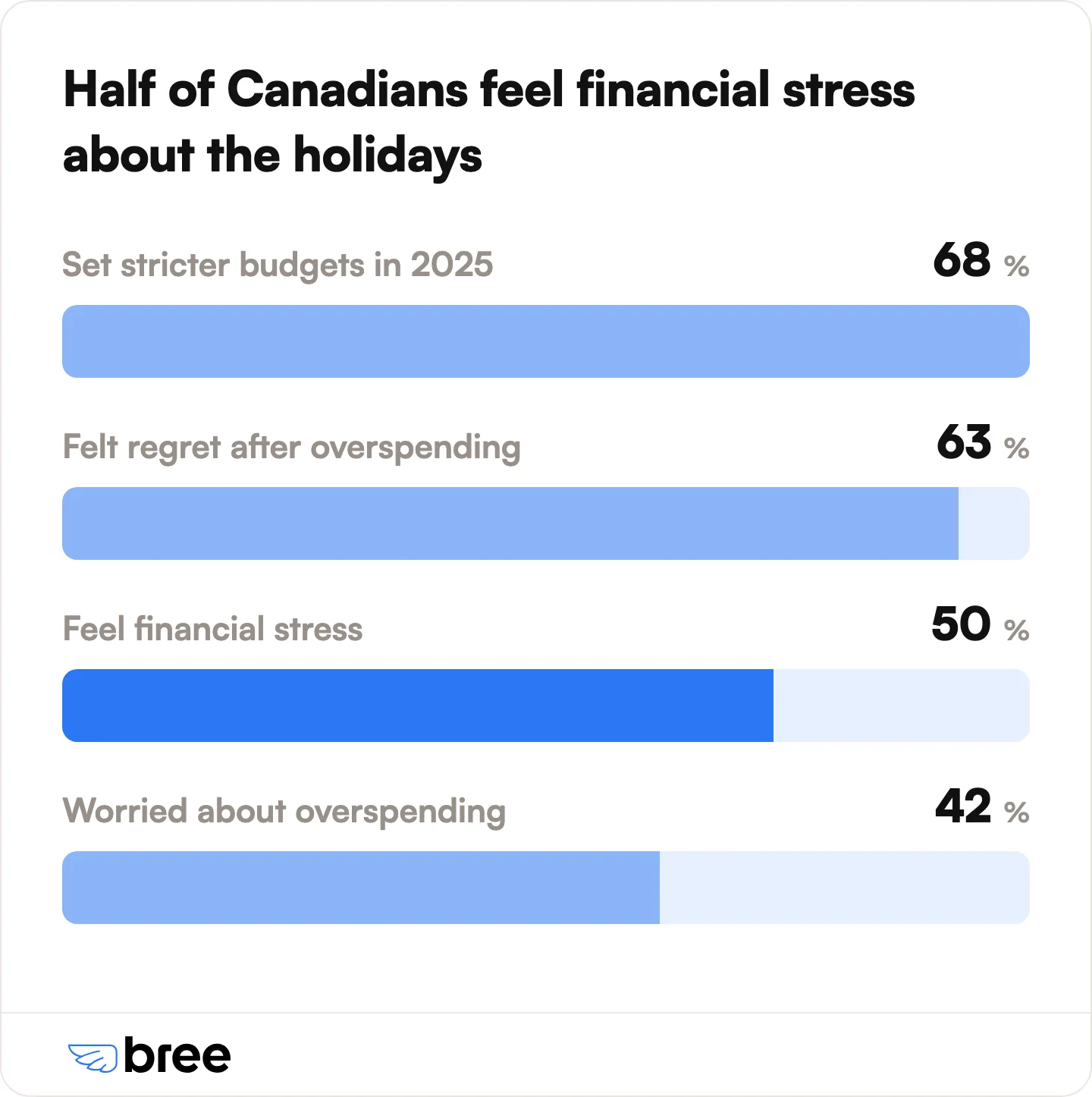
About half of Canadians feel real financial stress about holiday spending, and most respond by tightening their budgets. BMO and Ipsos found 50% of Canadians felt financial stress about the holidays and 68% set stricter budgets in 2025.
Interac's holiday research put numbers to the regret. It found 42% of Canadians worried about overspending, rising to 52% among parents; 63% had experienced regret after past holiday overspending; and 20% said they regret their holiday spending almost every year. Interac also reported that 57% of Canadians said rising costs made holiday spending harder, and 40% said last year's budget would not stretch to cover this year.
The mood has been sour for a few seasons. In 2023, the Angus Reid Institute found 55% of Canadians planned to spend less and 37% planned to cut charitable giving because of inflation. In 2025, Moneris reported that 43% of Canadians still planned to spend less against just 7% planning to spend more.
The "Buy Canadian" Holiday Shift
Buy-Canadian sentiment surged during the 2025 holidays as tariffs pushed shoppers toward domestic goods. The Retail Council of Canada and Leger found about 84% of Canadian shoppers sought out Canadian-made goods, one of the defining trends of the season.
PwC Canada measured the shift in detail: 49% of Canadians said they would pay more for Canadian-made products, 78% planned to seek alternatives to United States-made goods, and only 12% planned to cross-border shop, down from 20% the year before. BMO and Ipsos found 61% of Canadians adjusted their holiday plans specifically because of tariffs.
The willingness to pay more for local goods skews older. PwC Canada found 64% of Boomers would pay a premium for Canadian-made products, against 38% of Gen Z.
AI Is Changing How Canadians Shop
Canadian shoppers are folding AI into their holiday routine for gift ideas, product recommendations, and deal-finding, and Deloitte Canada flagged AI as one of the season's defining retail shifts. The hardest numbers, though, come from the United States and global markets, where adoption is moving fast.
Deloitte found 33% of United States shoppers planned to use generative AI while shopping, double the 2024 share. Adobe Analytics reported generative-AI-referred retail traffic up 693.4% year over year in the United States. Salesforce estimated AI and AI agents influenced about US$67 billion in global Cyber Week sales, roughly a fifth of purchases.
Gift Cards and the Most-Wanted Gifts
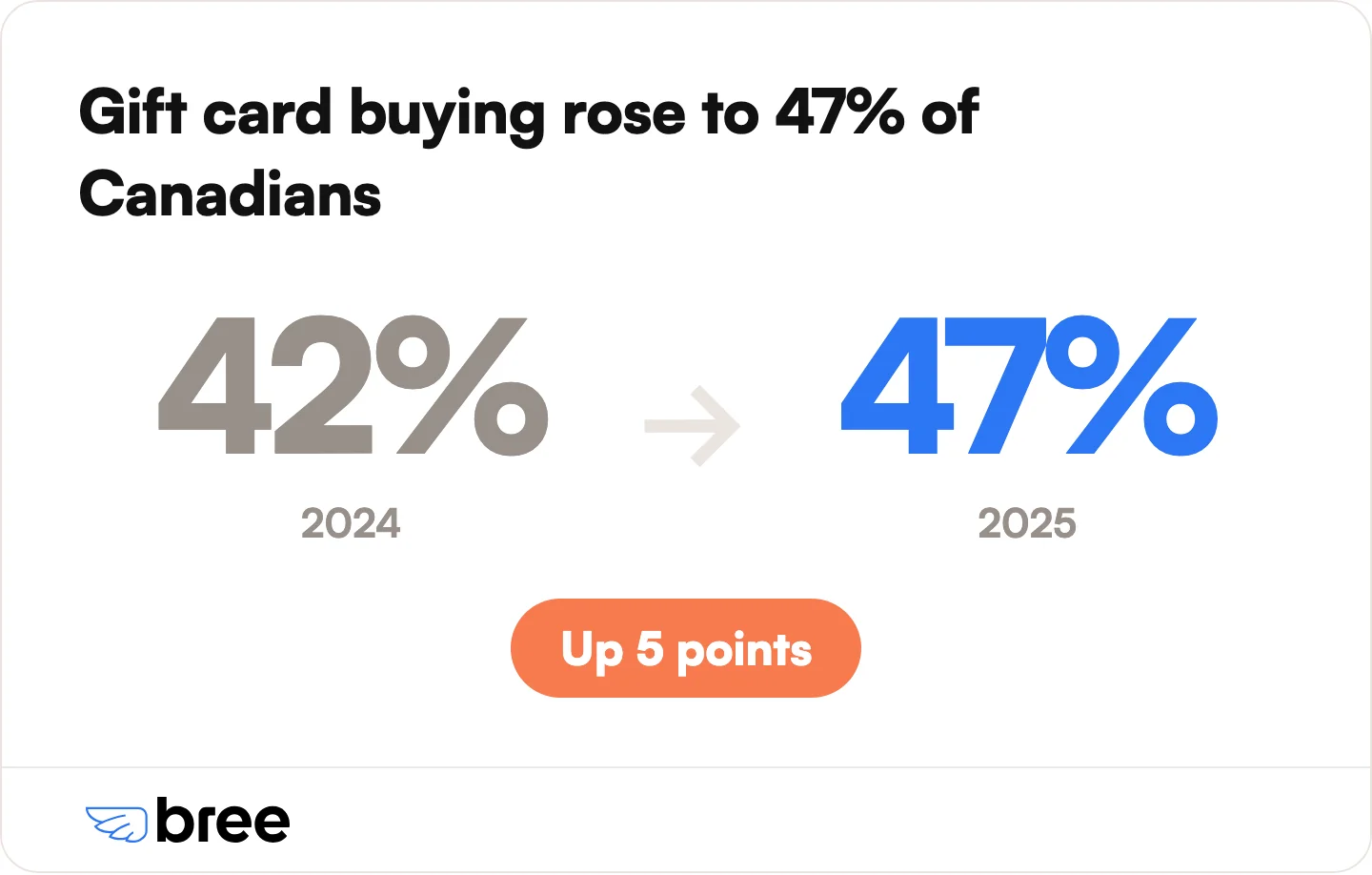
Gift cards keep gaining ground as a holiday purchase in Canada. The Retail Council of Canada and Leger found 47% of Canadians planned to buy gift cards in 2025, up from 42% in 2024.
In the United States, gift cards were the most-wanted gift, named by 50% of shoppers, according to the NRF.
If you are buying or receiving gift cards this season, it is worth knowing the consumer rules: see our guide on whether gift cards can expire in Canada.
How Canada Compares: US and Global Holiday Spending
The United States had a record 2025 holiday season, crossing US$1 trillion in total holiday retail sales for the first time. Adobe Analytics reported United States online holiday sales of US$257.8 billion, up 6.8% year over year, while the NRF projected total United States holiday retail just above US$1 trillion.
Per-person, United States budgets softened much like Canada's. The NRF and Prosper put average United States holiday spending at US$890.49, and Deloitte measured planned spend at US$1,595, down 10%. Gallup recorded a sharp within-season drop in United States spending intentions, from US$1,007 to US$778 in a single month, as economic confidence slipped.
Globally, the season broke records online. Shopify reported US$14.6 billion in Black Friday and Cyber Monday sales across its merchants, up 27%, and Salesforce estimated US$336.6 billion in global Cyber Week spending, up 7%.
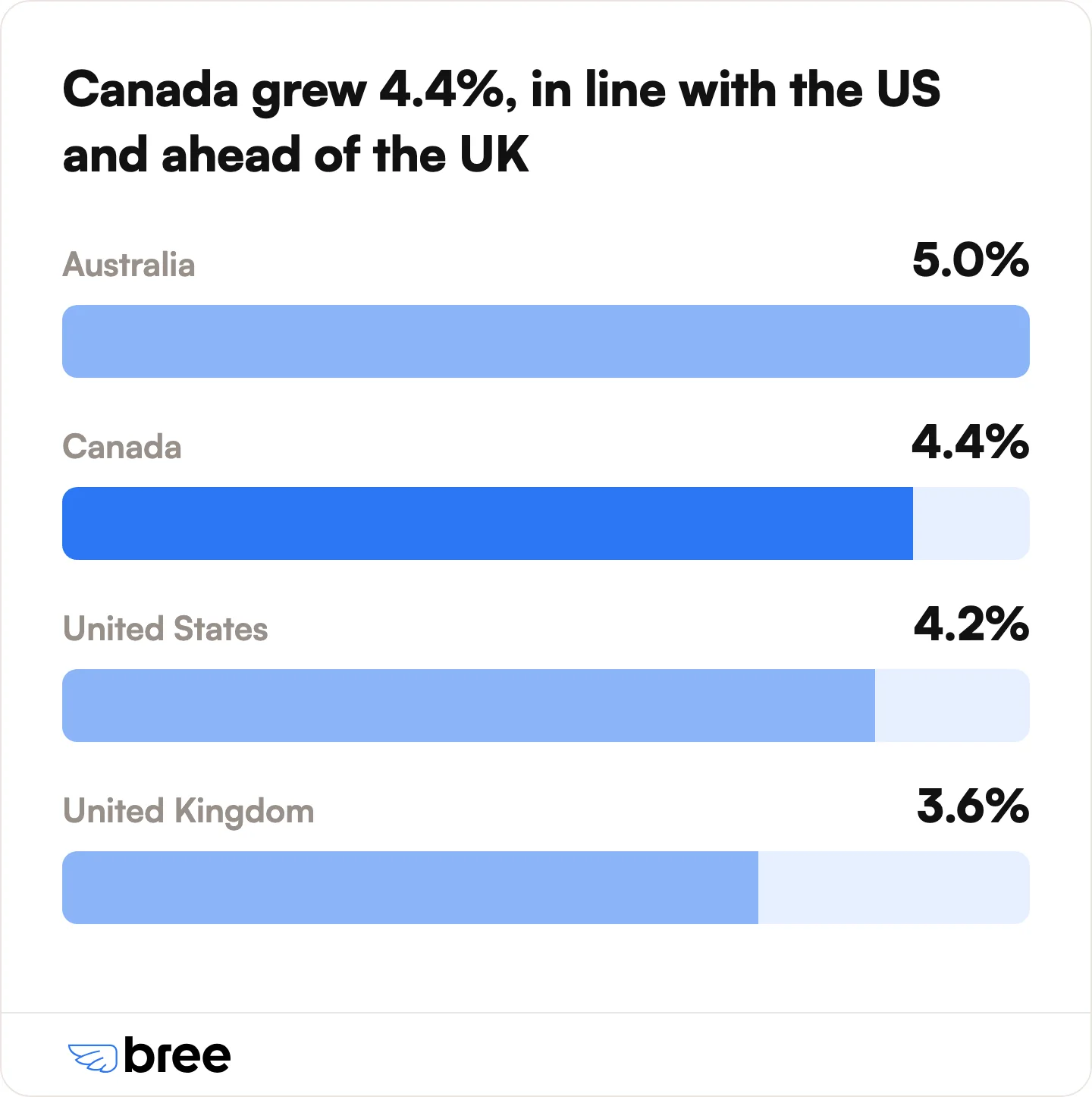
Visa's cross-country data placed Canadian holiday spending growth at about 4.4%, roughly in line with the United States at 4.2% and ahead of the United Kingdom at 3.6%, though behind Australia at 5.0%.
Frequently Asked Questions
How much do Canadians spend on holiday shopping?
Canadian retail sales reached $70.0 billion in December 2025, per Statistics Canada. Per person, PwC Canada found the average Canadian planned to spend $1,675 on gifts, travel, and entertainment in 2025, while the average gift-only budget was $975, according to the Retail Council of Canada and Leger.
Are Canadians spending less this holiday season?
Per person, yes. PwC Canada found average planned spending fell 10% in 2025, and gift budgets were flat year over year. National retail dollars still rose because of more shoppers and higher prices, so the total went up while individual budgets came down.
What do Canadians buy most during the holidays?
Travel and gifts are the two largest holiday spending categories for Canadians. BMO and Ipsos found travel the biggest single category at $545 per person in 2025, followed by food and groceries at $517, then electronics and clothing.
When is the busiest holiday shopping day in Canada?
Black Friday is the busiest holiday shopping day in Canada by transaction volume, according to Moneris, with Cyber Monday close behind and Boxing Day now under half of Black Friday's volume. Interac separately predicted December 19 would be the busiest day of the season for debit purchases.
The Bottom Line
The 2025 Canadian holiday season was a study in contrasts. National retail sales rose to record levels, an estimated $140 billion across November and December combined by our tally of Statistics Canada's monthly totals, while per-person budgets fell 10% and half of Canadians reported real financial stress. Shoppers leaned harder on credit, carried record card balances, chose Canadian-made goods, concentrated their spending around Black Friday, and started experimenting with AI to find deals.
The debt side of that picture is where the season leaves its longest mark. With 49% of Canadians using credit and many expecting to carry the bill for more than two months, the cost of borrowing matters. Bree is a Canadian interest-free line of credit of up to $750, built for people who need a little room between paycheques without paying credit-card interest around 20% or payday-loan rates near 365%. It charges 0% APR with no credit check and no mandatory fees, funds arrive by direct deposit to your bank account, and more than 600,000 Canadians use it with a Trustpilot rating of 4.8 out of 5.
If holiday spending has stretched your budget, it is worth understanding all your options before reaching for high-interest credit. Our guides on borrowing money for Christmas, quick holiday loans, and Christmas cash advances compare the routes, and you can get up to $750 with Bree if an interest-free line of credit fits.
Sources
- Statistics Canada: Monthly Retail Trade, December 2025
- Statistics Canada: Monthly Retail Trade, December 2024
- PwC Canada Holiday Outlook
- Retail Council of Canada and Leger Holiday Shopping Survey
- BMO Holiday Spending Survey
- Equifax Canada Consumer Credit Trends
- Interac Holiday Spending Report
- Moneris Black Friday and Cyber Monday Data
- CPA Canada Holiday Spending Study
- Payments Canada Retail Payment Trends
- Financial Consumer Agency of Canada: Buy Now, Pay Later Pilot Study
- Angus Reid Institute: Christmas Economics
- Deloitte Holiday Retail Survey
- Deloitte Canada Holiday Retail Outlook
- Adobe Analytics Holiday Shopping Report
- NRF Winter Holiday Data and Trends
- Gallup: Holiday Spending Plans
- Salesforce Cyber Week Data
- Shopify Black Friday Cyber Monday Data
- Visa Canada Holiday Spending
- Financial Consumer Agency of Canada: Payday Loans
- Statistics Canada: Consumer Holiday Shopping Patterns

Join our newsletter to get the latest updates