

Overdraft and non-sufficient funds (NSF) fees quietly pull hundreds of millions of dollars out of Canadian bank accounts every year, and the rules just changed. As of March 2026, NSF fees are capped at $10, down from the $45 to $48 the big banks used to charge. Overdraft protection, though, is a different product, and it still is not capped.
This page pulls together the current numbers on overdraft and NSF fees in Canada. Every stat is sourced to a Canadian government or regulatory source. If you have ever been $5 short on a bill and watched a fee nearly ten times that size land on your account, you already know these fees hit hardest when you can least afford them.
We built Bree, an instant cash advance app, for Canadians living between paycheques. It gives you up to $750 at 0% interest with no late fees or penalties, and more than 800,000 people across Canada now use it. That perspective shapes how we read the data below.
Key Takeaways
- NSF fees are now capped at $10 across federally regulated banks, down from a typical $45 to $48, effective March 12, 2026.
- Overdraft protection is not capped. It is a separate product that still costs around $5 a month plus roughly 21% annual interest.
- About 1 in 3 Canadians pays an NSF fee in a given year.
- The $10 cap is expected to save Canadians more than $600 million a year.
- Payday loans and overdraft protection are still costly. A payday loan runs about 365% to 391% a year, and overdraft protection charges roughly 21%.
Overdraft Fees in Canada At a Glance
- $10: the new maximum NSF fee at a federally regulated bank in Canada.
- $45 to $48: the typical NSF fee before the cap.
- ~34%: share of Canadians who pay an NSF fee in a given year.
- $753 million: estimated annual NSF fee revenue for Canadian banks.
- $600 million+: projected annual savings for Canadians from the cap.
- ~$5/month + 21%: the ongoing cost of bank overdraft protection, which the cap does not touch.
- $14 per $100: the cost of a payday loan in most provinces, roughly 365% to 391% a year.
Overdraft Fees vs. NSF Fees: What's the Difference?
Overdraft fees and NSF fees are not the same thing, and the difference matters for reading these statistics. An NSF fee is charged when a payment is declined because your account does not have enough money, so the transaction bounces. Overdraft protection is the opposite: your bank covers the shortfall and lets the payment go through, then charges you a monthly fee plus interest on the amount it fronted.

Canada's 2026 cap applies to NSF fees, not overdraft protection. For the full breakdown of NSF fees specifically, see our NSF fee statistics guide. For step-by-step ways to reduce or reverse these charges, see our guides on getting rid of NSF and overdraft fees and how overdraft protection works.
Overdraft and NSF Fee Statistics in Canada (2026)
The 2026 NSF Fee Cap
- NSF fees are capped at $10 as of March 12, 2026. Federally regulated banks can no longer charge more than $10 for a non-sufficient funds fee, according to the Department of Finance Canada.
- Before the cap, NSF fees typically ran $45 to $48. The Financial Consumer Agency of Canada (FCAC) confirms fees "typically ranged from $45 to $48" before the new rules came into force.
- The weighted average NSF fee was $46.85. Across Canada's major banks, the Canada Gazette regulatory analysis put the pre-cap weighted average at $46.85 per NSF transaction.

- Some Canadians were charged as much as $50 for being a few dollars short. As Finance Canada put it, "even if someone is just $5 short when paying a bill or covering a cheque, they can be hit with a non-sufficient funds fee as high as $50."
- No NSF fee is allowed when the shortfall is under $10. The rules block any NSF fee when the overdraft amount on the account is less than $10, per Finance Canada.
- Banks can charge only one NSF fee per two business days for the same account. This stops the old practice of stacking multiple fees when several payments bounce in a row.
- Banks are expected to lose about $619 million in NSF revenue in the first year. Law firm Torys LLP estimated the industry would forgo roughly $619 million in NSF fee revenue in the year after implementation.
- NSF transactions are projected to fall by about 1.9 million. Torys also estimated the cap would reduce NSF fee transactions by roughly 1.9 million.
How Many Canadians Pay These Fees
- About 34% of Canadians, more than 1 in 3, pay an NSF fee each year. Finance Canada notes "over one out of three Canadians incurring an NSF fee annually," and the Canada Gazette puts the figure at approximately 34%.
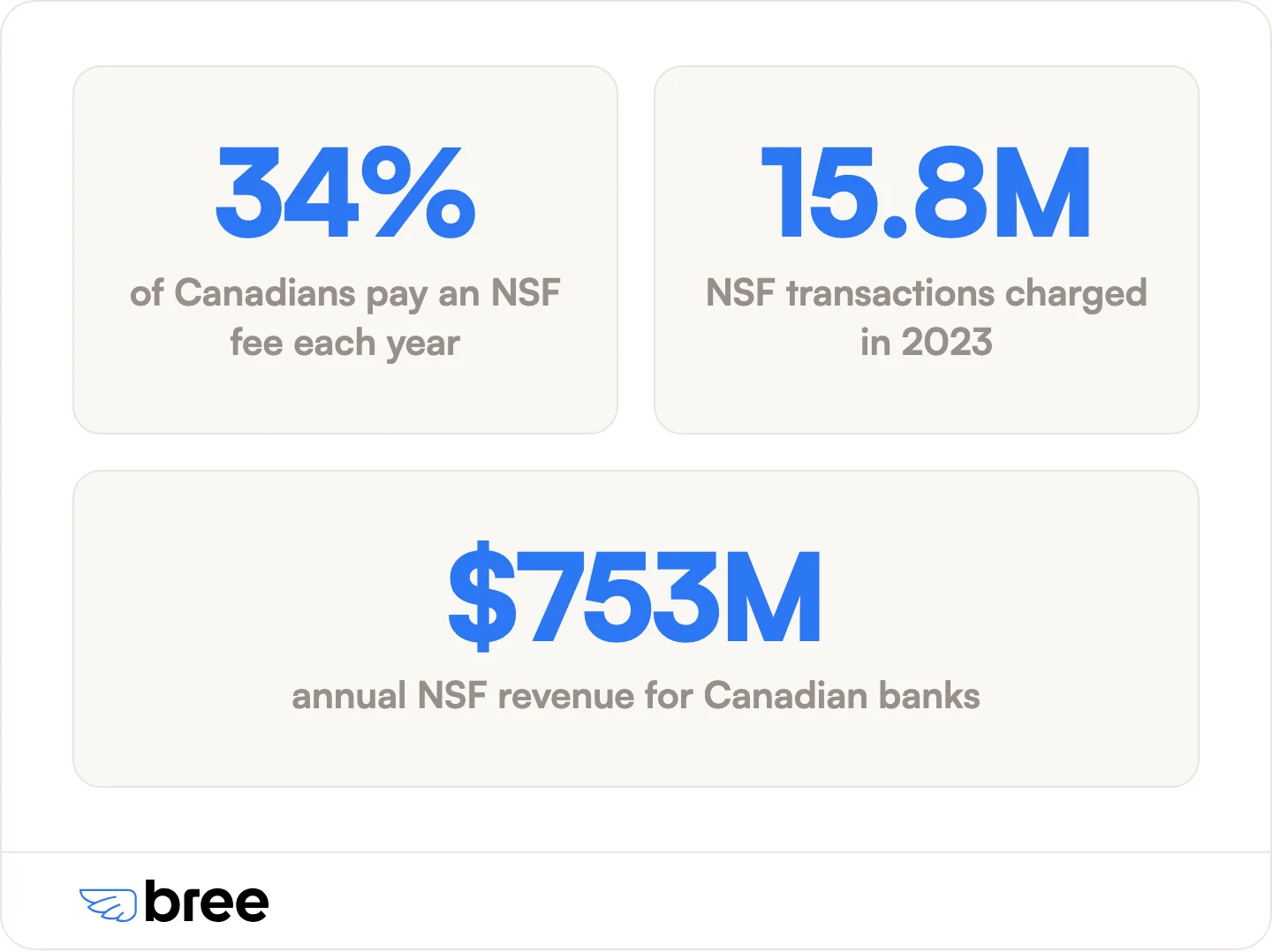
- Canadian banks charged fees on 15.8 million NSF transactions in 2023. That transaction count comes from the Canada Gazette regulatory analysis.
- NSF transactions were projected to reach 16.1 million in 2025. The same Canada Gazette analysis expected volumes to keep climbing before the cap took effect.
- NSF fees are estimated to generate $753 million in annual bank revenue. This Government of Canada figure is based on a projected 16.1 million NSF transactions in 2025, with the full NSF revenue and transaction breakdown covered in our NSF fee statistics guide linked above.
What Overdraft Protection Costs in Canada
Overdraft protection is flat-fee: your bank charges it every month you hold the feature, whether you dip into overdraft or not.
- Overdraft protection costs around $5 a month. Unlike NSF fees, overdraft protection is not capped. The FCAC reports the flat monthly fee is "usually around $5."
- Overdraft protection also charges about 21% annual interest. On top of the monthly fee, FCAC lists a 21% annual interest rate on the amount your bank covers.
Projected Savings and Other 2025 to 2026 Banking Changes
Alongside the NSF cap, the government asked the FCAC to publish a report on the structure and transparency of bank fees later in 2026.
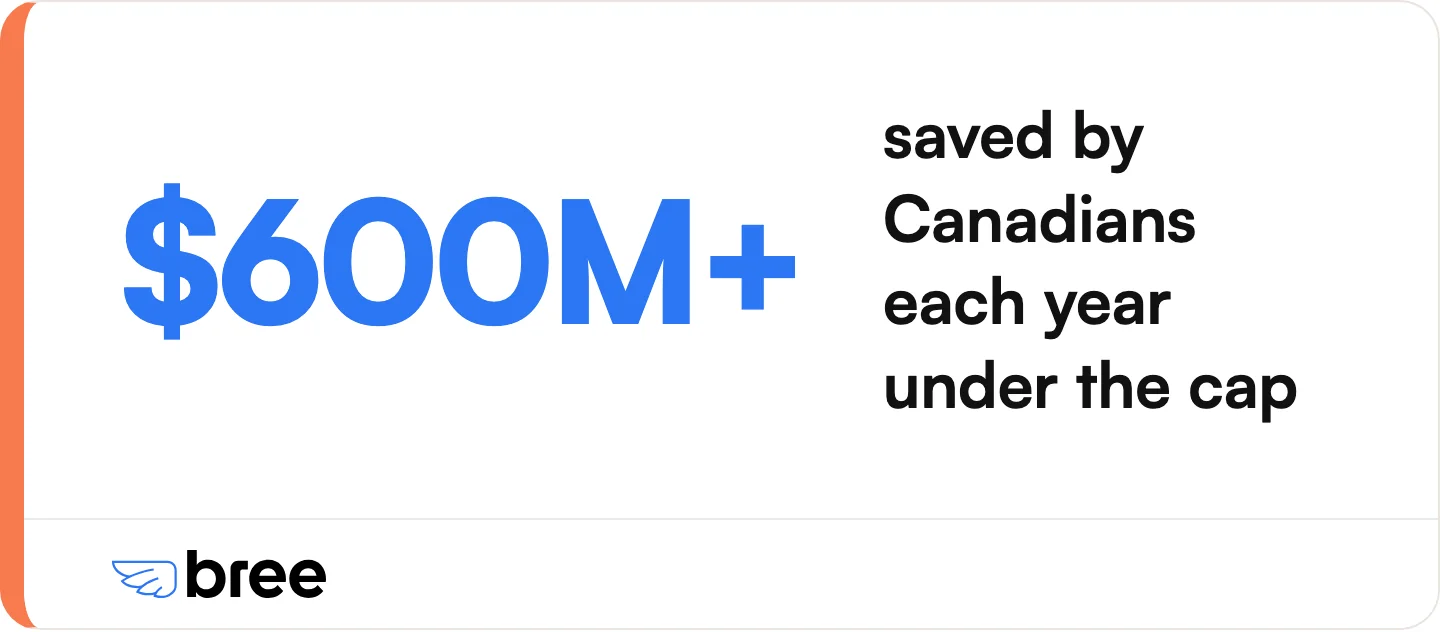
- The $10 cap is expected to save Canadians more than $600 million a year. Finance Canada projects the cap will "save Canadians more than $600 million annually."
- The reform is projected to deliver $4.1 billion in benefits over 10 years. The Canada Gazette analysis estimated discounted benefits of $4.1 billion over a ten-year period.
- The net benefit to society is estimated at $94.1 million over 10 years. That reflects about $4.1 billion in benefits set against a nearly equal level of costs, per the Canada Gazette analysis.
- Low-cost bank accounts are now capped at $4 a month. As of December 1, 2025, Finance Canada says "all Canadians can now access accounts costing no more than $4 per month."
- The amount of immediately available deposited funds rose from $100 to $250. A separate measure increased the cheque-hold floor so more of a deposit is available right away, reducing the odds of a bounced payment.
- The default low-balance alert threshold is $100. Banks send an electronic alert when your balance drops below a set amount, defaulting to $100, which customers can adjust.
Who Gets Hit Hardest by These Fees
Low-income Canadians carry these fees disproportionately. The Canada Gazette notes that women, female lone-parent families, and people not in an economic family are overrepresented in the low-income group most affected.
- 26% of Canadians say they are struggling financially. The Canada Gazette analysis cites that "26 per cent of Canadians are either 'struggling somewhat' or 'struggling a lot' financially."
- 25% of Canadians spend more than their monthly income. The same source reports a quarter of Canadians spend beyond what they bring in each month, the exact gap that triggers overdraft and NSF fees.
- 85% of Canadians report living paycheque to paycheque. An H&R Block Canada survey found 85% of respondents living paycheque to paycheque, up from 60% the year before.
How Overdraft Fees Compare to Other Ways to Cover a Shortfall
- A payday loan costs $14 for every $100 borrowed. The FCAC sets the cost of borrowing example at $14 per $100 in most provinces.
- That $14 per $100 works out to roughly 365% to 391% a year. FCAC's own 14-day example annualizes to about 365%, and the commonly cited ceiling is closer to 391%.

- The criminal interest rate cap dropped to 35%. Since January 2025, the maximum legal cost of borrowing fell from 48% to an annual rate of 35%, per FCAC.
- Payday loans are capped at $1,500 and up to 62 days. FCAC notes you may borrow up to $1,500 with up to 62 days to repay, terms that push many borrowers into repeat use.
Here is what coming up $100 short can cost you in Canada, from the payment bouncing to the ways you can cover it:
The NSF, overdraft, and payday figures come from the Financial Consumer Agency of Canada and the Department of Finance Canada, as cited in the statistics throughout this page. Bree's terms are its own.
How to Avoid Overdraft and NSF Fees in Canada
The cheapest overdraft fee is the one you never trigger. A few habits lower your odds of a bounced or covered payment:
- Turn on low-balance alerts so you know before a payment clears against an empty account.
- Switch to a low-cost account. With federally regulated accounts now capped at $4 a month, the ongoing cost of banking has dropped.
- Keep a small buffer if you can, even $50, to absorb timing gaps between bills and payday.
- Do not lean on overdraft protection as a plan. At about 21% annual interest plus a monthly fee, it is a costly way to bridge a gap.
The bigger fix is not going into the red in the first place. That is the gap Bree is built for. A Bree cash advance gives you up to $750 at 0% interest, with no credit check and no late fees, so a short shortfall before payday does not turn into a fee. Government benefits like ODSP, OW, CPP, CCB, and EI count as qualifying income, which many other options reject. If you are weighing your choices, our guide to payday loan alternatives in Canada breaks down the trade-offs. More than 800,000 Canadians use Bree, which holds a 4.8 out of 5 rating on Trustpilot across more than 8,000 reviews.
Frequently Asked Questions
How much is an NSF fee in Canada in 2026?
An NSF fee at a federally regulated bank in Canada is capped at $10 as of March 12, 2026. Before the cap, these fees typically ran $45 to $48 and could reach $50, according to the Financial Consumer Agency of Canada.
Are overdraft fees capped in Canada?
Only NSF fees are capped at $10. Overdraft protection is a separate product and is not capped. It still costs around $5 a month plus about 21% annual interest, per FCAC. The distinction matters: an NSF fee applies when a payment is declined, while overdraft protection covers the payment for a fee and interest.
How much do banks make from NSF fees in Canada?
Canadian banks are estimated to collect about $753 million a year in NSF fee revenue, based on the government's projected 16.1 million NSF transactions for 2025. Banks charged fees on 15.8 million NSF transactions in 2023. The 2026 cap is expected to cut that revenue by about $619 million in its first year.
How many Canadians pay overdraft or NSF fees?
About 34% of Canadians, more than 1 in 3, pay an NSF fee in a given year, per Finance Canada. Low-income Canadians, women, and lone-parent families are overrepresented among those hit hardest.
What is the cheapest way to avoid an overdraft fee?
The cheapest way to avoid an overdraft or NSF fee is to not go negative in the first place. Low-balance alerts, a small buffer, and a low-cost account all help. An interest-free cash advance of up to $750 can also cover a shortfall before payday without the 21% interest of overdraft protection or the roughly 365% to 391% cost of a payday loan.
The Bottom Line
Overdraft and NSF fees are finally getting cheaper for Canadians. The 2026 cap drops NSF fees to $10 and should save Canadians more than $600 million a year. But the relief is not total: overdraft protection still runs about 21% annual interest plus a monthly fee, and payday loans remain far more expensive at roughly 365% to 391%. The Canadians who pay these fees are overwhelmingly the ones already stretched thin, which is why the real fix is avoiding the shortfall that triggers a fee at all.
Bree is a Canadian instant cash advance app offering up to $750 at 0% interest, so a short gap before payday does not have to become a $10 NSF fee or 21% overdraft interest. You can get up to $750 with no credit check and no late fees, and join the more than 800,000 Canadians already using it.
Sources
- Department of Finance Canada: New $10 cap on NSF fees
- Financial Consumer Agency of Canada: New NSF fee regulations
- Canada Gazette: Regulations Amending the Financial Consumer Protection Framework Regulations
- Torys LLP: Federal government limits NSF fees
- Financial Consumer Agency of Canada: Getting overdraft protection
- Financial Consumer Agency of Canada: Payday loans

Join our newsletter to get the latest updates
.png)
.png)

